Coenzyme Q10
also CoQ10 · Ubiquinone · Ubidecarenone · Ubiquinone-10
Coenzyme Q10 (CoQ10) is part of the mitochondrial energy chain and one of the most widely used supplements [1]. Its best evidence is in chronic heart failure. There, the Q-SYMBIO trial found fewer major cardiovascular events and deaths over two years [2]. For statin muscle pain, migraine and blood pressure, the results are mixed or modest [3][4][5][6].
Worth knowing about for heart failure, where one well-designed trial was positive; for statin aches and blood pressure the evidence points in both directions.
- meta-analysis
- RCT
- trial
- observational
- preclinical / case
- review / patent / other
- retracted
- + Fewer major cardiovascular events in a two-year heart failure trial
- + Fewer and shorter migraine attacks in meta-analysis
- + Did not change warfarin needs in a randomized crossover trial
- − Statin muscle-pain meta-analyses disagree
- − Cochrane found no clinically significant blood pressure effect in primary hypertension
- − Absorption varies widely with formulation
CoQ10 is a lipid-soluble quinone at the heart of the mitochondrial energy chain, and it is among the best-selling supplements [1][7]. The body's own production falls with age [7].
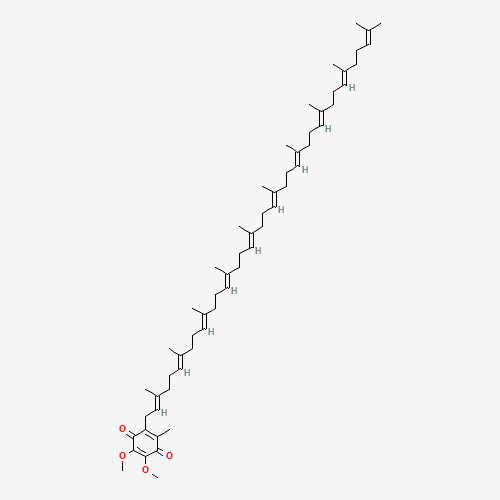
It is built in two halves. A benzoquinone ring, made from tyrosine by way of 4-hydroxybenzoic acid, does the chemistry: it takes one electron to become the ubisemiquinone radical and a second to become the fully reduced ubiquinol. A tail of ten isoprene units — the "10" in the name — does nothing chemically but keeps the molecule dissolved in lipid membranes, where it can diffuse but never leave. Assembly needs the mevalonate pathway for the tail's building blocks, PDSS1 and PDSS2 to set its length, COQ2 to join tail to ring, and COQ3 through COQ9 to finish the ring [8].
Two things follow from that structure and explain most of what is confusing about the supplement. Because the tail makes it extremely hydrophobic, getting a swallowed dose into a given tissue's mitochondria is genuinely hard. And because the mevalonate pathway is shared with cholesterol synthesis, statins are the drug class most often discussed alongside it [8].
Mutations in the biosynthetic genes cause primary CoQ10 deficiency, whose symptoms range from multisystem disease in infancy to an isolated problem in a single organ. A much wider set of conditions — mitochondrial disorders, multiple system atrophy, some ataxias, Parkinson's disease — is associated with secondary CoQ10 deficiency, where the biosynthetic pathway itself is intact [8].
Heart failure has the most important trial. In Q-SYMBIO, 420 patients with chronic heart failure were randomized to CoQ10 or placebo on top of standard care. Over two years, major adverse cardiovascular events occurred in 15% on CoQ10 versus 26% on placebo, and cardiovascular and all-cause deaths were lower. Short-term endpoints did not change [2].
Statin muscle symptoms have produced conflicting meta-analyses. One pooled 12 trials and found less muscle pain, weakness, cramps and tiredness [3]. Another pooled seven trials and found no benefit for myalgia or statin adherence [4]. A review reads the overall weight of evidence as supportive [1].
Migraine: across six trials CoQ10 reduced the frequency and duration of attacks but not their severity [5]. Blood pressure: a Cochrane review found no clinically significant effect in primary hypertension, based on very few trials [6]. A larger meta-analysis in people with cardiometabolic disease found a 4.8 mmHg fall in systolic pressure, largest at 100 to 200 mg a day [9]. Endothelial function: a 2024 meta-analysis of 12 trials in 489 people found flow-mediated dilation improved by 1.45 percentage points (95% CI 0.55 to 2.36) after eight weeks, in proportion to dose, with no significant change in the adhesion molecules VCAM or ICAM [10].
Primary CoQ10 deficiency is the place where CoQ10 ought to work best, and the results there are the most sobering in the whole field — see the mechanism section [8][11].
CoQ10 does not bind one receptor. Its quinone head reversibly accepts one or two electrons while its ten-unit isoprenoid tail keeps it inside lipid membranes. In the inner mitochondrial membrane, ubiquinone accepts electrons from complexes I and II and other dehydrogenases. The resulting Ubiquinol diffuses to complex III, gives up those electrons through the Q cycle and returns to the oxidized pool; that cycle contributes to the proton gradient that drives ATP synthase [8].
Most of that pool is loose. Over 84% of mitochondrial CoQ is thought to be free in the bilayer, with only 10–32% protein-bound across five mammalian species [8]. Complexes I and III also assemble into supercomplexes, within which electrons may move by tunneling or microdiffusion rather than by random collision; whether CoQ participates in complex I's proton pumping is still argued [8][12].
The same redox cycling supports other enzymes. Dihydroorotate dehydrogenase needs oxidized CoQ during pyrimidine synthesis, and sulfide-quinone oxidoreductase transfers electrons from hydrogen sulfide into the CoQ pool [8].
CoQ is also where a lot of the cell's reactive oxygen comes from. This is usually left out of the supplement story. The one-electron-reduced intermediate, ubisemiquinone, is the source of the superoxide that complex III produces at its Qo site, and reverse electron transport — electrons flowing backward out of an over-reduced CoQ pool into complex I — is a major site of mitochondrial ROS generation [8]. The same molecule that terminates lipid peroxidation in one place initiates oxygen radical production in another.
The antioxidant half, in detail. Ubiquinol is a chain-breaking antioxidant: it donates an electron to a lipid peroxyl radical to give a lipid hydroperoxide and a CoQ semiquinone, which quenches a second peroxyl radical and returns to fully oxidized CoQ. It also regenerates the other two lipophilic antioxidants — reducing the vitamin E radical left behind after vitamin E quenches a peroxyl radical, and, through the plasma-membrane redox system, reducing the extracellular ascorbyl radical back to ascorbate [8].
That plasma-membrane redox system is a genuinely separate electron chain, and it does more than antioxidant work. NADH-cytochrome b5 reductase, NQO1 and FSP1 all reduce CoQ at the plasma membrane; the surface oxidase ENOX passes electrons from ubiquinol out to extracellular acceptors. Running that cycle regenerates cytosolic NAD+ from NADH, which is what lets glycolysis keep making ATP — and cells with damaged mitochondria, such as those stripped of mitochondrial DNA, upregulate the whole system in response [8]. FSP1-driven ubiquinol regeneration at the plasma membrane is also the arm that suppresses ferroptotic lipid damage [8].
Where CoQ actually sits in a membrane is still unsettled — flat in the middle of the bilayer, or with the quinone ring up near the phospholipid head groups and the tail buried, with some evidence that the reduced form sits closer to the surface than the oxidized one [8]. Two other proposed roles, on the mitochondrial permeability transition pore and on the uncoupling proteins, are similarly unresolved: the claim that CoQ is obligatory for fatty-acid-driven proton transport through UCPs was refuted, leaving a narrower proposal that the CoQ redox state tunes how strongly purine nucleotides inhibit them [8][12].
The hard question is whether more helps. The kinetics say it depends on which complex you ask about: mitochondrial CoQ appears to be limiting for NADH oxidation by complex I, and saturating for succinate oxidation by complex II. Adding excess CoQ10 to beef-heart submitochondrial particles raised the NADH oxidation rate and did nothing for succinate — though that work needed lyophilization and organic solvents, which may not leave a native membrane behind [8].
In intact cells with normal CoQ, the result flips depending on the study: some found added CoQ10 raised respiration, others found no effect in skin fibroblasts or a beta-cell line. The review's own summary is that boosting CoQ in cells that are not deficient does not increase respiratory rate, because normal CoQ is already sufficient for mitochondrial respiratory function [8]. In people, that has now been tested directly: CoQ10 supplementation in healthy individuals did not alter mitochondrial respiration in platelets, while in a patient with a COQ2 mutation three months of it raised ATP synthesis, cut proton leak and improved neurological status [11].
Deficiency also has to be deep before it matters. In mammalian cells, CoQ has to fall below roughly 60–70% of normal before complex I–III and II–III activity, respiratory capacity and ATP levels drop [8]. And the relationship with oxidative stress is not monotonic: in human skin fibroblasts, severe defects (under 30% residual CoQ10) and mild ones (over 50%) did not induce oxidative stress, while intermediate defects of 30–50% did [8]. More CoQ is not uniformly better and less is not uniformly worse.
The most uncomfortable data point. Oral CoQ10 is the only treatment available for primary CoQ10 deficiency — people whose own biosynthesis is broken by mutation. Its effectiveness there is described as highly controversial: reported positive responses are partial, uncontrolled and poorly followed up, and a recent systematic review of all treated patients suggests oral supplementation is virtually without effect, even though lack of CoQ10 is the undisputed cause of their disease. Meanwhile, in animals, partially restoring endogenous biosynthesis rescues most of the same phenotypes [8]. The problem is delivery: CoQ10 is extremely hydrophobic, oral bioavailability is not enough to ensure uptake by most organs, and hepatic uptake is the substantial exception [8]. Raising plasma CoQ after a capsule does not prove that any particular tissue's mitochondrial pool moved.
Statins. The proposed link is real biochemistry. Statins inhibit HMG-CoA reductase in the mevalonate pathway, which makes farnesyl pyrophosphate — the precursor of squalene and cholesterol, and also the source of CoQ's ten-unit isoprenoid tail [8]. Whether that translates is another matter. Statins do lower blood CoQ10 in most reports, though one randomized crossover in healthy volunteers found no decrease, and blood CoQ largely tracks circulating lipoproteins anyway. In muscle, one study found about a 34% fall on simvastatin while three others found no significant effect or an increase; and a randomized trial in 37 simvastatin users found no change in muscle CoQ10 after eight weeks of supplementation despite a 4.8-fold rise in plasma CoQ10. The review's conclusion is that the effect of statins on CoQ levels, and its role in statin myopathy, remain to be convincingly demonstrated [8] — which is exactly why the clinical meta-analyses disagree [3][4].
Supplements contain either oxidized CoQ10 (ubiquinone) or its reduced form, Ubiquinol.
- Direct receptor targetno bindingCoQ10 is not a receptor ligand; it is a mobile redox cofactor dissolved in membranes [8]strong
- Complex I / II to complex III electron transfermodulatesoxidized CoQ accepts electrons from complex I, complex II and other dehydrogenases; ubiquinol then donates them to complex III, coupling the Q cycle to the proton gradient used for ATP synthesis [8]strong
- Dihydroorotate dehydrogenase and sulfide-quinone oxidoreductasemodulatesCoQ serves as an electron acceptor for enzymes in pyrimidine synthesis and hydrogen-sulfide oxidation, connecting its redox pool to processes beyond ATP production [8]strong
- Complex I and complex III reactive oxygen speciesactivatesthe pro-oxidant half of the job: the ubisemiquinone intermediate is the source of the superoxide complex III generates at the Qo site, and reverse electron transport from an over-reduced CoQ pool back into complex I is a major site of mitochondrial ROS production [8]strong
- Plasma membrane redox systemmodulatesCoQ is the shuttle in a second, non-mitochondrial electron chain: NADH-cytochrome b5 reductase, NQO1 and FSP1 reduce it, ENOX passes electrons out to extracellular acceptors, and the cycle regenerates cytosolic NAD+ for glycolysis — which is why cells with failed mitochondria upregulate it [8]moderate
- Mitochondrial uncoupling proteinsmodulatesunclear
- Mitochondrial permeability transition poremodulatesCoQ analogs raised calcium retention in isolated rat liver mitochondria and stimulated pore opening in rabbit heart mitochondria; in CoQ-deficient mouse podocytes at about 30% of normal CoQ, pore opening was not significantly altered [8]unclear
- FSP1-CoQ membrane antioxidant systemactivatesFSP1 uses NAD(P)H to regenerate ubiquinol at the plasma membrane, where it traps lipid peroxyl radicals and suppresses ferroptotic lipid damage [8]moderate
- Vitamin E and vitamin C regenerationactivatesubiquinol reduces the vitamin E radical left behind after it quenches a lipid peroxyl radical, and the plasma-membrane redox system reduces the extracellular ascorbyl radical back to ascorbate [8]moderate
- Mevalonate pathway and CoQ biosynthesisno bindingthe route statins share: farnesyl pyrophosphate from the mevalonate pathway supplies CoQ's isoprenoid tail as well as squalene for cholesterol, PDSS1/PDSS2 set the tail length, COQ2 attaches it to a 4-hydroxybenzoate ring, and COQ3–COQ9 finish the ring [8]moderate
Formulation
how the form changes blood levelsCoQ10 is extremely hydrophobic, so delivery system can matter at least as much as oxidation state. Oil dispersion, crystal modification, emulsification and water-dispersible carriers can change how much reaches plasma. In the direct older-adult crossover cited here, a water-soluble ubiquinone syrup produced 2.4 times the exposure of a standard ubiquinone capsule and also outperformed a ubiquinol capsule [7].
Ubiquinol is chemically reduced CoQ10 and ubiquinone is oxidized CoQ10; cells continuously interconvert them. One 12-person comparison found 200 mg ubiquinol raised plasma total CoQ10 more than 200 mg ubiquinone after four weeks [13], while a 21-person randomized crossover found a nonsignificant 1.7-fold advantage for the ubiquinol capsule [7]. Neither trial shows superior delivery into heart, muscle or brain mitochondria. Product formulation and an individual's absorption may dominate the label's oxidation state [8].
Dosing
as studied or commonly reported; not a recommendationDoses below are what studies used or, where marked, what is commonly reported. None is a recommendation.
Oral
- 100 mg
- 100–200 mg
- 200 mg (ubiquinone)
Pharmacokinetics
what the body does with it| Bioavailability | Varies with formulation; a water-soluble syrup gave 2.4 times the exposure of standard ubiquinone capsules in older adults [7] |
|---|---|
| Steady state | Four weeks at 200 mg a day of ubiquinone raised plasma CoQ10 from 0.9 to 2.5 µg/mL [13] |
Safety
risks and cautions, not medical adviceQ-SYMBIO found long-term CoQ10 treatment safe in heart failure [2], and a Cochrane review noted it was well tolerated where adverse effects were reported [6].
- Heart failure patients should add it alongside, not instead of, standard treatment; Q-SYMBIO tested it as an add-on [2]
- The strongest outcome trial (Q-SYMBIO) is a single trial of 420 patients [2]
- Statin myopathy meta-analyses reach opposite conclusions [3][4]
- The blood pressure evidence in primary hypertension rests on two small trials [6]
- A review of memory supplements found no compelling evidence that CoQ10 improves memory [15]
- Plasma CoQ10 rises do not establish delivery into a target tissue or its mitochondria [8]
- In primary CoQ10 deficiency — the condition caused by lacking CoQ10 — a systematic review of all treated patients suggests oral supplementation is virtually without effect [8]
- Boosting CoQ in cells that are not deficient does not raise respiratory rate, and CoQ10 supplementation did not alter mitochondrial respiration in healthy people [8][11]
- A randomized trial in 37 simvastatin users found no change in muscle CoQ10 after 8 weeks of supplementation, despite a 4.8-fold rise in plasma CoQ10 [8]
- Whether statins lower muscle CoQ10 at all is unsettled: one study found a ~34% fall and three found no significant effect or an increase [8]
- Where CoQ sits within a lipid bilayer, and whether it regulates the permeability transition pore or the uncoupling proteins, are all still open questions [8][12]
Interactions
documented pairs only, not exhaustiveWarfarin is the classic concern. In a randomized, double-blind crossover trial in 24 patients on stable long-term warfarin, CoQ10 did not change INR or the warfarin dose needed [14]. INR monitoring when starting any supplement is still sensible.
- UbiquinolcompatibleThe same molecule in its reduced form; taking both duplicates one supplement
- Citrus bergamotcompatibleNo interaction documented
- Does CoQ10 help statin muscle pain?
- Evidence conflicts. One meta-analysis found less pain, weakness and cramps [3], another found no benefit [4].
- Is CoQ10 safe with warfarin?
- A randomized crossover trial found no change in INR or warfarin dose [14]. Checking INR when starting is still advisable.
- Ubiquinone or ubiquinol?
- See the Ubiquinol entry. In older adults, ubiquinol capsules raised blood CoQ10 by 1.7 times as much as ubiquinone, a difference that was not statistically significant [7].
- Why does it not work for people born unable to make it?
- That is the central puzzle. Oral CoQ10 is the only treatment for primary CoQ10 deficiency, and a systematic review of every treated patient suggests it is virtually without effect — while in animals, partially restoring the body's own biosynthesis rescues most of the same phenotypes [8]. The likeliest explanation is delivery: the molecule is extremely hydrophobic and oral bioavailability is not enough to reach most organs.
- Will taking it make my mitochondria work better?
- Not if they were working already. CoQ10 supplementation did not change mitochondrial respiration in healthy people, whereas in a patient with a COQ2 mutation three months of it restored ATP synthesis and cut proton leak [11]. The reviewed position is that normal CoQ levels are already sufficient for respiration [8].
- Is CoQ10 an antioxidant or a source of free radicals?
- Both, in different places. Ubiquinol is a chain-breaking antioxidant that terminates lipid peroxidation and regenerates vitamins E and C, while the ubisemiquinone intermediate is the source of the superoxide complex III makes, and an over-reduced CoQ pool driving electrons backward into complex I is a major ROS site [8].
- What receptor does CoQ10 target?
- None is established. CoQ10 is a membrane redox carrier: it cycles between ubiquinone and ubiquinol to transfer electrons in respiration and to intercept lipid-radical reactions [8].
References
entry last reviewed 2026-09-20- [1]Coenzyme Q10.Raizner AEMethodist Debakey Cardiovasc J 2019reviewPMID 31687097◌ unreviewed
- [2]The effect of coenzyme Q10 on morbidity and mortality in chronic heart failure: results from Q-SYMBIO: a randomized double-blind trial.Mortensen SA, Rosenfeldt F, Kumar A et al.JACC Heart Fail 2014RCT · humanPMID 25282031◌ unreviewed
- [3]Effects of Coenzyme Q10 on Statin-Induced Myopathy: An Updated Meta-Analysis of Randomized Controlled Trials.Qu H, Guo M, Chai H et al.J Am Heart Assoc 2018meta-analysis · humanPMID 30371340◌ unreviewed
- [4]Effect of Coenzyme Q10 on statin-associated myalgia and adherence to statin therapy: A systematic review and meta-analysis.Kennedy C, Köller Y, Surkova EAtherosclerosis 2020meta-analysis · humanPMID 32179207◌ unreviewed
- [5]Coenzyme Q10 supplementation for prophylaxis in adult patients with migraine-a meta-analysis.Sazali S, Badrin S, Norhayati MN et al.BMJ Open 2021meta-analysis · humanPMID 33402403◌ unreviewed
- [6]Blood pressure lowering efficacy of coenzyme Q10 for primary hypertension.Ho MJ, Li EC, Wright JMCochrane Database Syst Rev 2016meta-analysis · humanPMID 26935713◌ unreviewed
- [7]Comparative Bioavailability of Different Coenzyme Q10 Formulations in Healthy Elderly Individuals.Pravst I, Rodríguez Aguilera JC, Cortes Rodriguez AB et al.Nutrients 2020RCT · humanPMID 32188111◌ unreviewed
- [8]Understanding coenzyme Q.Wang Y, Lilienfeldt N, Hekimi SPhysiol Rev 2024reviewPMID 38722242◌ unreviewed
- [9]Dose-Response Effect of Coenzyme Q10 Supplementation on Blood Pressure among Patients with Cardiometabolic Disorders: A Grading of Recommendations Assessment, Development, and Evaluation (GRADE)-Assessed Systematic Review and Meta-Analysis of Randomized Controlled Trials.Zhao D, Liang Y, Dai S et al.Adv Nutr 2022meta-analysis · humanPMID 36130103◌ unreviewed
- [10]Effect of Coenzyme Q10 Supplementation on Vascular Endothelial Function: A Systematic Review and Meta-Analysis of Randomized Controlled Trials.Daei S, Ildarabadi A, Goodarzi S et al.High Blood Press Cardiovasc Prev 2024meta-analysis · humanPMID 38630421◌ unreviewed
- [11]Coenzyme Q10 supplementation restores mitochondrial respiration in patients with primary CoQ10 deficiency caused by novel COQ2 and COQ4 variants.Jayan AS, Nataraj P, Gangadharan AK et al.Metab Brain Dis 2026case report · humanPMID 42714630◌ unreviewed
- [12]New developments on the functions of coenzyme Q in mitochondria.Genova ML, Lenaz GBiofactors 2011reviewPMID 21989973◌ unreviewed
- [13]Comparison study of plasma coenzyme Q10 levels in healthy subjects supplemented with ubiquinol versus ubiquinone.Langsjoen PH, Langsjoen AMClin Pharmacol Drug Dev 2014clinical trial · humanPMID 27128225◌ unreviewed
- [14][Effect of Coenzyme Q10 and Ginkgo biloba on warfarin dosage in patients on long-term warfarin treatment. A randomized, double-blind, placebo-controlled cross-over trial].Engelsen J, Nielsen JD, Hansen KFUgeskr Laeger 2003RCT · humanPMID 12772396in Danish◌ unreviewed
- [15]Over the Counter Supplements for Memory: A Review of Available Evidence.Hersant H, He S, Maliha P et al.CNS Drugs 2023reviewPMID 37603263◌ unreviewed