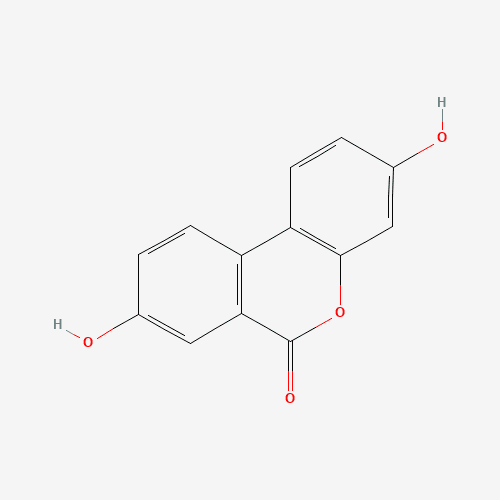
Urolithin A
also 3,8-dihydroxy-6H-benzo[c]chromen-6-one · 3,8-Dihydroxyurolithin · 3,8-dihydroxybenzo[c]chromen-6-one · 3,8-Hydroxydibenzo-alpha-pyrone · Mitopure
Urolithin A is not something plants make. It is what some people's gut bacteria make out of the ellagitannins in pomegranates, walnuts and berries [1], and only about one person in seven produces enough of it to show up in blood without a supplement [2]. Synthetic urolithin A was identified as the first natural compound to induce mitophagy — the pathway that clears worn-out mitochondria [3]. Four randomised trials have now tested it in people. The two muscle trials both missed their primary endpoint and both reported gains on secondary measures [2][4]; a 2025 trial found changes in T-cell composition and metabolism [5]; and a trial in trained runners found no performance benefit [6].
The best-evidenced mitophagy activator sold as a supplement, with a consistent molecular story and a clinical record of missed primary endpoints and positive secondary ones — produced almost entirely by the company that sells it.
- meta-analysis
- RCT
- trial
- observational
- preclinical / case
- review / patent / other
- retracted
- + A defined mechanism confirmed in human muscle biopsies, not just in cells
- + Four placebo-controlled human trials, unusual for a supplement of this kind
- + Excellent tolerability and a very high animal no-effect level
- + Available to the majority of people whose gut bacteria do not make it themselves
- − Both muscle trials missed their pre-registered primary endpoint
- − No performance benefit in trained endurance athletes
- − Nearly every human trial is sponsored by the manufacturer
- − No published human half-life or time to peak
Overview
Urolithin A is a postbiotic: a molecule the body does not make and plants do not contain, produced instead by gut bacteria acting on food. The substrates are ellagitannins and ellagic acid, found in pomegranates, walnuts, strawberries, raspberries and oak-aged wine. When faecal samples from six volunteers were incubated anaerobically with ellagic acid, the pomegranate ellagitannin punicalagin, or a walnut extract, every culture produced urolithin A — but at very different rates and concentrations, which is why urinary excretion of urolithins after a pomegranate varies so much between people [1]. That variability is now treated as a trait: people are sorted into urolithin metabotypes according to which urolithins their microbiota can make, and the urolithins are far better absorbed than the ellagitannins they come from [7].
Chemically it is a small tricyclic lactone — a dibenzo[b,d]pyran-6-one with hydroxyls at the 3 and 8 positions — and it looks nothing like the large, sugar-laden tannins it comes from. That is the point: the bacteria strip the molecule down to something that can cross the gut wall.
The compound became interesting in 2016, when it was identified as the first natural compound in its class to induce mitophagy. It did so in cells and in living animals after oral dosing, prevented the age-related accumulation of dysfunctional mitochondria in C. elegans and extended the worms' lifespan, mobility and pharyngeal pumping, and improved exercise capacity in two mouse models of age-related muscle decline as well as in young rats [3]. Synthetic urolithin A has since been sold as Mitopure and taken through four placebo-controlled human trials.
What the human trials found. The pattern is consistent: pre-registered primary endpoints missed, secondary endpoints positive.
- First-in-human, 2019. Healthy sedentary elderly adults took a single dose or four weeks of daily urolithin A. The primary outcome was safety, and it was favourable. The compound was bioavailable in plasma at every dose, and at 500 mg and 1000 mg for four weeks it modulated plasma acylcarnitines and skeletal-muscle mitochondrial gene expression [8].
- Older adults, 4 months, 2022. Sixty-six adults aged 65 to 90 took 1000 mg a day or placebo. Neither primary endpoint — six-minute walk distance, and maximal ATP production in the hand muscle by magnetic resonance spectroscopy — improved significantly. Muscle endurance, a secondary endpoint, improved at two months in both the hand and the leg muscle tested, and plasma acylcarnitines, ceramides and C-reactive protein fell by four months [4].
- Middle-aged adults, 4 months, 2022. Eighty-eight overweight, untrained adults took 500 mg, 1000 mg or placebo. Peak power output, the primary endpoint, did not improve significantly (+4.3% and +3.9%). Hamstring average peak torque rose 12% at 500 mg and 9.8% at 1000 mg against placebo, which itself declined; peak oxygen uptake rose about 10% in the high-dose group. Lean and fat mass were unchanged [2].
- Immune ageing, 4 weeks, 2025. Fifty healthy middle-aged adults took 1000 mg a day. Urolithin A expanded peripheral naive-like, less terminally exhausted CD8+ cells by 0.50 percentage points (95% CI 0.16 to 0.83) and raised CD8+ fatty-acid oxidation capacity by 14.72 percentage points (95% CI 6.46 to 22.99). Mitochondrial biogenesis in CD8+ cells increased, as did CD56dim CD16bright NK cells and non-classical monocytes, activation-elicited TNF secretion and bacterial uptake by monocytes [5].
- Trained runners, 4 weeks, 2025. Forty-two competitive male distance runners took 1000 mg a day through an altitude camp. The 3000 m time trial did not improve, and there was no significant treatment effect on VO2max. Perceived exertion fell and post-exercise creatine kinase dropped sharply; muscle proteomics showed mitochondrial pathways up and inflammatory pathways down, with mitophagy markers trending up but no measured change in mitochondrial function [6].
Read together, these trials describe a compound that reliably shifts mitochondrial and inflammatory biology and unreliably shifts what people can do. The molecular signal is real; the functional signal is small, inconsistent across endpoints, and absent in people who are already fit.
Mechanism
Mitophagy, not antioxidant chemistry. Urolithin A sits in the polyphenol aisle, but its mechanism has little to do with scavenging radicals. Ellagitannins are potent antioxidants in vitro and largely lose that property on conversion to urolithins; what urolithin A does instead is switch on the quality-control pathway that removes damaged mitochondria [3][7].
Mitophagy is selective autophagy of mitochondria. In its best-characterised form, PINK1 accumulates on the outer membrane of a depolarised mitochondrion, recruits and activates the ubiquitin ligase Parkin, and Parkin tags the organelle for engulfment. The 2016 screen identified urolithin A as the first natural compound to induce this process both in vitro and in vivo following oral consumption [3].
The human muscle evidence is the strongest part of the case. Vastus lateralis biopsies taken before and after four months of supplementation showed, at 500 mg a day, enrichment of the "Parkin-mediated ubiquitin and proteasomal systems" pathway, with the ubiquitin-conjugating enzymes UBE2N and UBE2R2 raised. Targeted immunoblotting confirmed a rise in phospho-Parkin at Ser65 — the fraction of Parkin that PINK1 phosphorylates once it has translocated onto a mitochondrion. At 1000 mg a day the dominant change was metabolic rather than degradative: TCA-cycle, fatty-acid oxidation, electron-transport-chain and oxidative-phosphorylation proteins rose dose-dependently. BNIP3, which drives the PINK1/Parkin-independent mitophagy route, fell at the higher dose, which argues for an effect specific to the PINK1/Parkin axis rather than a general upregulation of autophagy. The fusion and fission machinery did not move — MFN1, MFN2, DRP1 and OPA1 were all unchanged — and VDAC, a marker of raw mitochondrial content, was unchanged too [2].
That last detail matters. Urolithin A appears to improve the quality of a muscle's mitochondria rather than the number of them. Falling plasma acylcarnitines in both four-month trials point the same way, since acylcarnitines accumulate when fatty acids enter the mitochondrion faster than they are oxidised [2][4].
No binding target has been identified for the mitophagy effect. This is the honest gap. The discovery paper describes urolithin A as inducing mitophagy without naming a receptor or enzyme it occupies to do so [3], and the later human work does not fill that in. "Mitophagy activator" names what happens downstream, not what the molecule binds.
Where a direct receptor target does exist, it is the aryl hydrocarbon receptor, and it is weak. In colon epithelial cells, urolithin A raised Cyp1A1 message, protein and enzyme activity, drove AhR into the nucleus, and gave 2–4-fold induction in an XRE-luciferase reporter. The calibration is the interesting part: at 50 µM it matched β-naphthoflavone, a low-affinity AhR ligand, while the high-affinity ligands FICZ and TCDD produced larger responses at nanomolar concentrations and about 15-fold reporter induction. In AhR-knockout mice, oral urolithin A produced no Cyp1A1 induction at all [9]. So AhR is a real direct target engaged at micromolar concentrations, and calling urolithin A an AhR agonist without that qualifier overstates it.
Downstream of AhR sits Nrf2. Urolithin A raised Nrf2 message and protein and moved it into the nucleus, inducing its target genes NQO1 and haem oxygenase-1, and raised the tight-junction proteins claudin-4, occludin, ZO-1 and TJP3. Colon explants and mice lacking either Nrf2 or AhR failed to respond, and knocking down AhR or Cyp1A1 in cells abolished the claudin-4 response, so the order runs AhR → Cyp1A1 → Nrf2 → tight junctions. Functionally, pretreatment stopped LPS-induced leakage of FITC-dextran across an epithelial monolayer, and oral dosing attenuated colitis in mouse models [9].
Mitophagy feeds a second, less obvious pathway in T cells. In mice, urolithin A expanded T memory stem cells and naive T cells and conferred strong anti-tumour CD8+ immunity. The route is mechanically specific: PINK1-mediated mitophagy released the mitochondrial phosphatase Pgam5 into the cytosol, where it dephosphorylated β-catenin, driving Wnt signalling and compensatory mitochondrial biogenesis [10]. The 2025 human trial was designed against that model and found a matching, if small, shift in circulating T-cell phenotype and fatty-acid oxidation capacity [5].
In the brain, timing appears to decide the outcome. Urolithin A attenuated memory impairment and neuroinflammation in APP/PS1 mice [11]. A 2026 study then deliberately compared prevention with rescue and found an asymmetry. Given to 16-month-old C57BL/6 mice for eight weeks, urolithin A raised hippocampal ATP, increased fusion, antioxidant and biogenesis proteins and lowered phosphorylated tau — and did not restore memory in the Morris water maze. Given to 5-month-old senescence-accelerated SAMP8 mice, before their cognitive decline begins at six months, it raised ATP roughly four-fold, cut reactive oxygen species and unfolded-protein load, lowered PHF-1 tau, raised the postsynaptic protein PSD95 and preserved spatial memory [12]. Both arms used 1.5 mg/kg intraperitoneally three times a week, a dose and route no one uses, but it is a rare study that asked whether the molecular changes translate and reported honestly that in old animals they did not.
Joints. Urolithin A improved mitophagy and mitochondrial respiration in primary chondrocytes from both healthy and osteoarthritic human donors, and reduced cartilage degeneration, synovial inflammation and pain in a mouse osteoarthritis model [13]. No human osteoarthritis trial is cited here.
- PINK1/Parkin mitophagy pathwayactivatesmoderate
- Aryl hydrocarbon receptor (AhR)activatesa genuine but low-affinity ligand: 50 µM urolithin A induced Cyp1A1 activity to about the level of the weak reference ligand β-naphthoflavone and gave 2–4-fold reporter induction, against ~15-fold for a high-affinity ligand acting at nanomolar concentrations; the effect is absent in AhR-knockout mice [9]weak
- Nrf2 antioxidant responseactivatesurolithin A raised Nrf2 message and protein and drove its nuclear translocation, inducing NQO1 and haem oxygenase-1; colon explants from Nrf2-knockout and AhR-knockout mice failed to respond, placing Nrf2 downstream of AhR [9]moderate
- Epithelial tight junctionsactivatesclaudin-4, occludin, ZO-1 and TJP3 rose in colon epithelial cells and in mouse colon, and pretreatment blocked LPS-driven FITC-dextran leak across the monolayer; knocking down AhR or Cyp1A1 abolished it [9]moderate
- Mitochondrial oxidative metabolismactivatestricarboxylic-acid-cycle, fatty-acid-oxidation, electron-transport-chain and oxidative-phosphorylation proteins rose dose-dependently in human skeletal muscle over four months, with no change in the fusion and fission machinery (MFN1, MFN2, DRP1, OPA1) [2]moderate
- Pgam5-β-catenin-Wnt axisactivatesin mice, PINK1-mediated mitophagy released the mitochondrial phosphatase Pgam5 into the cytosol, where it dephosphorylated β-catenin and drove Wnt signalling and compensatory mitochondrial biogenesis, expanding T memory stem cells [10]weak
- Circulating acylcarnitines and C-reactive proteinblocksmoderate
Formulation
how the form changes blood levelsSupplement urolithin A is synthetic. That is a deliberate solution to the metabotype problem: because production depends on carrying the right gut bacteria, eating the precursor food is not a reliable way to get the molecule [1][7]. Only about 15% of participants in the largest muscle trial had measurable plasma urolithin A before supplementation began [2].
In circulation, most of what is measured is conjugated. Plasma urolithin A-glucuronide and urolithin A-sulfate both rose dose-dependently alongside the parent compound over four months [2], matching rat ADME work in which glucuronidated and sulfonated forms were the predominant metabolites after both oral and intravenous dosing [14]. Whether the conjugates are inert carriers or contribute activity is not settled by any study cited here.
Dosing
as studied or commonly reported; not a recommendationDoses below are what studies used or, where marked, what is commonly reported. None is a recommendation.
Oral
- 500 mgoverweight, untrained middle-aged adults, muscle strength and enduranceonce daily · 4 monthshuman study[2]
- 1000 mgoverweight, untrained middle-aged adults, muscle strength and enduranceonce daily · 4 monthshuman study[2]
- 1000 mgadults aged 65 to 90, muscle endurance and mitochondrial biomarkersonce daily · 4 monthshuman study[4]
- 1000 mghealthy middle-aged adults, T-cell composition and immune metabolismonce daily · 4 weekshuman study[5]
- 1000 mgcompetitive male distance runners during an altitude training camponce daily · 4 weekshuman study[6]
- 500 or 1000 mghealthy sedentary elderly adults, first-in-human safety and mitochondrial gene expressiononce daily · 4 weekshuman study[8]
Intraperitoneal (animals)
- 1.5 mg/kg (human equivalent ≈0.12 mg/kg)
- Form
- The trialled material is synthetic urolithin A, sold as Mitopure. Making it in a reactor sidesteps the problem that most people's gut bacteria will not: only about 15% of participants in the 500-and-1000 mg trial had any detectable urolithin A in plasma before they started [2]. Eating pomegranate or walnuts is not equivalent, because whether ellagitannins become urolithin A at all depends on which bacteria a person carries [1][7].
- Timing and food
- No trial cited here tested time of day or the effect of food.
- Time to effect
- Slow. In the older-adult trial, muscle endurance had improved by 2 months while the plasma biomarker changes only reached significance at 4 months [4]. Both muscle trials ran for 4 months; the immune and athlete trials ran for 4 weeks [2][5][6].
- Notes
- Every human dose above comes from a placebo-controlled trial, and almost every one of those trials was sponsored by Amazentis, the company that sells Mitopure [2][4][5][6]. The two doses studied for muscle did not separate cleanly: the 500 mg group showed the larger strength gain and the clearer transcriptomic and acylcarnitine response, while 1000 mg gave the larger rise in peak oxygen uptake and in mitochondrial proteins [2].
Pharmacokinetics
what the body does with it| Bioavailability | Urolithin A was bioavailable in plasma at every dose tested in the first-in-human trial [8], but circulates largely as conjugates: parent urolithin A, urolithin A-glucuronide and urolithin A-sulfate all rose dose-dependently after four months of supplementation [2]. Urolithins are far better absorbed than the ellagitannins they come from [7]. |
|---|---|
| Steady state | No half-life or time to peak is quoted here: the first-in-human trial reports plasma bioavailability at all doses but its full text is paywalled and was not available [8]. |
| Metabolism | Phase II conjugation. In rats given urolithin A orally or intravenously, glucuronidated and sulfonated forms were the predominant metabolites by both routes [14]. |
Safety
risks and cautions, not medical adviceTolerability in the human trials has been unremarkable. Across four months at 1000 mg a day in adults aged 65 to 90, 33 adverse events were recorded, none serious, with no statistical difference between urolithin A and placebo and no changes in vital signs, blood biochemistry, haematology or urinalysis [4]. In the 88-person middle-aged trial, adverse events were likewise diverse and not concentrated in the treated groups; a slight excess of musculoskeletal events was attributed to the muscle-biopsy procedure [2].
The animal toxicology was done properly and is reassuring. Synthetic urolithin A was not genotoxic across a battery of assays. In 28-day and 90-day oral rat studies at up to 5% of the diet, there were no alterations in clinical parameters, blood chemistry or haematology, no target organs and no specific toxic mechanism; the no-observed-adverse-effect level was the highest dose tested, 3451 mg/kg/day in males and 3826 mg/kg/day in females [14]. That is several thousand times the human trial doses on a weight basis.
Two caveats sit outside the toxicology. No trial cited here has run longer than four months, so the effect of switching on a mitochondrial quality-control pathway for years is untested. And urolithin A engages the aryl hydrocarbon receptor [9] — weakly, but AhR is a transcription factor with broad effects on xenobiotic metabolism and immunity, and no cited study followed that out over long-term use.
- No serious adverse events and no between-group difference in adverse events across four months at 1000 mg a day in adults aged 65 to 90 [4]
- No significant changes in vital signs, blood biochemistry, haematology or urinalysis in either four-month trial [2][4]
- A small number of gastrointestinal events was recorded in the older-adult trial, without excess over placebo [4]
- Safety beyond four months of continuous use is untested in any trial cited here [2][4]
- It weakly activates the aryl hydrocarbon receptor and induces Cyp1A1 in mouse colon and liver [9]; no human study cited here examined whether this changes the clearance of other drugs
- Results with the supplement are not interchangeable with eating pomegranate or walnuts, because production from food depends on the individual's gut bacteria [1][7]
- Both four-month muscle trials missed their pre-registered primary endpoint — six-minute walk distance and maximal ATP production in one, peak power output in the other [2][4]
- In competitive distance runners, four weeks at 1000 mg a day did not improve 3000 m time-trial performance and showed no significant treatment effect on VO2max [6]
- Effectively the whole human evidence base is sponsored by or co-authored with the manufacturer [2][4][5][6][8]
- No molecular target has been identified for the mitophagy effect itself; the pathway is described downstream of an unknown initiating event [3]
- The AhR-Nrf2-tight-junction work is cell and mouse work at 50 µM and 20 mg/kg, with no human gut-permeability trial cited here [9]
- Human pharmacokinetics are not publicly documented in detail; the first-in-human paper reports bioavailability but its full text was not available, so no half-life or time to peak is given here [8]
- The longest trial cited here is four months [2][4]
- In aged mice, molecular improvements in hippocampal bioenergetics did not translate into restored memory [12]
Interactions
documented pairs only, not exhaustiveNo clinical interaction study is cited here. Two mechanistic points are worth flagging rather than ignoring.
Urolithin A induces Cyp1A1 through AhR in colon and liver, confirmed in vivo by its absence in AhR-knockout mice [9]. Cyp1A1 induction is the classic route by which AhR ligands change the clearance of other substrates. The induction there was modest — about 5–6-fold in liver by the intraperitoneal route, against roughly 30-fold for a high-affinity ligand — and nothing cited here measured drug clearance in people, so this is a mechanism worth knowing about rather than a documented interaction.
Because the proposed benefit runs through mitochondrial quality control, it overlaps conceptually with NAD+ precursors, CoQ10 and PQQ. None of those combinations has been trialled.
- NAD+compatibleBoth are promoted for mitochondrial quality control by different routes; no interaction and no combination trial is documented
- Coenzyme Q10compatibleNo interaction documented; the combination has not been trialled
- PQQcompatibleNo interaction documented; both are marketed for mitochondrial function with no head-to-head or combination data
History
Urolithins were described as human metabolites of dietary ellagitannins in the early 2000s, and their microbial origin was confirmed in 2005 by incubating human faecal samples anaerobically with ellagic acid, punicalagin and a walnut extract [1]. For the next decade they were studied mainly as bioavailability markers — what pomegranate polyphenols actually turn into — rather than as active compounds in their own right [7].
The 2016 paper from the Auwerx laboratory at EPFL, with the EPFL spin-out Amazentis, reframed them by identifying urolithin A as a mitophagy inducer that extended lifespan in C. elegans and improved muscle function in rodents [3]. Safety work followed in 2017 [14], a first-in-human trial in 2019 [8], and the two muscle trials in 2022 [2][4]. The most recent additions are a T-cell ageing trial and a null performance result in elite runners, both in 2025 [5][6].
Reputation
how it is regarded elsewhere, not this wiki's readingUrolithin A is marketed as a longevity compound and discussed in that register online, where the framing is usually that it "cleans out old mitochondria". That is closer to the truth than most supplement marketing — the human muscle-biopsy data really do show Parkin-pathway activation [2] — but it skips the part where both muscle trials missed their primary endpoints and trained athletes got no faster [2][4][6].
The other thing rarely mentioned is who ran the studies. The discovery paper, the safety assessment, the first-in-human trial and all four randomised trials involve Amazentis authors, employees or funding [2][3][4][5][6][8][14]. That is normal for a novel ingredient and it is disclosed in every paper; it is also a reason to want independent replication before treating the effect sizes as settled.
FAQ
- Can I just eat pomegranates instead?
- Only if your gut bacteria make urolithin A, and most people's do not make much. Faecal cultures from six volunteers all produced urolithin A from ellagic acid and from pomegranate and walnut ellagitannins, but at very different rates and concentrations [1], and only about 15% of participants in the largest muscle trial had detectable plasma urolithin A before supplementing [2].
- Does it actually make you stronger?
- Partly, and not on the measure the trial was built around. In 88 overweight middle-aged adults, hamstring peak torque rose about 12% at 500 mg and 9.8% at 1000 mg against placebo, but peak power output — the primary endpoint — did not improve significantly [2]. In older adults, muscle endurance improved at two months while neither primary endpoint did [4].
- Is it useful for athletes?
- The one trial in trained athletes says no for performance. Forty-two competitive distance runners taking 1000 mg a day for four weeks showed no improvement in a 3000 m time trial and no significant treatment effect on VO2max, though perceived exertion and post-exercise creatine kinase both fell [6].
References
entry last reviewed 2026-09-20- [1]Identification of urolithin a as a metabolite produced by human colon microflora from ellagic acid and related compounds.Cerdá B, Periago P, Espín JC et al.J Agric Food Chem 2005preclinical · cellPMID 15998116◌ unreviewed
- [2]Urolithin A improves muscle strength, exercise performance, and biomarkers of mitochondrial health in a randomized trial in middle-aged adults.Singh A, D'Amico D, Andreux PA et al.Cell Rep Med 2022RCT · humanPMID 35584623◌ unreviewed
- [3]Urolithin A induces mitophagy and prolongs lifespan in C. elegans and increases muscle function in rodents.Ryu D, Mouchiroud L, Andreux PA et al.Nat Med 2016preclinical · animalPMID 27400265◌ unreviewed
- [4]Effect of Urolithin A Supplementation on Muscle Endurance and Mitochondrial Health in Older Adults: A Randomized Clinical Trial.Liu S, D'Amico D, Shankland E et al.JAMA Netw Open 2022RCT · humanPMID 35050355◌ unreviewed
- [5]Effect of the mitophagy inducer urolithin A on age-related immune decline: a randomized, placebo-controlled trial.Denk D, Singh A, Kasler HG et al.Nat Aging 2025RCT · humanPMID 41174221◌ unreviewed
- [6]Evaluating the Impact of Urolithin A Supplementation on Running Performance, Recovery, and Mitochondrial Biomarkers in Highly Trained Male Distance Runners.Whitfield J, McKay AKA, Tee N et al.Sports Med 2025RCT · humanPMID 40839339◌ unreviewed
- [7]Urolithins, the rescue of "old" metabolites to understand a "new" concept: Metabotypes as a nexus among phenolic metabolism, microbiota dysbiosis, and host health status.Tomás-Barberán FA, González-Sarrías A, García-Villalba R et al.Mol Nutr Food Res 2017reviewPMID 27158799◌ unreviewed
- [8]The mitophagy activator urolithin A is safe and induces a molecular signature of improved mitochondrial and cellular health in humans.Andreux PA, Blanco-Bose W, Ryu D et al.Nat Metab 2019clinical trial · humanPMID 32694802◌ unreviewed
- [9]Enhancement of the gut barrier integrity by a microbial metabolite through the Nrf2 pathway.Singh R, Chandrashekharappa S, Bodduluri SR et al.Nat Commun 2019preclinical · animalPMID 30626868◌ unreviewed
- [10]Expansion of T memory stem cells with superior anti-tumor immunity by Urolithin A-induced mitophagy.Denk D, Petrocelli V, Conche C et al.Immunity 2022preclinical · animalPMID 36351375◌ unreviewed
- [11]Urolithin A attenuates memory impairment and neuroinflammation in APP/PS1 mice.Gong Z, Huang J, Xu B et al.J Neuroinflammation 2019preclinical · animalPMID 30871577◌ unreviewed
- [12]Early mitophagy activation by Urolithin A prevents, but late activation does not reverse, age-related cognitive impairment.Jara C, Venegas-Zamora L, Park-Kang HS et al.NPJ Aging 2026preclinical · animalPMID 41786716◌ unreviewed
- [13]Urolithin A improves mitochondrial health, reduces cartilage degeneration, and alleviates pain in osteoarthritis.D'Amico D, Olmer M, Fouassier AM et al.Aging Cell 2022preclinical · animalPMID 35778837◌ unreviewed
- [14]Safety assessment of Urolithin A, a metabolite produced by the human gut microbiota upon dietary intake of plant derived ellagitannins and ellagic acid.Heilman J, Andreux P, Tran N et al.Food Chem Toxicol 2017preclinical · animalPMID 28757461◌ unreviewed
- [15]A simple practice guide for dose conversion between animals and human.Nair AB, Jacob SJ Basic Clin Pharm 2016reviewPMID 27057123◌ unreviewed