Elamipretide (SS-31)
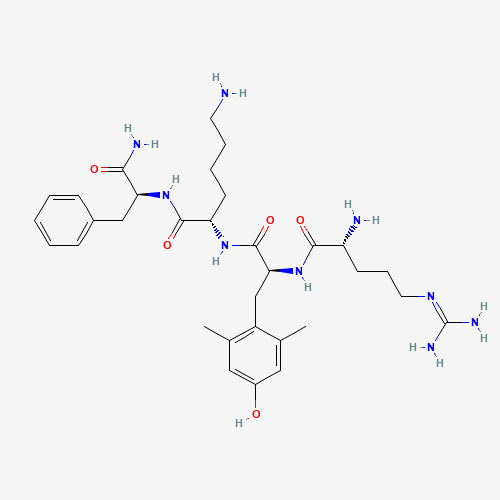
also SS-31 · MTP-131 · Bendavia · Forzinity · D-Arg-Dmt-Lys-Phe-NH2
Elamipretide (SS-31) is a four-amino-acid peptide that concentrates in the inner mitochondrial membrane and binds cardiolipin, a membrane lipid that mitochondria need to form their inner folds (cristae) [1][2]. In September 2025 the US FDA gave it accelerated approval, as Forzinity, to improve muscle strength in Barth syndrome [3]. Its randomised trials have mostly missed their primary endpoints, in Barth syndrome, mitochondrial myopathy, heart attack and macular degeneration [4][5][6][7]. The positive signals come mainly from open-label extensions and secondary measures.
A well-designed mitochondrial drug with a clear mechanism and an approval for one ultra-rare disease, but a string of missed primary endpoints in larger trials.
- meta-analysis
- RCT
- trial
- observational
- preclinical / case
- review / patent / other
- retracted
- + Approved (accelerated) for Barth syndrome in the US
- + Walking distance improved over three years in the Barth syndrome open-label extension
- + Well tolerated apart from injection-site reactions
- − Missed its primary endpoints in the main phase 3 mitochondrial myopathy trial
- − Injection-site reactions in most people on daily injections
- − Did not reduce heart-attack size
Overview
Elamipretide is a Szeto-Schiller (SS) peptide, one of a family of short peptides that alternate aromatic and basic amino acids. Its dimethyltyrosine residue gives it antioxidant properties, and the peptides concentrate about 1,000-fold in the inner mitochondrial membrane [1]. It is developed by Stealth BioTherapeutics [3].
Barth syndrome. This rare genetic disorder of cardiolipin was where it was finally approved. In TAZPOWER, 12 patients took 40 mg a day or placebo for 12 weeks each, and neither primary endpoint improved. In the open-label extension, walking distance improved by 95.9 m at 36 weeks [4], an improvement that was sustained to 168 weeks in the 8 patients who got that far [8]. It then received US accelerated approval in September 2025 to improve muscle strength, the first treatment specific to Barth syndrome [3].
Primary mitochondrial myopathy. A 5-day intravenous trial showed a dose-dependent gain in walking distance [9]. A 4-week subcutaneous crossover trial missed its walking endpoint but improved fatigue scores [10]. The pivotal phase 3 trial, MMPOWER-3 (218 patients, 24 weeks), found no effect on walking distance (-3.2 m vs placebo) or fatigue [5].
Heart and kidney. In the EMBRACE STEMI trial, an infusion during primary angioplasty did not reduce infarct size or improve imaging or clinical outcomes [6]. A single high-dose infusion in heart failure with reduced ejection fraction briefly shrank left-ventricular volumes [11]. In a 14-patient pilot, adding it to renal artery stenting improved kidney blood flow and function at 3 months [12].
Eye. In dry macular degeneration (ReCLAIM-2, 176 patients, 48 weeks), it missed both primary endpoints but slowed loss of the ellipsoid zone, a marker of photoreceptor damage [7]. Phase 3 trials in macular degeneration and mitochondrial myopathy are under way [3].
Mechanism
Cardiolipin is a phospholipid of the inner mitochondrial membrane, and cristae need it to form. Elamipretide binds it with high affinity. The complex blocks the peroxidase activity of cytochrome c, which would otherwise damage cardiolipin during ischaemia. In rats, pretreatment preserved cristae in the kidney during ischaemia, and ATP recovered promptly on reperfusion [2]. Biophysical work suggests that it also sits at the membrane surface, changes its electrical charge and eases calcium stress [13].
In the original cell studies, the SS peptides reduced mitochondrial reactive oxygen species and prevented mitochondrial swelling and cytochrome c release. Versions without dimethyltyrosine did not work [1].
- Cardiolipinmodulatesbinds cardiolipin with high affinity, blocks cytochrome c's peroxidase activity and protects mitochondrial cristae during ischaemia in rats [2]strong
- Inner mitochondrial membrane surface chargemodulatessits in the membrane surface, alters its electrostatics and eases calcium stress in mitochondria [13]moderate
- Mitochondrial reactive oxygen speciesblocksreduced mitochondrial ROS, permeability transition, swelling and cytochrome c release in cells and isolated mitochondria [1]moderate
Dosing
as studied or commonly reported; not a recommendationDoses below are what studies used or, where marked, what is commonly reported. None is a recommendation.
Subcutaneous injection
- 40 mg
- 40 mg
- 40 mgdry age-related macular degeneration with geographic atrophy (ReCLAIM-2)once daily · 48 weekshuman study[7]
Intravenous
- 0.01, 0.1 or 0.25 mg/kg/h
- 0.005, 0.05 or 0.25 mg/kg/h
- 0.05 mg/kg/hfirst anterior ST-elevation heart attack (EMBRACE STEMI)1-hour infusion around primary PCIhuman study[6]
- Time to effect
- In Barth syndrome, no benefit was seen in the 12-week randomised phase; improvements appeared by 36 weeks of open-label treatment [4].
Pharmacokinetics
what the body does with it| Half-life | Short: after a 4-hour infusion, levels peaked at the end of the infusion and were undetectable by 24 hours [11] |
|---|---|
| Time to peak | At the end of an intravenous infusion [11] |
| Metabolism | Two metabolites, M1 and M2, are formed. Their clearance fell with age and rose with kidney function [5] |
| Excretion | Metabolite clearance depends on kidney function [5] |
Safety
risks and cautions, not medical adviceGiven intravenously, it was safe and well tolerated in heart-attack and heart-failure trials, with stable blood pressure and heart rate [6][11]. Daily subcutaneous injections cause frequent injection-site reactions: 80% of participants in MMPOWER-2 [10], and redness in all 12 Barth patients on the drug, with 2 dropping out of the extension because of them [4]. In MMPOWER-3, 98% on elamipretide and 76% on placebo reported adverse events, mostly mild to moderate [5]. The MMPOWER-3 authors described it as generally well tolerated [5], as did the 168-week Barth extension [8].
- Accelerated approval covers Barth syndrome only, in patients weighing at least 30 kg [3]
- "SS-31" sold online as a research chemical is not the approved product
FAQ
- Is SS-31 the same as elamipretide?
- Yes. SS-31 is its research name and elamipretide its drug name [13]; it was also tested as MTP-131 [9].
- Is it approved?
- In the US, under accelerated approval since September 2025, for muscle strength in Barth syndrome [3].
- Did it work for mitochondrial myopathy?
- The phase 3 MMPOWER-3 trial found no improvement in walking distance or fatigue over 24 weeks [5].
References
entry last reviewed 2026-09-19- [1]Cell-permeable peptide antioxidants targeted to inner mitochondrial membrane inhibit mitochondrial swelling, oxidative cell death, and reperfusion injury.Zhao K, Zhao GM, Wu D et al.J Biol Chem 2004preclinical · cellPMID 15178689◌ unreviewed
- [2]The mitochondrial-targeted compound SS-31 re-energizes ischemic mitochondria by interacting with cardiolipin.Birk AV, Liu S, Soong Y et al.J Am Soc Nephrol 2013preclinical · animalPMID 23813215◌ unreviewed
- [3]Elamipretide: First Approval.Shirley MDrugs 2026reviewPMID 41335372◌ unreviewed
- [4]A phase 2/3 randomized clinical trial followed by an open-label extension to evaluate the effectiveness of elamipretide in Barth syndrome, a genetic disorder of mitochondrial cardiolipin metabolism.Reid Thompson W, Hornby B, Manuel R et al.Genet Med 2021RCT · humanPMID 33077895◌ unreviewed
- [5]Efficacy and Safety of Elamipretide in Individuals With Primary Mitochondrial Myopathy: The MMPOWER-3 Randomized Clinical Trial.Karaa A, Bertini E, Carelli V et al.Neurology 2023RCT · humanPMID 37268435◌ unreviewed
- [6]EMBRACE STEMI study: a Phase 2a trial to evaluate the safety, tolerability, and efficacy of intravenous MTP-131 on reperfusion injury in patients undergoing primary percutaneous coronary intervention.Gibson CM, Giugliano RP, Kloner RA et al.Eur Heart J 2016RCT · humanPMID 26586786◌ unreviewed
- [7]ReCLAIM-2: A Randomized Phase II Clinical Trial Evaluating Elamipretide in Age-related Macular Degeneration, Geographic Atrophy Growth, Visual Function, and Ellipsoid Zone Preservation.Ehlers JP, Hu A, Boyer D et al.Ophthalmol Sci 2025RCT · humanPMID 39605874◌ unreviewed
- [8]Long-term efficacy and safety of elamipretide in patients with Barth syndrome: 168-week open-label extension results of TAZPOWER.Thompson WR, Manuel R, Abbruscato A et al.Genet Med 2024clinical trial · humanPMID 38602181◌ unreviewed
- [9]Randomized dose-escalation trial of elamipretide in adults with primary mitochondrial myopathy.Karaa A, Haas R, Goldstein A et al.Neurology 2018RCT · humanPMID 29500292◌ unreviewed
- [10]A randomized crossover trial of elamipretide in adults with primary mitochondrial myopathy.Karaa A, Haas R, Goldstein A et al.J Cachexia Sarcopenia Muscle 2020RCT · humanPMID 32096613◌ unreviewed
- [11]Novel Mitochondria-Targeting Peptide in Heart Failure Treatment: A Randomized, Placebo-Controlled Trial of Elamipretide.Daubert MA, Yow E, Dunn G et al.Circ Heart Fail 2017RCT · humanPMID 29217757◌ unreviewed
- [12]Phase 2a Clinical Trial of Mitochondrial Protection (Elamipretide) During Stent Revascularization in Patients With Atherosclerotic Renal Artery Stenosis.Saad A, Herrmann SMS, Eirin A et al.Circ Cardiovasc Interv 2017RCT · humanPMID 28916603◌ unreviewed
- [13]The mitochondria-targeted peptide SS-31 binds lipid bilayers and modulates surface electrostatics as a key component of its mechanism of action.Mitchell W, Ng EA, Tamucci JD et al.J Biol Chem 2020preclinical · cellPMID 32273339◌ unreviewed