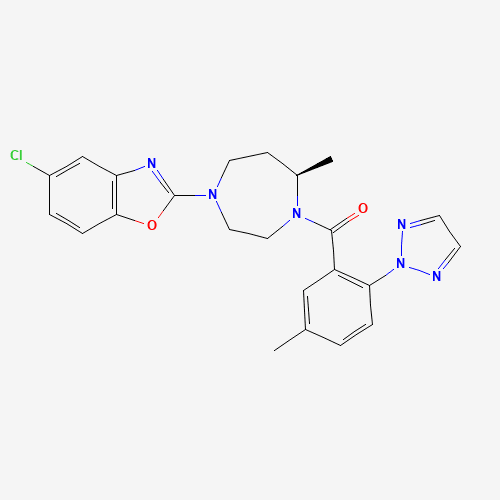
Suvorexant
also Belsomra · MK-4305 · MK4305
Suvorexant (Belsomra) was the first orexin receptor antagonist licensed for insomnia, approved in the United States in 2014 [1][2]. Instead of damping the whole brain through GABA-A receptors, as benzodiazepines and Z-drugs do, it blocks both receptors for orexin, the hypothalamic peptide that keeps people awake [2]. At the licensed 15–20 mg doses, people in two 3-month trials reported 11–22 more minutes of sleep a night than on placebo, and polysomnography measured 17–31 fewer minutes awake after falling asleep, with smaller and less consistent effects on how quickly they fell asleep [1]. Next-day sleepiness is its main drawback, and it is a Schedule IV controlled substance in the United States [1].
An established, modestly effective insomnia drug whose clearest benefit is staying asleep through the night; next-morning drowsiness and driving impairment in some people are the price, and the hope that it slows Alzheimer's disease rests on a two-night spinal-fluid study.
- meta-analysis
- RCT
- trial
- observational
- preclinical / case
- review / patent / other
- retracted
- + At licensed doses, 17–31 fewer minutes awake during the night on polysomnography than placebo over 3 months
- + The benefit held over a year of nightly use, without rebound insomnia or withdrawal on stopping
- + In mild-to-moderate Alzheimer's disease it added about 28 minutes of measured sleep in 4 weeks without worsening cognition
- + Mean next-morning driving was not impaired in healthy older adults at 15 or 30 mg
- + At up to twice the top licensed dose it did not lower overnight oxygen levels in mild-to-moderate sleep apnea or COPD
- + In recreational drug users, euphoria-type effects were less frequent than with zolpidem
- − Somnolence is the commonest side effect, in 7% against 3% on placebo at licensed doses, and rises with dose
- − Next-morning driving was impaired in some healthy adults after 20 mg, and four women stopped test drives because of drowsiness
- − Sleep paralysis, vivid hallucinations as sleep starts or ends, and brief cataplexy-like leg weakness can occur
- − Questionnaires picked up a dose-related rise in suicidal thoughts in trials
- − Rated similar to zolpidem for drug liking by recreational sedative users, and a Schedule IV controlled substance
- − More falls than placebo in two trials in older adults with dementia or in hospital
Suvorexant is a dual orexin receptor antagonist (DORA) developed by Merck [3]. It was the first drug of its kind approved for insomnia [4], in the United States in 2014 [1] and also in Japan [5], and it is licensed for difficulty falling asleep, staying asleep or both [1].
Insomnia. In a phase 2 crossover trial, 10–80 mg produced dose-related gains in polysomnographic sleep efficiency on the first night and after 4 weeks, with dose-related effects on sleep onset and maintenance [6]; 10 and 20 mg were each better than placebo on both [1]. Two 3-month phase 3 trials randomized 2,040 adults, testing 40 mg (30 mg in people aged 65 and over) and a smaller arm of 20 mg (15 mg) [7]. At the licensed 15–20 mg, suvorexant beat placebo by 11–22 minutes of self-reported sleep and 17–31 minutes less wake after sleep onset; the effect on polysomnographic sleep onset was 8–10 minutes at month 1 and had disappeared in one trial by month 3 [1]. In the year-long safety trial at 30–40 mg, people reported 22.7 more minutes of sleep and fell asleep 9.5 minutes sooner than on placebo at month 1, and 62% completed the year [3]. In pooled data from people aged 65 and over, 30 mg and 15 mg both improved sleep maintenance and onset, although the onset effect of 15 mg was less evident at later time points [8]. Calculated from the phase 3 data, about 8 people need to be treated for one more to improve by at least 6 points on the Insomnia Severity Index at 3 months [4].
How it compares. A meta-analysis of four trials (3,076 patients) found better subjective sleep onset, total sleep and sleep quality at 1 and 3 months [5]. In a 2025 network meta-analysis of the three licensed DORAs, every dose beat placebo, but suvorexant had the smallest effect on time to fall asleep (standardized mean difference −0.16), and lemborexant 5 and 10 mg did better than it on that measure [9]. The 2022 Lancet network meta-analysis of 154 trials grouped suvorexant with drugs that work in the short term but have poor tolerability or no long-term data [10], and the American Academy of Sleep Medicine's 2017 guideline weakly suggests it for sleep-maintenance insomnia [11].
Dementia and delirium. In 285 people with mild-to-moderate Alzheimer's disease and insomnia, 4 weeks of 10–20 mg added 28 minutes of total sleep time over placebo (73 against 45 minutes) and cut wake after sleep onset by 16 minutes, most markedly in the last third of the night, with no change in cognitive test scores [12]; the Cochrane review of sleep drugs in dementia rated this moderate-certainty evidence [13]. For delirium, a rater-blinded trial of 72 older emergency admissions found no cases on 15 mg against 6 of 36 on placebo [14], but a larger double-blind phase 3 trial in 203 high-risk inpatients found 16.8% against 26.5%, a difference that was not statistically significant [15]. A 2025 meta-analysis pooling suvorexant, lemborexant and ramelteon found fewer cases of delirium, on low-certainty evidence and without clear differences between the drugs [16].
Other groups. In a pilot trial in 19 night-shift workers, 20 mg before daytime sleep added about 2 hours of sleep by actigraphy [17]. In 56 midlife women whose insomnia came with night-time hot flushes, insomnia severity fell 8.1 points against 5.6 on placebo and night-time flushes became less frequent [18]. In trauma-related insomnia it did no better than placebo [19]. During a buprenorphine taper in 38 people with opioid use disorder, suvorexant increased sleep during the taper and reduced withdrawal symptoms afterward, with no sign of abuse potential [20].
Alzheimer's biomarkers. In 38 cognitively normal adults with spinal catheters, 20 mg lowered the phosphorylated fraction of tau at threonine 181 by about 10–15% and amyloid-β by 10–20% for some hours after each of two doses, without increasing sleep time; other tau sites did not change and 10 mg had no significant effect [21]. The authors say chronic studies are needed before it can be considered for preventing Alzheimer's disease [21].
The orexin system. Orexin A and B (also called hypocretins) are made by neurons found only in the lateral hypothalamus, which project to the brain's arousal centers [22]. These neurons fire during wakefulness and fall silent during sleep; their loss causes narcolepsy in people, a mutation of the OX2 receptor causes it in dogs, and mice lacking orexin develop a narcolepsy-like disorder [22][23]. The OX2 receptor carries orexin's effect on histamine-mediated arousal, and both receptors take part in the brainstem circuits that gate wake and sleep [23].
Blocking the wake signal. Suvorexant binds OX1 and OX2 receptors with Ki values of 0.55 and 0.35 nM [1]. The rationale is to lower the threshold for falling asleep and dampen orexin-driven arousal, rather than suppressing brain activity broadly as GABA-A receptor modulators do [2]. Taken by mouth it reduced activity and promoted sleep in rats, dogs and rhesus monkeys, with consistent changes in sleep architecture across species, and occupied over 90% of human OX2 receptors in transgenic rat brain at plasma levels of 1.1 µM [24]. Its half-life was tuned to cover the night at low-to-moderate doses [2].
Effect on sleep stages. Reviews of its development report that DORAs promote both non-REM and REM sleep without altering the stage-specific EEG spectra, and that people stay able to wake to salient stimuli [2]. In the Alzheimer's trial the proportion of time in each sleep stage did not change significantly compared with placebo [12].
Side effects from the mechanism. Because losing orexin causes narcolepsy, blocking it can produce narcolepsy-like symptoms: sleep paralysis, hallucinations at sleep onset or waking and cataplexy-like weakness [1]. Dogs given 5 and 30 mg/kg a day showed cataplexy-like limb buckling when offered food [1], and across DORA trials excessive daytime sleepiness and sleep paralysis were about two and three times as common as on placebo [25].
- Orexin-driven arousal systemsblocksstrong
- Amyloid-β and tau phosphorylation in cerebrospinal fluidmodulatesin 38 cognitively normal adults, 20 mg at night lowered the phospho-tau-181 ratio by about 10–15% and amyloid-β by 10–20% for some hours; 10 mg had no significant effect and other tau phosphosites did not change [21]weak
Formulation
how the form changes blood levelsTablets and absorption. Suvorexant is a white powder that does not dissolve in water, sold as film-coated tablets of 5–20 mg [1]. Exposure rises less than in proportion to dose because absorption falls at higher doses, and a high-fat meal delays the peak by about 1.5 hours without changing total exposure [1].
Who reaches higher levels. Women have 17% higher exposure than men at 40 mg, people with obesity 31% higher, and obese women 46% higher than non-obese women [1]. Moderate liver impairment did not change exposure but lengthened the half-life, and severe kidney impairment did not change exposure; the drug has not been studied in severe liver impairment [1].
Dosing
as studied or commonly reported; not a recommendationDoses below are what studies used or, where marked, what is commonly reported. None is a recommendation.
Oral
- 15 mg (age 65 and over) or 20 mg (under 65)
- 30 mg (age 65 and over) or 40 mg (under 65)781 adults with insomnia in the long-term safety trial; above the doses later licensedonce nightly · 1 year, then 2 months continued or abruptly switched to placebohuman study[3]
- 10, 20, 40 or 80 mgphase 2 polysomnography trial in non-elderly adults with insomnia; dose-related gains in sleep efficiencyonce nightly · 4 weeks, crossed over with placebohuman study[6]
- 10 mg, raised to 20 mg after 2 weeks in 77%285 people with mild-to-moderate Alzheimer's disease and insomnia; about 28 more minutes of sleep than placeboonce nightly, 30 minutes before bedtime · 4 weekshuman study[12]
- 15 mg203 adults aged 65–90 at high risk of delirium; fewer cases than placebo (16.8% vs 26.5%), not statistically significantat bedtime · up to 7 days in hospitalhuman study[15]
- 15 mg72 emergency admissions aged 65–89; no delirium on suvorexant against 6 of 36 on placeboonce nightly · 3 nightshuman study[14]
- 10 mg for 1 week, then 20 mg19 night-shift workers in a pilot trial; about 2 hours more daytime sleep than placebo by actigraphybefore daytime sleep after night shifts · 3 weekshuman study[17]
- 10–20 mg56 midlife women with insomnia linked to night-time hot flushes; insomnia severity fell more than on placeboonce nightly · 4 weekshuman study[18]
- 10 mg, raised to 20 mg after 1 week if tolerated37 evaluable adults with insomnia after trauma; no difference from placebo, which had a large responseonce nightly · 6 weekshuman study[19]
- 20 or 40 mg38 people with opioid use disorder in an inpatient unit; more sleep during the taper and less withdrawal after itonce nightly · through a 4-day buprenorphine taper and 4 days after ithuman study[20]
- 10 or 20 mg38 cognitively normal adults aged 45–65 with spinal-fluid sampling every 2 hours for 36 hoursat 21:00 on two nightshuman study[21]
- 10–100 mg/kg (human equivalent ≈1.6–16 mg/kg)
- Form
- Film-coated tablets of 5, 10, 15 and 20 mg [1].
- Timing and food
- Taken no more than once a night, within 30 minutes of going to bed and with at least 7 hours left before waking; a meal shortly before can delay its effect [1].
- Time to effect
- In the phase 3 trials the effect was present on the first night by polysomnography and in the first week by sleep diary, and was generally consistent with months 1 and 3 [1][7].
- Notes
- The label starts at 10 mg and allows up to 20 mg; with moderate CYP3A inhibitors it recommends 5 mg (generally no more than 10 mg), and it advises against strong CYP3A inhibitors [1]. The 30 and 40 mg doses tested in phase 3 worked no better than 15–20 mg and caused more adverse reactions [1], and the 10–20 mg range was recommended because of concern about dose-related next-day effects [4]. Exposure is higher in women and in people with obesity, by 46% for the area under the curve in obese women, which the label asks prescribers to weigh before raising the dose [1].
Pharmacokinetics
what the body does with it| Half-life | About 12 hours on average (95% CI 12–13) [1]; 7.7–14.5 hours across 10–100 mg in healthy young men [27]. In moderate liver impairment it lengthened from about 15 to 19 hours [1]. |
|---|---|
| Onset | Sleep improved on polysomnography from the first night of treatment [7]. Taking it with or soon after a meal may delay the effect [1]. |
| Time to peak | Median 2 hours fasting (range 30 minutes to 6 hours); a high-fat meal delayed the peak by about 1.5 hours without changing exposure [1]. Medians of 1.5–4 hours across doses in healthy men [27]. |
| Peak level | Exposure rises less than in proportion to dose from 10 to 80 mg because less is absorbed at higher doses [1]. The morning after bedtime doses, about 11 hours later, plasma levels averaged 0.29 µM after 20 mg and 0.48 µM after 40 mg [28]. |
| Bioavailability | 82% for a 10 mg dose; more than 99% bound to plasma proteins, with a volume of distribution of about 49 L [1]. |
| Steady state | Reached within 3 days, with about 1- to 2-fold accumulation on once-nightly dosing [1]; accumulation ratios for exposure were 1.21–1.60 over 14 nights in healthy men [27]. |
| Metabolism | Mainly by CYP3A, with a minor role for CYP2C19; the main circulating metabolite, hydroxy-suvorexant, is not expected to be active [1]. Ketoconazole raised exposure 2.79-fold and diltiazem 2.05-fold, while rifampin cut it by 88% [29]. |
| Excretion | About 66% of a radiolabeled dose is recovered in feces and 23% in urine [1]. |
Safety
risks and cautions, not medical adviceCommon effects. In the 3-month trials, somnolence affected 7% on 15–20 mg against 3% on placebo, and 3% stopped because of side effects against 5% on placebo [1]. Somnolence rose with dose, from 2% at 10 mg to 5% at 20 mg and 11–12% at 40–80 mg, and was more common in women (8%) than men (3%) [1]. Over a year at 30–40 mg, 69% had any adverse event against 64% on placebo, 13% had somnolence against 3%, and serious events occurred in 5% against 7% [3]. Across all three DORAs, treatment-related adverse events were about 1.7 times as common as on placebo [25].
Next-day function and driving. In 28 healthy adults under 65, 20 mg raised next-morning lane weaving by 1.01 cm, statistically significant but below the 2.4 cm threshold taken as clinically meaningful; more drivers were impaired than improved, and four women stopped five test drives because they felt too drowsy, all after suvorexant [28]. In 24 healthy adults aged 65–80, 15 and 30 mg did not impair next-morning driving [30]. A network meta-analysis found suvorexant 15–20 mg caused less impairment than zopiclone [31]. The label cautions people taking 20 mg against next-day driving and notes that its depressant effects can last several days after stopping in some people [1]. With alcohol, 40 mg had additive effects on attention, memory and balance, though the combination did not change suvorexant's pharmacokinetics [32].
Breathing. In 26 people with mild-to-moderate obstructive sleep apnea, four nights of 40 mg raised the apnea–hypopnea index by 2.66 events an hour; the upper confidence bound of 5.09 just missed the trial's prespecified non-inferiority limit of 5, oxygen saturation did not change, and responses varied widely within and between people [33]. In 25 people with mild-to-moderate COPD, 30–40 mg did not lower oxygen saturation [34]. A meta-analysis of four DORA trials in sleep apnea found more sleep and no rise in the apnea–hypopnea index or in oxygen desaturation [35]. Suvorexant has not been studied in severe sleep apnea or severe COPD [1].
Mood and complex behaviors. Questionnaires picked up a dose-dependent increase in suicidal ideation in clinical studies, and the label warns that hypnotics can worsen depression [1]. In the phase 3 program suicidal ideation was reported by 0.2% on 15–20 mg, 0.7% on 30–40 mg and 0.1% on placebo, none with a formal plan or suicidal behavior [4]. In US adverse-event reports, DORAs were not linked to more suicidal ideation or behavior than trazodone, and completed suicides were reported less often [36]. Sleep-walking, sleep-driving and other complex sleep behaviors have been reported with hypnotics including suvorexant, and the label says to stop it if they occur [1]; abnormal sleep-related events were its strongest signal in a 2025 analysis of US reports [37].
Falls. In the Alzheimer's trial three people on suvorexant fell, one breaking an ankle, against none on placebo; none of the falls was judged to be cataplexy [12]. In hospitalized older adults, 6.9% fell against 2.9% on placebo [15].
Abuse and dependence. Suvorexant is in Schedule IV [1]. In 36 recreational drug users, single 40–150 mg doses were liked more than placebo and about as much as zolpidem, but the effect did not grow with dose, "high" ratings were lower than with zolpidem 30 mg and euphoria-type events were numerically fewer [38]. No withdrawal or clear rebound insomnia appeared when it was stopped after 3 or 12 months [1][4][7].
Other findings. Doses up to 240 mg did not prolong the QTc interval to a clinically relevant extent [1]. Rats dosed for two years developed retinal atrophy at all doses, and thyroid and liver tumors at high doses that were attributed to rodent-specific mechanisms [1]. Human pregnancy data are insufficient; in breast milk the infant dose is under 1% of the mother's [1].
- Somnolence, headache, dizziness, dry mouth, diarrhea, abnormal dreams, cough and upper respiratory infection, each slightly more common than on placebo [1]
- Next-day sleepiness and impaired driving in some people [1][28]
- Sleep paralysis, hypnagogic or hypnopompic hallucinations and cataplexy-like leg weakness [1][25]
- Complex sleep behaviors such as sleep-walking and sleep-driving [1]
- Dose-dependent increase in suicidal ideation on questionnaires [1]
- Palpitations, nausea, anxiety and itching reported after marketing [1]
- Contraindicated in narcolepsy [1]
- People taking 20 mg should not drive or do anything needing full alertness the next day, and no one should within 8 hours of a dose [1]
- Avoid alcohol and other central depressants; avoid strong CYP3A inhibitors and use 5 mg with moderate ones [1]
- Older adults are at higher risk of falls from drowsiness [1][15]
- Use care with compromised breathing; not studied in severe sleep apnea or severe COPD [1][33]
- Watch for worsening depression or suicidal thoughts [1]
- Not recommended in severe liver impairment [1]
- The phase 3 and long-term trials were run and funded by Merck, and much of the phase 3 data was gathered at 30–40 mg, above the licensed doses [3][7]
- Effects at licensed doses are modest, and the effect on time to fall asleep was the smallest of the three licensed DORAs in a 2025 network meta-analysis [1][9]
- The Alzheimer's biomarker finding comes from two nights in 38 cognitively normal adults; no trial has tested whether suvorexant slows Alzheimer's disease [21]
- The delirium evidence is mixed: a small rater-blinded trial was positive and the larger double-blind trial was not statistically significant [14][15]
- The shift-work, menopause and opioid-withdrawal trials were small, with 19–56 participants [17][18][20]
- The phase 2 and phase 3 efficacy papers, the year-long trial, the pooled elderly analysis, the Kuriyama and Lancet meta-analyses, the abuse, alcohol, COPD and pharmacokinetic studies and the menopause, trauma and opioid-withdrawal trials were read from their abstracts, most of them paywalled; the prescribing information supplied the phase 3 numbers at licensed doses
Interactions
documented pairs only, not exhaustiveSuvorexant is cleared mainly by CYP3A, so ketoconazole raised its exposure 2.79-fold and diltiazem 2.05-fold, and rifampin cut it by 88% [29]. The label advises against strong CYP3A inhibitors such as itraconazole, clarithromycin and ritonavir, recommends 5 mg with moderate inhibitors such as fluconazole, erythromycin, verapamil and grapefruit juice, and warns that strong inducers such as carbamazepine and phenytoin may make it less effective [1]. It adds to the effects of alcohol and other central depressants, including benzodiazepines, opioids and tricyclics; the label advises against alcohol and against combining it with other insomnia drugs, and asks for digoxin to be monitored [1]. Paroxetine did not interact with it [1].
- Trazodonecaution
Orexin antagonism as a sleep treatment followed the discovery that narcolepsy comes from losing orexin signaling [2][22]. Merck developed suvorexant (MK-4305) [3][24], and its preclinical sleep data across three species were published in 2011 [24]. The FDA approved it in 2014 at 10–20 mg, below the 30–40 mg used in much of the phase 3 program, because of concern about dose-related next-day effects [1][4].
- How is suvorexant different from sleeping pills like zolpidem?
- Benzodiazepines and Z-drugs boost GABA-A receptors and suppress brain activity broadly, whereas suvorexant blocks the orexin wake signal [2]. In recreational drug users its drug liking was similar to zolpidem's but with lower 'high' ratings [38], and it is still a Schedule IV controlled substance [1].
- Will I feel groggy the next morning?
- Some people do. Somnolence was the commonest side effect [1], 20 mg impaired next-morning driving in some healthy adults [28], and the label warns people on 20 mg against driving the next day [1]. Older adults on 15 and 30 mg showed no average driving impairment [30].
- Is suvorexant addictive?
- It has some abuse potential, similar to zolpidem on drug liking [38], which is why it is in Schedule IV [1]. In trials of 3 and 12 months there were no withdrawal symptoms and no clear rebound insomnia when it was stopped [4][7].
- Can suvorexant prevent Alzheimer's disease?
- That is unknown. It improved sleep in people who already had Alzheimer's disease without changing cognition over 4 weeks [12], and two doses briefly lowered amyloid-β and one form of phosphorylated tau in spinal fluid [21], but no trial has tested whether long-term use protects the brain.
References
entry last reviewed 2026-10-16- [1]BELSOMRA (suvorexant) tablets, for oral use, C-IV Initial U.S. Approval: 2014DailyMed prescribing information 2025other◌ unreviewed
- [2]The Discovery of Suvorexant, the First Orexin Receptor Drug for Insomnia.Coleman PJ, Gotter AL, Herring WJ et al.Annu Rev Pharmacol Toxicol 2017reviewPMID 27860547◌ unreviewed
- [3]Safety and efficacy of suvorexant during 1-year treatment of insomnia with subsequent abrupt treatment discontinuation: a phase 3 randomised, double-blind, placebo-controlled trial.Michelson D, Snyder E, Paradis E et al.Lancet Neurol 2014RCT · humanPMID 24680372◌ unreviewed
- [4]Suvorexant for insomnia: a systematic review of the efficacy and safety profile for this newly approved hypnotic - what is the number needed to treat, number needed to harm and likelihood to be helped or harmed?Citrome LInt J Clin Pract 2014meta-analysis · humanPMID 25231363◌ unreviewed
- [5]Suvorexant for the treatment of primary insomnia: A systematic review and meta-analysis.Kuriyama A, Tabata HSleep Med Rev 2017meta-analysis · humanPMID 28365447◌ unreviewed
- [6]Orexin receptor antagonism for treatment of insomnia: a randomized clinical trial of suvorexant.Herring WJ, Snyder E, Budd K et al.Neurology 2012RCT · humanPMID 23197752◌ unreviewed
- [7]Suvorexant in Patients With Insomnia: Results From Two 3-Month Randomized Controlled Clinical Trials.Herring WJ, Connor KM, Ivgy-May N et al.Biol Psychiatry 2016RCT · humanPMID 25526970◌ unreviewed
- [8]Suvorexant in Elderly Patients with Insomnia: Pooled Analyses of Data from Phase III Randomized Controlled Clinical Trials.Herring WJ, Connor KM, Snyder E et al.Am J Geriatr Psychiatry 2017RCT · humanPMID 28427826◌ unreviewed
- [9]Comparative efficacy and safety of daridorexant, lemborexant, and suvorexant for insomnia: a systematic review and network meta-analysis.Kishi T, Ikuta T, Citrome L et al.Transl Psychiatry 2025meta-analysis · humanPMID 40555730◌ unreviewed
- [10]Comparative effects of pharmacological interventions for the acute and long-term management of insomnia disorder in adults: a systematic review and network meta-analysis.De Crescenzo F, D'Alò GL, Ostinelli EG et al.Lancet 2022meta-analysis · humanPMID 35843245◌ unreviewed
- [11]Clinical Practice Guideline for the Pharmacologic Treatment of Chronic Insomnia in Adults: An American Academy of Sleep Medicine Clinical Practice Guideline.Sateia MJ, Buysse DJ, Krystal AD et al.J Clin Sleep Med 2017reviewPMID 27998379◌ unreviewed
- [12]Polysomnographic assessment of suvorexant in patients with probable Alzheimer's disease dementia and insomnia: a randomized trial.Herring WJ, Ceesay P, Snyder E et al.Alzheimers Dement 2020RCT · humanPMID 31944580◌ unreviewed
- [13]Pharmacotherapies for sleep disturbances in dementia.McCleery J, Sharpley ALCochrane Database Syst Rev 2020meta-analysis · humanPMID 33189083◌ unreviewed
- [14]Preventive Effects of Suvorexant on Delirium: A Randomized Placebo-Controlled Trial.Hatta K, Kishi Y, Wada K et al.J Clin Psychiatry 2017RCT · humanPMID 28767209◌ unreviewed
- [15]Suvorexant for Reduction of Delirium in Older Adults After Hospitalization: A Randomized Clinical Trial.Hatta K, Kishi Y, Wada K et al.JAMA Netw Open 2024RCT · humanPMID 39150711◌ unreviewed
- [16]Efficacy of Ramelteon, Suvorexant, and Lemborexant for Delirium Prevention in Hospitalized Patients: A Systematic Review and Meta-Analysis.de Oliveira HM, Gallo Ruelas M, Zamora FV et al.Crit Care Med 2025meta-analysis · humanPMID 40511987◌ unreviewed
- [17]Effect of Suvorexant vs Placebo on Total Daytime Sleep Hours in Shift Workers: A Randomized Clinical Trial.Zeitzer JM, Joyce DS, McBean A et al.JAMA Netw Open 2020RCT · humanPMID 32484552◌ unreviewed
- [18]A double-blind, randomized, placebo-controlled trial of suvorexant for the treatment of vasomotor symptom-associated insomnia disorder in midlife women.Rahman SA, Nathan MD, Wiley A et al.Sleep 2022RCT · humanPMID 35022783◌ unreviewed
- [19]Evaluation of suvorexant for trauma-related insomnia.Mellman TA, Birku K, Sandhu I et al.Sleep 2022RCT · humanPMID 35554590◌ unreviewed
- [20]Suvorexant ameliorated sleep disturbance, opioid withdrawal, and craving during a buprenorphine taper.Huhn AS, Finan PH, Gamaldo CE et al.Sci Transl Med 2022RCT · humanPMID 35731889◌ unreviewed
- [21]Suvorexant Acutely Decreases Tau Phosphorylation and Aβ in the Human CNS.Lucey BP, Liu H, Toedebusch CD et al.Ann Neurol 2023RCT · humanPMID 36897120◌ unreviewed
- [22]Narcolepsy in orexin knockout mice: molecular genetics of sleep regulation.Chemelli RM, Willie JT, Sinton CM et al.Cell 1999preclinical · animalPMID 10481909◌ unreviewed
- [23]International Union of Basic and Clinical Pharmacology. LXXXVI. Orexin receptor function, nomenclature and pharmacology.Gotter AL, Webber AL, Coleman PJ et al.Pharmacol Rev 2012reviewPMID 22759794◌ unreviewed
- [24]Promotion of sleep by suvorexant-a novel dual orexin receptor antagonist.Winrow CJ, Gotter AL, Cox CD et al.J Neurogenet 2011preclinical · animalPMID 21473737◌ unreviewed
- [25]Clinical safety and narcolepsy-like symptoms of dual orexin receptor antagonists in patients with insomnia: a systematic review and meta-analysis.Na HJ, Jeon N, Staatz CE et al.Sleep 2024meta-analysis · humanPMID 37950346◌ unreviewed
- [26]A simple practice guide for dose conversion between animals and human.Nair AB, Jacob SJ Basic Clin Pharm 2016reviewPMID 27057123◌ unreviewed
- [27]Safety, Tolerability, and Pharmacokinetics of Suvorexant: A Randomized Rising-Dose Trial in Healthy Men.Yee KL, McCrea J, Panebianco D et al.Clin Drug Investig 2018RCT · humanPMID 29705869◌ unreviewed
- [28]On-the-Road Driving Performance the Morning after Bedtime Use of Suvorexant 20 and 40 mg: A Study in Non-Elderly Healthy Volunteers.Vermeeren A, Sun H, Vuurman EF et al.Sleep 2015RCT · humanPMID 26039969◌ unreviewed
- [29]Effect of CYP3A Inhibition and Induction on the Pharmacokinetics of Suvorexant: Two Phase I, Open-Label, Fixed-Sequence Trials in Healthy Subjects.Wrishko RE, McCrea JB, Yee KL et al.Clin Drug Investig 2019clinical trial · humanPMID 30810914◌ unreviewed
- [30]On-the-road driving performance the morning after bedtime use of suvorexant 15 and 30 mg in healthy elderly.Vermeeren A, Vets E, Vuurman EF et al.Psychopharmacology (Berl) 2016RCT · humanPMID 27424295◌ unreviewed
- [31]Residual effects of medications for sleep disorders on driving performance: A systematic review and network meta-analysis of randomized controlled trials: NMA driving and hypnotics.Fornaro M, Caiazza C, Rossano F et al.Eur Neuropsychopharmacol 2024meta-analysis · humanPMID 38401406◌ unreviewed
- [32]Psychomotor effects, pharmacokinetics and safety of the orexin receptor antagonist suvorexant administered in combination with alcohol in healthy subjects.Sun H, Yee KL, Gill S et al.J Psychopharmacol 2015RCT · humanPMID 26464455◌ unreviewed
- [33]Effects of Suvorexant, an Orexin Receptor Antagonist, on Respiration during Sleep In Patients with Obstructive Sleep Apnea.Sun H, Palcza J, Card D et al.J Clin Sleep Med 2016RCT · humanPMID 26194728◌ unreviewed
- [34]Effects of suvorexant, an orexin receptor antagonist, on breathing during sleep in patients with chronic obstructive pulmonary disease.Sun H, Palcza J, Rosenberg R et al.Respir Med 2015RCT · humanPMID 25661282◌ unreviewed
- [35]The efficacy and safety of dual orexin receptor antagonists in obstructive sleep apnea: A systematic review and meta-analysis of randomised controlled trials.Yeh WC, Li YS, Chang YP et al.J Sleep Res 2025meta-analysis · humanPMID 39543812◌ unreviewed
- [36]Association between dual orexin receptor antagonists (DORAs) and suicidality: reports to the United States Food and Drug Administration Adverse Event Reporting System (FAERS).McIntyre RS, Wong S, Kwan ATH et al.Expert Opin Drug Saf 2025observational · humanPMID 38804896◌ unreviewed
- [37]Safety of dual orexin receptor antagonists: a real-world pharmacovigilance study.Sun Y, Xu T, Xu HExpert Opin Drug Saf 2026observational · humanPMID 39985333◌ unreviewed
- [38]Assessment of the Abuse Potential of the Orexin Receptor Antagonist, Suvorexant, Compared With Zolpidem in a Randomized Crossover Study.Schoedel KA, Sun H, Sellers EM et al.J Clin Psychopharmacol 2016RCT · humanPMID 27253658◌ unreviewed
- [39]TRAZODONE HYDROCHLORIDE tablets, for oral use Initial U.S. Approval: 1981DailyMed prescribing information 2025other◌ unreviewed
- [40]INTUNIV (guanfacine) extended-release tablets, for oral use Initial U.S. Approval: 1986DailyMed prescribing information 2025other◌ unreviewed