GHK-Cu
also Copper tripeptide · Copper tripeptide-1 · GHK-copper · Glycyl-L-histidyl-L-lysine copper · Lamin gel
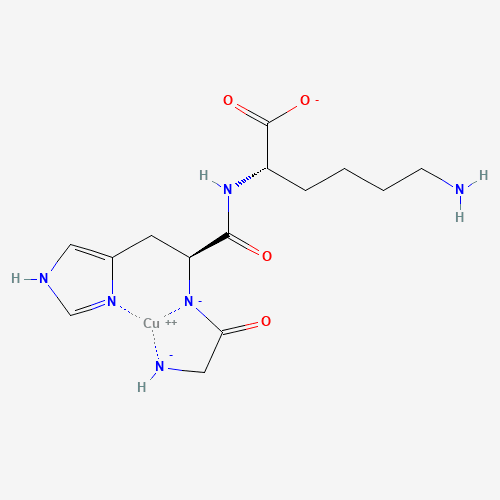
GHK-Cu is the copper complex of GHK (glycyl-histidyl-lysine), a tripeptide found in human plasma, saliva and urine whose levels fall with age [1]. In lab studies it raises collagen and elastin production and supports skin cells [2], and it is a common ingredient in anti-wrinkle products [3]. The best human evidence is one 1994 trial in which a GHK-Cu gel sped the healing of diabetic foot ulcers [4]. The cosmetic studies are described mainly in reviews by the peptide's discoverer, and an independent review found few published clinical studies [2][3].
Well-characterised in cell studies and backed by one old wound-healing trial; the anti-ageing skin claims rest on thinly published studies, and injected GHK-Cu has no human data at all.
- meta-analysis
- RCT
- trial
- observational
- preclinical / case
- review / patent / other
- retracted
- + Stimulates collagen, elastin and glycosaminoglycan production in skin cells
- + Faster closure of diabetic foot ulcers with a topical gel in one controlled trial
- + Passes through human skin in lab tests
- − Most cosmetic trial data come from reviews rather than peer-reviewed trial reports
- − No human data for injected GHK-Cu
- − Unstable and water-loving, which makes formulation difficult
Overview
GHK is a three-amino-acid peptide (glycyl-L-histidyl-L-lysine). It occurs naturally in human plasma, saliva and urine and declines with age: plasma levels are about 200 ng/mL at 20 and 80 ng/mL by 60 [1]. It binds copper(II) tightly, forming GHK-Cu [5]. GHK-Cu and a palmitoylated form are widely used in anti-wrinkle products [3].
Wound healing. The strongest human evidence is a multicentre, randomised, evaluator-blinded, placebo-controlled trial of a GHK-Cu gel in diabetic neuropathic foot ulcers. Median closure of plantar ulcers was 98.5% with the gel and 60.8% with vehicle, and closure was about three times faster. Infections were less common (7% vs 34%) [4].
Skin ageing. Reviews by Pickart, who first isolated GHK-Cu in 1973, describe several 12-week studies in women. In one, a facial cream improved laxity, clarity, fine lines and skin density in 71 women. In another, an eye cream outperformed placebo and a vitamin K cream in 41 women [1][2]. These studies are described with little detail. An independent 2024 review found "a surprising absence of clinical studies" of GHK-Cu in anti-wrinkle products [3].
Hair. In 45 men with pattern hair loss, a lotion combining copper-free GHK with 5-aminolevulinic acid increased hair count over 6 months compared with placebo. Hair length and thickness did not change [6].
Mechanism
GHK-Cu acts on tissue remodelling, the phase of healing that follows the first response to injury. It attracts repair cells such as macrophages and capillary cells, dampens inflammatory signals, and increases collagen, elastin, VEGF, FGF-2 and nerve growth factor [5]. At nanomolar concentrations it stimulates both the synthesis and the breakdown of collagen and glycosaminoglycans. Its reviewers call it a main regulator of wound healing and skin remodelling [1].
Pickart's group has also analysed Connectivity Map data and reports that GHK shifts the expression of at least 4,000 human genes, which they describe as resetting gene expression toward health [1][2]. These are computational analyses of cell-line data, not measurements in people who used GHK-Cu.
- Copper transportmodulatesGHK binds copper(II) with an affinity similar to the copper transport site on albumin [5]moderate
- Collagen and extracellular matrix turnovermodulatesstimulates both synthesis and breakdown of collagen and glycosaminoglycans, and modulates metalloproteinases and their inhibitors [1]moderate
- Gene expressionmodulatesreported to shift expression of at least 4,000 human genes in Connectivity Map data [1]unclear
Dosing
as studied or commonly reported; not a recommendationDoses below are what studies used or, where marked, what is commonly reported. None is a recommendation.
Topical
- metered daily dose of GHK-Cu geldiabetic neuropathic foot ulcers, with standard wound careonce daily after debridementhuman study[4]
- 50 or 100 mg/mL of a 5-aminolevulinic acid and GHK complex (copper-free)
Pharmacokinetics
what the body does with it| Bioavailability | Copper applied as GHK-Cu passed through human skin in lab diffusion cells: 136 µg/cm² over 48 hours, with 82 µg/cm² retained in the skin [7] |
|---|---|
| Steady state | Natural plasma GHK is about 200 ng/mL at age 20 and about 80 ng/mL by age 60 [1] |
Safety
risks and cautions, not medical adviceTopical GHK-Cu has a limited but reassuring record. The diabetic-ulcer trial reported fewer infections with the gel than with vehicle [4], and the hair-loss trial reported no adverse events [6]. Injected GHK-Cu has no human safety data.
- No human data for injected GHK-Cu; injectable products are unregulated
FAQ
- Does GHK-Cu work for wrinkles?
- Reviews by its discoverer describe 12-week cream studies with improvements in wrinkles and skin density [2], but an independent review found few published clinical studies [3].
- Does it get through the skin?
- In lab tests on human skin, copper applied as GHK-Cu passed through and was also retained in the skin [7].
References
entry last reviewed 2026-09-19- [1]GHK Peptide as a Natural Modulator of Multiple Cellular Pathways in Skin Regeneration.Pickart L, Vasquez-Soltero JM, Margolina ABiomed Res Int 2015reviewPMID 26236730◌ unreviewed
- [2]Regenerative and Protective Actions of the GHK-Cu Peptide in the Light of the New Gene Data.Pickart L, Margolina AInt J Mol Sci 2018reviewPMID 29986520◌ unreviewed
- [3]Topically applied GHK as an anti-wrinkle peptide: Advantages, problems and prospective.Mortazavi SM, Mohammadi Vadoud SA, Moghimi HRBioimpacts 2025reviewPMID 39963574◌ unreviewed
- [4]Enhanced healing of ulcers in patients with diabetes by topical treatment with glycyl-l-histidyl-l-lysine copper.Mulder GD, Patt LM, Sanders L et al.Wound Repair Regen 1994RCT · humanPMID 17147644◌ unreviewed
- [5]The human tri-peptide GHK and tissue remodeling.Pickart LJ Biomater Sci Polym Ed 2008reviewPMID 18644225◌ unreviewed
- [6]Efficacy of a Complex of 5-Aminolevulinic Acid and Glycyl-Histidyl-Lysine Peptide on Hair Growth.Lee WJ, Sim HB, Jang YH et al.Ann Dermatol 2016RCT · humanPMID 27489425◌ unreviewed
- [7]Human skin retention and penetration of a copper tripeptide in vitro as function of skin layer towards anti-inflammatory therapy.Hostynek JJ, Dreher F, Maibach HIInflamm Res 2010preclinical · cellPMID 20703511◌ unreviewed