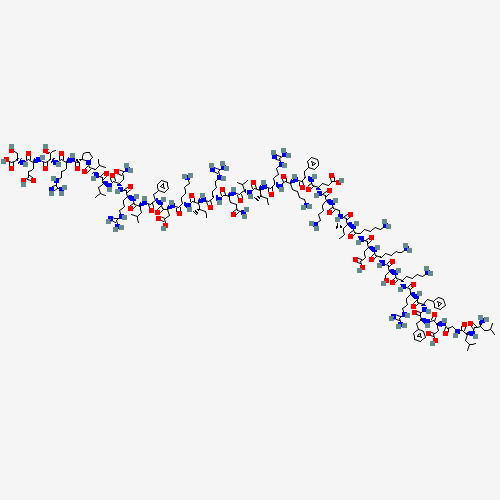
LL-37
also ropocamptide · Cap-18 · cathelicidin LL-37 · CAP18 · Antibacterial peptide LL-37
LL-37 is the only cathelicidin humans make - a 37-residue antimicrobial peptide released from the precursor hCAP18 in skin, neutrophils and epithelia, which kills bacteria, recruits immune cells and drives re-epithelialisation [1]. It has been through three randomised trials in chronic wounds, and the results run in exactly the direction that should make anyone cautious. A 2014 trial in hard-to-heal venous leg ulcers found the peptide safe and reported a marked effect, with mean ulcer area down 68% at the lower concentration [2]. A 2021 multicentre trial in 148 patients then found no significant improvement in healing across the whole cohort, with benefit only in a post-hoc subgroup with large ulcers [3]. A separate randomised trial in diabetic foot ulcers reported benefit [4].
A native human peptide with real wound biology, whose promising small trial did not survive the larger multicentre trial that followed it.
- meta-analysis
- RCT
- trial
- observational
- preclinical / case
- review / patent / other
- retracted
- + A native human peptide with well-established antimicrobial and wound-healing roles
- + Safe and well tolerated in every trial, including on open chronic wounds
- + Reported benefit in a randomised trial in diabetic foot ulcers
- + Activity against antibiotic-resistant organisms, as a host-defence rather than antibiotic mechanism
- − The larger multicentre venous ulcer trial found no significant healing benefit overall
- − Its positive subgroup was identified after the fact, in patients with large ulcers
- − Topical only; systemic use has no evidence and the peptide is cytotoxic at higher concentrations
- − Not approved as a medicine anywhere
Overview
What it is. Cathelicidins are a family of antimicrobial peptides of the innate immune system; humans make exactly one, cleaved from the precursor hCAP18 to give LL-37 - so named for its two leading leucines and 37 residues. It is found in neutrophil granules, keratinocytes, and epithelial surfaces throughout the body. It kills bacteria by disrupting their membranes, and it also chemoattracts immune cells, modulates cytokines, promotes angiogenesis and drives re-epithelialisation [1][5]. Its expression is driven by vitamin D, which is part of why vitamin D status and infection have been linked [6].
The trial sequence, which is the point. In 2014, a randomised placebo-controlled trial in hard-to-heal venous leg ulcers found topical LL-37 safe and well tolerated, with a marked effect on healing predictors: mean ulcer area fell 68% in the 0.5 mg/mL group and 50% in the 1.6 mg/mL group [2]. Worth noting that the lower concentration did better - LL-37 is cytotoxic to host cells above a certain concentration, so this is biologically coherent rather than noise.
In 2021 the same question was asked properly: a multicentre prospective randomised placebo-controlled trial in 148 patients with hard-to-heal venous leg ulcers, mean ulcer duration 20.3 months, three arms, alongside compression therapy. The whole-cohort analysis found no significant improvement in healing. A subgroup analysis suggested benefit in patients with large ulcers, and the authors called for a further study to test that [3]. A post-hoc subgroup in a null trial is a hypothesis, not a result.
A separate randomised double-blind trial of LL-37 cream in diabetic foot ulcers reported enhanced healing [4] - a different wound type with a different pathophysiology, and a smaller literature.
Why it is interesting anyway. Host-defence peptides kill by membrane disruption rather than by hitting a specific target, which makes resistance harder to develop, and LL-37 is active against organisms that resist conventional antibiotics [7]. The translational problem is the recurring one for this class: proteolytic instability, cytotoxicity at therapeutic concentrations, and cost [1]. It has also been explored in epidermolysis bullosa [8] and around dental implants [9].
Mechanism
LL-37 is cationic and amphipathic: it folds into a helix with charged residues on one face and hydrophobic residues on the other. That structure inserts into and disrupts the anionic membranes of bacteria while largely sparing cholesterol-rich mammalian membranes - at low concentrations. At higher concentrations the selectivity fails and it becomes cytotoxic to host cells too [1]. This is the most practically important fact about it, and it explains why the lower concentration outperformed the higher one in the venous ulcer trial [2].
Beyond direct killing, LL-37 acts as an alarm signal: it chemoattracts neutrophils, monocytes and T cells, modulates cytokine production, promotes angiogenesis and stimulates keratinocyte migration and proliferation [1][5]. Those immunomodulatory and reparative actions, not the antibacterial ones, are the stated rationale for the wound trials - chronic ulcers are stuck in a prolonged inflammatory phase rather than simply infected [4].
Its own regulation runs through vitamin D: the hCAP18 gene carries a vitamin D response element, and topical calcipotriol raised hCAP18/LL-37 upregulation during wounding in human skin [6].
- Bacterial membranesblocksstrong
- Re-epithelialisation and wound closureactivatesmoderate
- Innate immune signallingmodulatesbeyond killing microbes, LL-37 chemoattracts immune cells, modulates cytokine release and influences angiogenesis - the properties that make it a candidate for wounds rather than simply an antiseptic [1]moderate
- Endogenous hCAP18/LL-37 expressionactivatesvitamin D signalling drives its expression: topical calcipotriol enhanced the upregulation of hCAP18/LL-37 during wounding in human skin in vivo [6]moderate
Formulation
how the form changes blood levelsApplied topically to the wound bed, as a solution in the venous ulcer trials and as a cream in the diabetic foot ulcer trial [2][3][4]. Concentration matters in both directions - too little to act, too much to be safe for host cells - and the trials used 0.5 to 1.6 mg/mL.
The general obstacles for antimicrobial peptides as drugs are well catalogued: susceptibility to proteases, loss of activity in physiological salt and serum, host cytotoxicity, and manufacturing cost [1][7].
Dosing
as studied or commonly reported; not a recommendationDoses below are what studies used or, where marked, what is commonly reported. None is a recommendation.
Topical
- 0.5 mg/mL or 1.6 mg/mLhard-to-heal venous leg ulcers, randomised placebo-controlled trialrepeated application · not stated in the abstracthuman study[2]
- two concentrations, with compression therapy148 patients with hard-to-heal venous leg ulcers, multicentre randomised placebo-controlled trialrepeated application · not stated in the abstracthuman study[3]
- LL-37 creamdiabetic foot ulcer, randomised double-blind controlled trialas per protocol · not stated in the abstracthuman study[4]
- Form
- Applied to the wound bed as a solution or cream, alongside standard care - compression therapy in the venous ulcer trials [3].
- Notes
- All published clinical use is topical, on open chronic wounds, alongside standard care. There is no studied systemic dose by any route. The 2014 trial's finding that the lower concentration outperformed the higher one [2] is consistent with the peptide's known cytotoxicity at higher concentrations and argues against the assumption that more is better.
Pharmacokinetics
what the body does with it| Half-life | Not applicable to the trials, which applied it topically to the wound bed. No systemic pharmacokinetic study exists |
|---|---|
| Bioavailability | Topical only in the clinical literature [2][3][4] |
| Metabolism | In the body LL-37 is cleaved from the hCAP18 precursor by proteinase 3 in neutrophils and by kallikreins in skin; the free peptide is further processed into fragments with their own activity [1] |
Safety
risks and cautions, not medical adviceTopical application has a good record. The 2014 trial described treatment of hard-to-heal venous leg ulcers as safe and well tolerated [2]; the larger 2021 multicentre trial raised no safety concerns despite finding no efficacy [3]. These are open chronic wounds in elderly patients, which is a demanding setting for tolerability.
The concentration issue is the real one. LL-37 is cytotoxic to mammalian cells above a threshold; its selectivity for bacterial membranes is relative, not absolute [1]. The trial finding that 0.5 mg/mL outperformed 1.6 mg/mL [2] is the clinical shadow of that. This is a compound where increasing the dose is a plausible way to make things worse.
There is no systemic safety data at all. Every clinical study is topical. LL-37 given systemically would face rapid proteolysis, and its immunomodulatory activity is not something whose whole-body consequences have been characterised in a trial. Material sold for injection has no published basis.
- Not approved as a medicine anywhere
- Higher concentration is not better: 0.5 mg/mL outperformed 1.6 mg/mL in the venous ulcer trial [2]
- There is no published basis for systemic or injected use
- The larger multicentre venous ulcer trial found no significant healing benefit in the full cohort [3]
- Its positive finding was a post-hoc subgroup of patients with large ulcers, which the authors flagged as needing a further study [3]
- Every trial is topical on chronic wounds; there is no systemic evidence of any kind
- The peptide is cytotoxic to host cells above a threshold concentration [1]
Interactions
documented pairs only, not exhaustiveNo interaction studies have been published. One relationship worth knowing is upstream rather than pharmacological: vitamin D drives endogenous LL-37 expression, and topical vitamin D analogues raise it during wounding [6].
In the venous ulcer trials LL-37 was applied alongside compression therapy, the standard of care [3], so the trial result is for the combination rather than for the peptide alone.
History
LL-37 was characterised in the 1990s as the sole human cathelicidin, and its roles in cutaneous defence were mapped through the 2000s [5]. Wound healing rather than infection became the clinical target, on the reasoning that chronic ulcers are stalled in inflammation.
The first randomised trial in venous leg ulcers was published in 2014 [2], the multicentre follow-up in 2021 [3], and the diabetic foot ulcer trial in 2023 [4]. Reviews of cathelicidins in skin therapeutics continue to describe the translational obstacles as unresolved [1].
FAQ
- Does LL-37 heal wounds?
- The evidence is mixed and got weaker with better trials. A 2014 trial reported a marked effect in venous leg ulcers [2]; the 2021 multicentre trial in 148 patients found no significant improvement overall [3]. A diabetic foot ulcer trial reported benefit [4].
- Is it a natural human peptide?
- Yes - the only cathelicidin humans make, cleaved from the hCAP18 precursor in neutrophils and skin [1].
References
entry last reviewed 2026-09-19- [1]Cathelicidins: Opportunities and Challenges in Skin Therapeutics and Clinical Translation.Dzurová L, Holásková E, Pospíšilová H et al.Antibiotics (Basel) 2024reviewPMID 39858288◌ unreviewed
- [2]Treatment with LL-37 is safe and effective in enhancing healing of hard-to-heal venous leg ulcers: a randomized, placebo-controlled clinical trial.Grönberg A, Mahlapuu M, Ståhle M et al.Wound Repair Regen 2014RCT · humanPMID 25041740◌ unreviewed
- [3]Evaluation of LL-37 in healing of hard-to-heal venous leg ulcers: A multicentric prospective randomized placebo-controlled clinical trial.Mahlapuu M, Sidorowicz A, Mikosinski J et al.Wound Repair Regen 2021RCT · humanPMID 34687253◌ unreviewed
- [4]Efficacy of LL-37 cream in enhancing healing of diabetic foot ulcer: a randomized double-blind controlled trial.Miranda E, Bramono K, Yunir E et al.Arch Dermatol Res 2023RCT · humanPMID 37480520◌ unreviewed
- [5]Protective roles of the skin against infection: implication of naturally occurring human antimicrobial agents beta-defensins, cathelicidin LL-37 and lysozyme.Niyonsaba F, Ogawa HJ Dermatol Sci 2005reviewPMID 16150577◌ unreviewed
- [6]Topical treatment with the vitamin D analogue calcipotriol enhances the upregulation of the antimicrobial protein hCAP18/LL-37 during wounding in human skin in vivo.Heilborn JD, Weber G, Grönberg A et al.Exp Dermatol 2010clinical trial · humanPMID 19878298◌ unreviewed
- [7]Antimicrobial Peptides.Fry DESurg Infect (Larchmt) 2018reviewPMID 30265592◌ unreviewed
- [8]Epidermolysis bullosa: Advances in research and treatment.Prodinger C, Reichelt J, Bauer JW et al.Exp Dermatol 2019reviewPMID 31140655◌ unreviewed
- [9]Dual-Function Antimicrobial Peptides as a Prospective Strategy Against Peri-Implantitis: Bridging Cutaneous Wound Healing and the Peri-Implant Soft-Tissue Seal.Maghiar L, Iftode A, Neamțu AA et al.Medicina (Kaunas) 2026reviewPMID 42654360◌ unreviewed