SNAP-8
also ACETYL OCTAPEPTIDE-3 [INCI] · SNAP-8 [trade mark] · Acetyl Octapeptide-3 (Powder) · Acetyl Octapeptide-3 (Liquid)
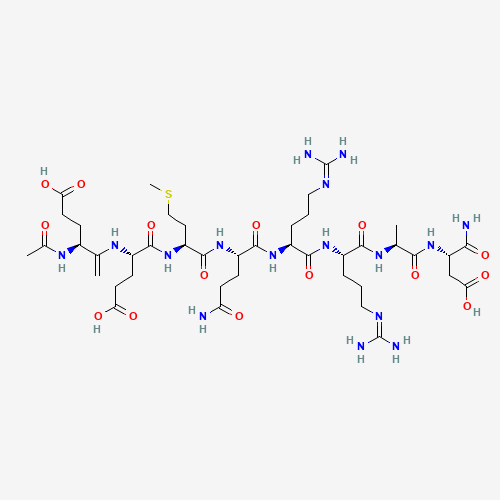
SNAP-8 (acetyl octapeptide-3) is a cosmetic peptide sold as a topical alternative to botulinum toxin. The idea is a mimic of the N-terminal end of SNAP-25, one of the SNARE proteins that lets a nerve terminal release acetylcholine; a decoy that competes for a place in the SNARE complex should weaken muscle contraction and so soften expression lines. That is the same mechanism claimed for its better-known and shorter predecessor Argireline (acetyl hexapeptide-8), which has been through at least one randomised placebo-controlled trial [1]. SNAP-8 itself has essentially no independent clinical literature. It appears in studies of multi-peptide microneedle patches where it is one ingredient among several [2][3], from which nothing can be attributed to it specifically.
A cosmetic peptide whose evidence is borrowed from a related molecule, and whose own appearances in the literature are as one ingredient in mixtures.
- meta-analysis
- RCT
- trial
- observational
- preclinical / case
- review / patent / other
- retracted
- + A coherent proposed mechanism, borrowed from a well-understood piece of neurobiology
- + The related peptide Argireline showed significant anti-wrinkle efficacy in a randomised placebo-controlled trial
- + Topical, with no systemic exposure at cosmetic concentrations
- + No safety signal in the studies that included it
- − No randomised trial of SNAP-8 on its own
- − The studies that include it test multi-peptide formulations, so its contribution is unmeasurable
- − Peptides of this size penetrate the stratum corneum poorly, which is the central problem for the whole class
- − Effect sizes for the related peptide are modest against a wrinkle-analysis apparatus, not against injectables
Overview
The idea. When a motor nerve fires, vesicles of acetylcholine fuse with the terminal membrane using the SNARE complex, of which SNAP-25 is a component. Botulinum toxin works by cleaving SNAP-25, which is why it paralyses muscle and softens expression lines. The cosmetic peptide idea is to supply a fragment resembling the N-terminal end of SNAP-25 that competes for its place in the complex - destabilising it and weakening release without cutting anything [1].
Argireline came first. Acetyl hexapeptide-8 (Argireline) is the six-residue version and has the actual trial. In 60 Chinese subjects, twice-daily application for four weeks significantly improved peri-orbital wrinkles against placebo, on subjective scoring and on objective measurement with a wrinkle-analysis apparatus [1]. A separate paper reviewed its anti-wrinkle efficacy [4]. This is a real, if small and short, randomised result.
SNAP-8 is the eight-residue successor, marketed as a longer and more potent version. Its own clinical literature is essentially empty. Searching for acetyl octapeptide-3 returns studies of multi-peptide delivery systems: a monocentric clinical study of bioactive peptides loaded on hyaluronic acid microneedle patches [2], and a dissolving microneedle patch evaluated for dual anti-wrinkle effects [3]. In both, several actives are present. Nothing in those results can be attributed to SNAP-8 specifically.
So the position is this: the mechanism is plausible and borrowed from real neurobiology; the trial evidence belongs to a related molecule; and the claim that the eight-residue version is better than the six-residue version rests on supplier literature rather than on a comparison anyone has published.
The delivery problem. Peptides this size do not cross intact stratum corneum well. That is the reason the published work has moved to microneedle patches [2][3], and it is the reason to be sceptical of a serum's ability to deliver enough peptide to a neuromuscular junction several millimetres below the surface. Botulinum toxin is injected for a reason.
Mechanism
SNARE-mediated vesicle fusion requires SNAP-25, syntaxin and VAMP to assemble into a four-helix bundle. Botulinum toxin type A proteolytically removes nine residues from the SNAP-25 C-terminus, which prevents assembly and blocks acetylcholine release.
The peptides here take the opposite approach: supply an excess of a sequence resembling part of SNAP-25 so that it competes for incorporation and yields a non-functional or less efficient complex, reducing catecholamine and acetylcholine release [1]. SNAP-8 extends the Argireline sequence by two residues on the theory that a longer mimic competes better.
Two honest caveats. First, the competition has been demonstrated in biochemical and cell systems rather than at a human neuromuscular junction after topical application. Second, for the mechanism to operate in a person, intact peptide must reach the junction beneath the dermis at a concentration high enough to compete with endogenous SNAP-25 - and no published study has measured that for either peptide.
It follows that the clinical improvement seen with Argireline [1] may be partly or wholly a surface effect - hydration, film formation - rather than neuromuscular. The trial measured wrinkles, not acetylcholine release.
- SNARE complex / SNAP-25blocksweak
- Facial expression linesblocksArgireline applied twice daily for 4 weeks significantly improved peri-orbital wrinkles against placebo in 60 Chinese subjects, on both subjective scoring and a wrinkle-analysis apparatus [1]weak
- Skin appearance in multi-peptide formulationsmodulatesbioactive peptide-loaded hyaluronic acid microneedle patches improved skin measures in a monocentric clinical study [2], and a dissolving microneedle patch with dual anti-wrinkle effects was evaluated for safety and efficacy [3]; in both, several peptides were present and no single-agent effect can be extractedweak
Formulation
how the form changes blood levelsAcetyl octapeptide-3 is supplied as an aqueous stock solution for incorporation into serums and creams at low concentrations. The N-terminal acetyl group slows peptidase degradation.
The more interesting formulation work is in delivery. Dissolving and hyaluronic-acid microneedle patches deposit peptide below the stratum corneum, which is the only published approach that addresses the penetration problem directly [2][3].
Dosing
as studied or commonly reported; not a recommendationDoses below are what studies used or, where marked, what is commonly reported. None is a recommendation.
Topical
- applied twice daily (Argireline, the related hexapeptide)60 Chinese subjects with peri-orbital wrinkles, randomised against placebotwice daily · 4 weekshuman study[1]
- multi-peptide microneedle patchmonocentric clinical study of bioactive peptides on hyaluronic acid microneedle patchesas per protocol · not stated in the abstracthuman study[2]
- Form
- Sold as acetyl octapeptide-3 in serums and creams, typically at low single-digit percentages of a stock solution, and increasingly in microneedle patches that bypass the stratum corneum [3].
- Notes
- No dose-finding study of SNAP-8 exists. The concentrations used in cosmetic products derive from supplier recommendations, not from published trials. The one randomised placebo-controlled trial in this family used Argireline, a different peptide, applied twice daily for four weeks [1].
Pharmacokinetics
what the body does with it| Bioavailability | The limiting factor. Peptides of this size cross the stratum corneum poorly, which is why delivery systems such as microneedle patches are used in the studies that include it [2][3] |
|---|---|
| Metabolism | Degraded by skin peptidases; the N-terminal acetylation is intended to slow that |
Safety
risks and cautions, not medical adviceNo safety concerns have been reported. The microneedle patch studies included safety evaluation and raised nothing [3], and the Argireline trial reported it as safe over four weeks [1].
That is unsurprising: at cosmetic concentrations, topically applied, with poor penetration, there is little opportunity for systemic exposure. The same poor penetration that limits efficacy limits risk.
What does not exist is any long-term data, any data on SNAP-8 specifically rather than in mixtures, and any characterisation of what happens with microneedle delivery over months, which bypasses the barrier that otherwise keeps exposure low.
- None reported; topical application at cosmetic concentrations has little systemic exposure [3]
- This is a cosmetic ingredient, not a drug, and it is not a substitute for botulinum toxin
- Effect sizes in the related peptide's trial were modest and measured over four weeks [1]
- No randomised trial of SNAP-8 on its own has been published
- The studies that include it test multi-peptide formulations, so its contribution cannot be isolated [2][3]
- Its evidence is borrowed from Argireline, a different peptide [1]
- Peptides of this size penetrate intact skin poorly, and no study has shown peptide reaching a neuromuscular junction
- The claim that eight residues beat six has not been tested in a published comparison
Interactions
documented pairs only, not exhaustiveNo interaction studies exist. In practice SNAP-8 is almost always used alongside other actives - other peptides, hyaluronic acid, retinoids - and the published studies that include it are studies of such mixtures [2][3]. That is precisely why its individual contribution is unknown.
History
Argireline (acetyl hexapeptide-8) was introduced by Lipotec in the late 1990s as a topical alternative to botulinum toxin, and its randomised evidence dates from 2013 [1][4]. SNAP-8, the eight-residue extension, followed as a next-generation product.
The subsequent literature has been formulation-led rather than ingredient-led, with microneedle delivery studies appearing from 2020 [2][3].
FAQ
- Is SNAP-8 like Botox?
- It borrows the same target - the SNARE complex - but works by competition rather than by cleaving SNAP-25, and it is applied to the skin rather than injected into muscle [1]. The effect sizes are not comparable.
- Is there a trial of SNAP-8?
- Not on its own. The randomised placebo-controlled evidence in this family is for Argireline, the related hexapeptide [1]. SNAP-8 appears only within multi-peptide formulations [2][3].
- Does it actually get through the skin?
- Poorly, which is the central problem for the class and the reason published work has moved to microneedle patches [2][3].
- Is it safe?
- No safety concerns have been reported, and topical use at cosmetic concentrations produces little systemic exposure [3].
References
entry last reviewed 2026-09-19- [1]The anti-wrinkle efficacy of argireline, a synthetic hexapeptide, in Chinese subjects: a randomized, placebo-controlled study.Wang Y, Wang M, Xiao S et al.Am J Clin Dermatol 2013RCT · humanPMID 23417317◌ unreviewed
- [2]Efficacy of bioactive peptides loaded on hyaluronic acid microneedle patches: A monocentric clinical study.Avcil M, Akman G, Klokkers J et al.J Cosmet Dermatol 2020clinical trial · humanPMID 31134751◌ unreviewed
- [3]Clinical Safety and Efficacy Evaluation of a Dissolving Microneedle Patch Having Dual Anti-Wrinkle Effects With Safe and Long-Term Activities.Shin JY, Han D, Yoon KY et al.Ann Dermatol 2024clinical trial · humanPMID 39082657◌ unreviewed
- [4]The anti-wrinkle efficacy of Argireline.Wang Y, Wang M, Xiao XS et al.J Cosmet Laser Ther 2013reviewPMID 23464592◌ unreviewed