TB-500
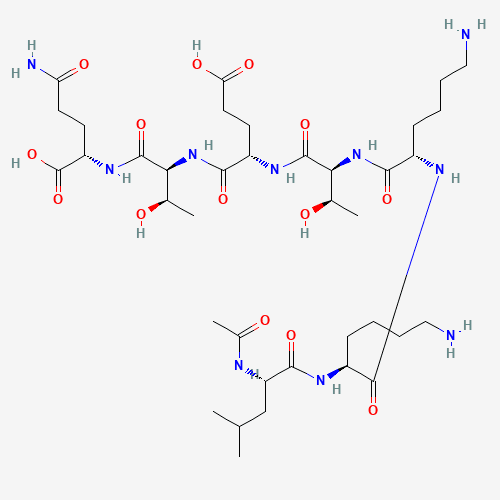
also TB500 · TB 500 · Ac-LKKTETQ · Ac-Leu-Lys-Lys-Thr-Glu-Thr-Gln-OH · Thymosin beta-4 fragment 17-23
TB-500 is a product built on Ac-LKKTETQ, a synthetic, acetylated copy of the seven-amino-acid actin-binding region of thymosin beta-4 [1][2]. It began as a veterinary preparation and is marketed for wound healing and tissue repair [2]. It has never been tested for efficacy in humans. In a lab study, the intact peptide did not speed wound closure; one of its breakdown products did [3].
A doping-control problem more than a medicine. It borrows the reputation of thymosin beta-4 but has no human data and little direct evidence of its own.
- meta-analysis
- RCT
- trial
- observational
- preclinical / case
- review / patent / other
- retracted
- + The unacetylated LKKTETQ sequence promotes cell migration and wound healing in lab studies
- + One of its metabolites sped wound closure in fibroblasts
- − No human studies of any kind
- − The intact peptide showed no wound-healing activity in the one direct test
- − The name is used for two different molecules, the fragment and the full protein
- − Banned in sport
Overview
TB-500 is not the same thing as Thymosin beta-4 (TB-4). Doping-control chemists analysed the product and found its active ingredient to be Ac-LKKTETQ, the N-terminally acetylated 17–23 fragment of human thymosin beta-4 [1]. The product emerged as a veterinary preparation, and its makers claim it promotes blood-vessel growth, skin cell migration, collagen deposition and less inflammation [2]. The name is also used loosely for full-length thymosin beta-4, which is a different molecule with its own literature [4].
There are no human studies of TB-500. What is known comes from three kinds of work:
- Parent-protein biology. The LKKTETQ stretch is thymosin beta-4's actin-binding site. Unacetylated, it promotes angiogenesis, wound healing and cell migration [5].
- Direct testing. In a 2024 study, the biological effects of TB-500 itself had not been documented. In fibroblasts, only one metabolite, Ac-LKKTE, sped wound closure, not the intact peptide. The authors suggest the reported wound-healing activity may come from that metabolite [3].
- Doping control. Methods exist to detect it and its metabolites in horse urine and plasma [2].
A 2026 review places TB-500 among the peptides whose animal results look promising while rigorous human data remain scarce [6].
Mechanism
The proposed mechanism is borrowed from thymosin beta-4. Its 17-23 region binds actin and is responsible for cell migration and wound healing [2][5]. TB-500 adds an acetyl group to the front of this fragment - and that matters, because the biological activities attributed to the sequence were established for the unacetylated form, LKKTETQ, not for TB-500 [3][5].
Only one study has tested the acetylated peptide against its own breakdown products side by side, using synthesised authentic standards of each, after following its metabolism through human serum, several isolated enzyme systems and rat urine. Four metabolites were confirmed in both the in vitro systems and in rats. At 50 µg/mL in fibroblasts, the metabolite Ac-LKKTE closed a scratch wound 36% faster than control over 8 hours, while TB-500 itself did not differ from control; nothing tested was toxic to the cells between 6.25 and 50 µg/mL. The authors' reading is that the wound-healing activity reported for TB-500 in the literature may belong to Ac-LKKTE rather than to the peptide people inject [3].
- Actin (via the Tβ4 17–23 actin-binding region)modulatesunclear
Dosing
as studied or commonly reported; not a recommendationDoses below are what studies used or, where marked, what is commonly reported. None is a recommendation.No peer-reviewed human dosing data. The doses below come from animal studies or company filings; animal doses do not translate directly to people.
Intraperitoneal (animals)
- 50 mg/kg (human equivalent ≈8 mg/kg, or ≈480 mg at 60 kg)
- Notes
- No human doses have been studied. A horse doping study gave a single dose of TB-500 containing 10 mg of the peptide [2]. The rat dose above is from a metabolism study, chosen to make metabolites measurable rather than to test any effect, and its human equivalent is a body-surface-area estimate [7], not a dose tested in people.
Pharmacokinetics
what the body does with it| Metabolism | In human serum and in rats it is broken down to shorter fragments. Ac-LK is the main metabolite in rats in the first 6 hours, and Ac-LKK is still detectable at 72 hours [3] |
|---|---|
| Excretion | The parent peptide and its metabolites are found in the urine and plasma of horses after a single dose [2] |
Safety
risks and cautions, not medical adviceThere are no human safety data. The fragment and its metabolites were not toxic to fibroblasts in culture at 6.25-50 µg/mL, which is a cell-survival screen and not a toxicology study [3]. The metabolite picture is at least well described: in rats the peptide is cut down to Ac-LK within hours and Ac-LKK is still detectable at 72 hours, so what circulates after a dose is mostly short fragments of ordinary amino acids rather than the intact peptide [3]. Thymosin beta-4 is forbidden by the World Anti-Doping Agency and by horse-racing and equestrian authorities [4], and labs can detect TB-500 in horses [2].
- Not studied in humans
- No published human studies of any kind
- Most of the claimed benefits come from the unacetylated fragment or the full thymosin beta-4 protein, not TB-500 itself [3][5]
- In the one study that tested the acetylated peptide directly against its own breakdown products, TB-500 itself produced no significant wound healing [3]
FAQ
- Is TB-500 the same as thymosin beta-4?
- No. It is built on a synthetic, acetylated seven-amino-acid fragment (LKKTETQ, positions 17–23) of the 43-amino-acid protein [1][2].
- Does TB-500 work?
- There are no human trials. In the one lab study that tested it directly, the intact peptide did not speed wound closure, but one of its metabolites did [3].
References
entry last reviewed 2026-09-19- [1]Synthesis and characterization of the N-terminal acetylated 17-23 fragment of thymosin beta 4 identified in TB-500, a product suspected to possess doping potential.Esposito S, Deventer K, Goeman J et al.Drug Test Anal 2012otherPMID 22962027◌ unreviewed
- [2]Doping control analysis of TB-500, a synthetic version of an active region of thymosin β₄, in equine urine and plasma by liquid chromatography-mass spectrometry.Ho EN, Kwok WH, Lau MY et al.J Chromatogr A 2012other · animalPMID 23084823◌ unreviewed
- [3]Simultaneous quantification of TB-500 and its metabolites in in-vitro experiments and rats by UHPLC-Q-Exactive orbitrap MS/MS and their screening by wound healing activities in-vitro.Rahaman KA, Muresan AR, Min H et al.J Chromatogr B Analyt Technol Biomed Life Sci 2024preclinical · animalPMID 38382158◌ unreviewed
- [4]Equine Doping Controls of Thymosin β 4: A Population Study and Strategy for Misuse Detection.Delcourt V, Garcia P, Chabot B et al.Drug Test Anal 2025other · animalPMID 39314109◌ unreviewed
- [5]Biological activities of thymosin beta4 defined by active sites in short peptide sequences.Sosne G, Qiu P, Goldstein AL et al.FASEB J 2010reviewPMID 20179146◌ unreviewed
- [6]Safety and Efficacy of Approved and Unapproved Peptide Therapies for Musculoskeletal Injuries and Athletic Performance.Mendias CL, Awan TMSports Med 2026reviewPMID 41966639◌ unreviewed
- [7]Dose translation from animal to human studies revisited.Reagan-Shaw S, Nihal M, Ahmad NFASEB J 2008reviewPMID 17942826◌ unreviewed