Noopept
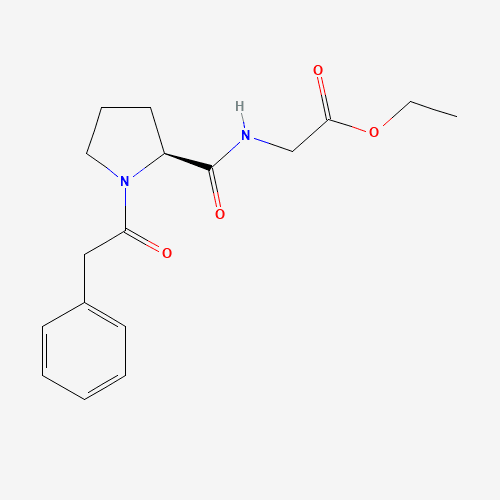
also Omberacetam · GVS-111 · N-phenylacetyl-L-prolylglycine ethyl ester
Noopept is a Russian dipeptide designed to mimic the Piracetam pharmacophore, reported active at doses about a thousandth of piracetam's [1]. It is a prodrug: the parent is undetectable in rat brain an hour after dosing, and the active species is cycloprolylglycine, a peptide the brain already makes [2]. Its clinical evidence is Russian, small and uncontrolled [3], and its primary molecular action appears to be stabilisation of HIF-1 [4].
A clever molecule with a plausible endogenous mechanism, sold at roughly the dose its Russian developers used — and with no controlled trial in English to show it does anything.
- meta-analysis
- RCT
- trial
- observational
- preclinical / case
- review / patent / other
- retracted
- + Active at milligram rather than gram doses, unlike every other compound in the class
- + Converts to an endogenous brain dipeptide rather than to a foreign metabolite
- + Raises hippocampal NGF and BDNF expression in rats without tolerance over 28 days
- − No randomised, placebo-controlled trial is cited here
- − The clinical studies are Russian, open-label, and small
- − Supplements sold as containing it have been found at four times the pharmacologic dose
Overview
Noopept is not a racetam by structure. It was designed at the Zakusov Institute in Moscow by taking the Piracetam pharmacophore and rebuilding it as a short peptide — the ethyl ester of N-phenylacetyl-L-prolylglycine [1]. It is filed with the racetams here because that is its lineage and how it is sold; its cognitive-peptide character is closer to Semax and Selank.
Its developers report that it exceeds piracetam both in effective dose — about a thousand times lower — and in the breadth of its effect on memory: where piracetam facilitates only the early stages, noopept is reported to act on consolidation and retrieval as well, with an additional selective anxiolytic action [1]. It is registered and prescribed in Russia for cognitive deficits of cerebrovascular and post-traumatic origin [1].
Mechanism
Two findings dominate.
The first is that noopept is a prodrug. An hour after 5 mg/kg intraperitoneally, noopept itself could not be detected in rat brain at all. What had risen — 2.5-fold — was cycloprolylglycine, a cyclic dipeptide the brain already produces endogenously and which has nootropic activity of its own. The conversion also happens in vitro in the presence of plasma and brain enzymes [2]. Later pharmacokinetic work confirmed that cycloprolylglycine differs markedly from the parent in its kinetics while sharing its pharmacological spectrum [5]. One caveat: an oral study found noopept stimulated one-session learning in a way its metabolite and piracetam did not, so the prodrug story may not be the whole of it [6].
The second is HIF-1. When noopept was screened against nine transcription factors in transfected HEK293 cells, it increased the DNA-binding activity of hypoxia-inducible factor 1 and of nothing else — not CREB, NFAT, NF-κB, p53, STAT1, GAS, VDR or HSF1. The effect was concentration-dependent and additive with chemically induced HIF-1 stabilisation, and molecular docking suggested that noopept and its active L-isomer metabolite bind the active site of prolyl hydroxylase 2, the enzyme that marks HIF-1α for destruction. Piracetam at a hundred times the concentration affected none of the nine [4].
Downstream, noopept raises NGF and BDNF mRNA in rat hippocampus after a single dose, and 28 days of dosing potentiated rather than blunted the effect [7]. In cell models it reduced oxidative damage and apoptosis in human cortical neurons, including Down syndrome neurons [8], and reduced apoptosis and tau hyperphosphorylation in an Alzheimer's model [9]. In a rat photochemical stroke model it restored memory and protected tissue [10].
- HIF-1 (hypoxia-inducible factor 1)activatesof nine transcription factors screened, noopept at 10 µM increased the DNA-binding activity of HIF-1 alone, concentration-dependently; docking suggests it and its metabolite bind prolyl hydroxylase 2, while piracetam at 1 mM affected none of them [4]moderate
- Cycloprolylglycineno bindingnoopept itself is undetectable in rat brain 1 h after dosing; brain cycloprolylglycine — an endogenous nootropic cyclopeptide — rises 2.5-fold, making noopept a prodrug for it [2]strong
- NGF and BDNF expressionactivatesraised mRNA for both neurotrophins in rat hippocampus after acute dosing, and chronic dosing over 28 days potentiated rather than diminished the effect [7]moderate
- Neuronal oxidative damage and apoptosisblocksweak
Dosing
as studied or commonly reported; not a recommendationDoses below are what studies used or, where marked, what is commonly reported. None is a recommendation.
Oral
- 20 mgmild cognitive impairment after stroke; open, uncontrolled prospective study in 60 patientsdaily · 2 months (within a 12-month study)human study[3]
- 0.5–10 mg/kg (human equivalent ≈0.08–1.6 mg/kg)
- Form
- Noopept is the ethyl ester of a phenylacetyl-prolyl-glycine dipeptide, not a racetam by structure; the name omberacetam is a later INN [12].
- Notes
- The only human dose cited here is 20 mg a day for two months, from an open uncontrolled study [3]. A US analysis puts the typical pharmacologic dose of omberacetam at 10 mg, and found one supplement delivering 40.6 mg per serving — four times that [12]. Noopept's developers report it effective at about a thousandth of piracetam's dose [1], which is why a 10–20 mg tablet is the normal unit.
Pharmacokinetics
what the body does with it| Half-life | Not quantified in the references cited here. A Russian interspecies study reports that elimination slows progressively from rat to rabbit to human, and that human kinetics show considerable individual variability [13]. |
|---|---|
| Bioavailability | Orally active in rats at 0.5–10 mg/kg, retaining the antiamnesic effect seen after injection — the stated advantage over larger peptides [6]. |
| Metabolism | A prodrug. In rats the parent is below the limit of detection in brain 1 h after 5 mg/kg intraperitoneally, while brain cycloprolylglycine rises 2.5-fold; conversion also occurs in vitro with plasma and brain enzymes [2]. Cycloprolylglycine's own pharmacokinetics differ markedly from the parent's but its pharmacological spectrum is similar [5]. Metabolism is strongly species-dependent: rats metabolise noopept very intensively and presystemically, forming a phenyl-ring-hydroxylated metabolite that rabbits do not make; in human plasma no metabolite was detected at all, which the authors attribute to the small dose and low concentrations [13]. |
Safety
risks and cautions, not medical adviceNo controlled human safety data is cited here. The 60-patient open study of 20 mg daily for two months in stroke patients reported a high level of safety, but it had no blinded comparator and was not designed to detect harm [3].
The concrete risk is dosing. Noopept is active in milligrams where the rest of the class is active in grams, so the margin for error in an unregulated product is small. In a 2021 analysis of cognitive-enhancement supplements, the maximum omberacetam exposure from a recommended serving was 40.6 ± 0.4 mg against a typical pharmacologic dose of 10 mg — a fourfold overshoot — and products in that category routinely contained undeclared unapproved drugs such as phenibut, vinpocetine and picamilon, with 75% of declared quantities inaccurate [12].
European medicines control laboratories intercepted noopept as bulk raw material during a 2020–2024 market surveillance exercise, alongside phenylpiracetam and phenibut, noting that consumers buying these as dietary supplements may not be aware of the risks [14].
- The open stroke study described a high level of safety over two months at 20 mg daily, but was not designed to detect harm [3]
- No controlled human adverse-event data is available in the references cited here
- Active in milligrams, so mislabelled products carry a larger relative error; one analysed supplement delivered four times the typical pharmacologic dose [12]
- Not approved outside Russia and neighbouring countries; intercepted as illegal-market bulk material in Europe and Australia [14]
- Its one clean molecular action is HIF-1 stabilisation [4], a pathway with consequences well beyond cognition that no human study here has examined
- No randomised, placebo-controlled trial of noopept is cited here
- The main clinical study is open-label and uncontrolled in 60 patients [3]
- The pivotal randomised comparison against piracetam could not be obtained in any language, in either its Russian original or its English translation, and is not cited here
- The mechanistic work is in rats and cell culture, including the HIF-1 and neurotrophin findings [4][7]
- Human pharmacokinetics are described only qualitatively: elimination is slower than in animals and highly variable between people, with no half-life, Tmax or bioavailability figure reported [13]
- The prodrug account is not settled: oral noopept had an effect on one-session learning that its metabolite did not reproduce [6]
History
Noopept was developed as GVS-111 in the 1990s by Gudasheva, Ostrovskaya, Voronina and Seredenin, using an explicit design strategy: imitate a non-peptide nootropic's structure with a short peptide [1]. Retaining activity after oral dosing was the specific problem they solved, and it is what distinguished noopept from more complex peptides [1][6].
The clinical work is Russian. An open prospective study followed 60 stroke patients on 20 mg daily for up to twelve months and reported significant improvement in MMSE and verbal association scores after two months against a control group, with mild global improvement [3]. An earlier clinical study characterised its EEG signature in patients with post-traumatic and vascular cognitive impairment: increased alpha and beta power and reduced delta, a pattern the authors read as non-specific activation plus anxiolysis, and clearest in cerebrovascular rather than post-traumatic disease [15].
The drug's pivotal trial — a multicentre randomised comparison against piracetam in mild cognitive impairment of vascular and traumatic origin — was published in Russian in 2008 and in English translation in 2009. PubMed indexes neither version with an abstract, and no free full text of either could be obtained, so it is not cited here. That is a gap in what can be verified, not in what exists, and it is the single most important missing piece on this page.
Reputation
how it is regarded elsewhere, not this wiki's readingNoopept's reputation online rests on two claims: that it is a thousand times stronger than piracetam, and that it raises BDNF. Both trace to real papers — the potency claim to its developers' own review [1], the BDNF claim to a rat hippocampus study [7] — and neither has been shown to mean anything for cognition in a person under controlled conditions.
The genuinely interesting findings are less advertised. The compound you swallow is probably not the compound that acts: noopept disappears from brain and an endogenous cyclopeptide appears in its place [2]. And its one clean molecular signal, out of nine transcription factors tested, is HIF-1 stabilisation via prolyl hydroxylase inhibition [4] — which puts it in unexpected company with hypoxia-mimetic drugs rather than with the racetams it was modelled on.
What is missing is the same thing missing for Phenylpiracetam: a randomised, placebo-controlled trial. The Russian literature is read and cited here where it can be obtained — the stroke study, the EEG study and the interspecies pharmacokinetics are all Russian-language papers [3][13][15] — but what exists is open-label, uncontrolled, or preclinical.
FAQ
- Is noopept a racetam?
- Not structurally — it is a dipeptide ethyl ester. It was deliberately designed to imitate the piracetam pharmacophore in peptide form [1], and is sold and filed with the racetams.
- Is it really a thousand times stronger than piracetam?
- That figure comes from its developers' own review of the animal work [1]. No head-to-head human trial supports it in the references cited here.
- What dose is used?
- The one human study cited here used 20 mg a day for two months [3]; a US analysis describes 10 mg as the typical pharmacologic dose [12].
- Does it raise BDNF?
- In rat hippocampus, yes — mRNA for both NGF and BDNF rose after acute dosing and the effect grew rather than faded over 28 days [7]. Nothing comparable has been measured in people.
References
entry last reviewed 2026-09-20- [1][The original novel nootropic and neuroprotective agent noopept].Ostrovskaia RU, Gudasheva TA, Voronina TA et al.Eksp Klin Farmakol 2002reviewPMID 12596521in Russian◌ unreviewed
- [2]The major metabolite of dipeptide piracetam analogue GVS-111 in rat brain and its similarity to endogenous neuropeptide cyclo-L-prolylglycine.Gudasheva TA, Boyko SS, Ostrovskaya RU et al.Eur J Drug Metab Pharmacokinet 1997other · animalPMID 9358206◌ unreviewed
- [3][Noopept in the treatment of mild cognitive impairment in patients with stroke].Amelin AV, Iliukhina AIu, Shmonin AAZh Nevrol Psikhiatr Im S S Korsakova 2011clinical trial · humanPMID 22500312in Russian◌ unreviewed
- [4]Molecular Mechanism Underlying the Action of Substituted Pro-Gly Dipeptide Noopept.Vakhitova YV, Sadovnikov SV, Borisevich SS et al.Acta Naturae 2016otherPMID 27099787◌ unreviewed
- [5][Pharmacokinetics of noopept and its active metabolite cycloprolyl glycine in rats].Boyko SS, Zherdev VP, Shevchenko RVBiomed Khim 2018other · animalPMID 30378564in Russian◌ unreviewed
- [6]Proline-containing dipeptide GVS-111 retains nootropic activity after oral administration.Ostrovskaya RU, Mirsoev TK, Romanova GA et al.Bull Exp Biol Med 2001other · animalPMID 11782792◌ unreviewed
- [7]Noopept stimulates the expression of NGF and BDNF in rat hippocampus.Ostrovskaya RU, Gudasheva TA, Zaplina AP et al.Bull Exp Biol Med 2008other · animalPMID 19240853◌ unreviewed
- [8]GVS-111 prevents oxidative damage and apoptosis in normal and Down's syndrome human cortical neurons.Pelsman A, Hoyo-Vadillo C, Gudasheva TA et al.Int J Dev Neurosci 2003other · humanPMID 12711349◌ unreviewed
- [9]Neuroprotective effect of novel cognitive enhancer noopept on AD-related cellular model involves the attenuation of apoptosis and tau hyperphosphorylation.Ostrovskaya RU, Vakhitova YV, Kuzmina USh et al.J Biomed Sci 2014other · humanPMID 25096780◌ unreviewed
- [10]Memory restoring and neuroprotective effects of the proline-containing dipeptide, GVS-111, in a photochemical stroke model.Ostrovskaya RU, Romanova GA, Barskov IV et al.Behav Pharmacol 1999other · animalPMID 10780261◌ unreviewed
- [11]A simple practice guide for dose conversion between animals and human.Nair AB, Jacob SJ Basic Clin Pharm 2016reviewPMID 27057123◌ unreviewed
- [12]Five Unapproved Drugs Found in Cognitive Enhancement Supplements.Cohen PA, Avula B, Wang YH et al.Neurol Clin Pract 2021otherPMID 34484905◌ unreviewed
- [13][Interspecies differences of noopept pharmacokinetics].Boĭko SS, Korotkov SA, Zherdev VP et al.Eksp Klin Farmakol 2004other · humanPMID 15079908in Russian◌ unreviewed
- [14]The Occurrence of Illicit Smart Drugs or Nootropics in Europe and Australia and Their Associated Dangers: Results from a Market Surveillance Study by 12 Official Medicines Control Laboratories.Vanhee C, Deconinck E, George M et al.J Xenobiot 2025otherPMID 40558871◌ unreviewed
- [15][Clinical and electroencephalographic characteristic of noopept in patients with mild cognitive impairment of posttraumatic and vascular origin].Bochkarev VK, Teleshova ES, Siuniakov SA et al.Zh Nevrol Psikhiatr Im S S Korsakova 2008clinical trial · humanPMID 19008801in Russian◌ unreviewed