Ipamorelin
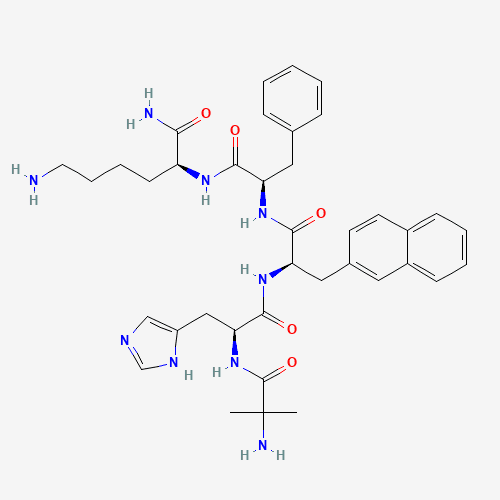
also NNC-26-0161 · Aib-His-D-2-Nal-D-Phe-Lys-NH2 · NNC-260161 · NNC 26-0161 · Aib-His-2Nal-Phe-Lys-NH2
Ipamorelin is a synthetic pentapeptide (Aib-His-D-2-Nal-D-Phe-Lys-NH2) that releases growth hormone through the ghrelin receptor. Novo Nordisk designed it in the 1990s from the GHRP-1 series, and its selling point was selectivity: in pigs it released growth hormone as strongly as GHRP-6 but, unlike GHRP-6 and GHRP-2, did not raise ACTH or cortisol even at more than 200 times the effective dose [1]. The catch is that almost nothing has been published about what it does in people. The one controlled human trial gave it intravenously for postoperative bowel paralysis, and found no benefit over placebo [2]. No published human study has measured growth hormone, IGF-1 or body composition on ipamorelin.
A cleanly selective growth hormone releaser in animals, marketed on the strength of two rodent and pig papers from the 1990s; its only controlled human trial was for an unrelated indication and was negative.
- meta-analysis
- RCT
- trial
- observational
- preclinical / case
- review / patent / other
- retracted
- + Released growth hormone as strongly as GHRP-6 in rats and pigs
- + Did not raise ACTH or cortisol in pigs, unlike GHRP-6 and GHRP-2
- + Was well tolerated over seven days of intravenous dosing in surgical patients
- − No published human study has measured growth hormone, IGF-1 or body composition
- − The only controlled human trial missed its endpoint
- − Everything sold is unlicensed; it was never approved anywhere
Overview
Ipamorelin came out of a Novo Nordisk chemistry programme that stripped the central Ala-Trp dipeptide out of GHRP-1. The resulting pentapeptide released growth hormone from rat pituitary cells about as potently as GHRP-6, and antagonist experiments placed its action at the GHRP (ghrelin) receptor rather than the GHRH receptor [1].
What made it interesting. The older GH-releasing peptides are not clean: GHRP-6 and GHRP-2 also push ACTH, cortisol and prolactin [3]. In pigs, ipamorelin released growth hormone without moving FSH, LH, prolactin, TSH, ACTH or cortisol, even at doses more than 200 times its ED50 for growth hormone [1]. Its developers called it the first selective growth hormone secretagogue.
What happened next. It was not developed as a growth hormone drug. The one controlled human trial used it for postoperative ileus, on the ghrelin receptor's effect on gut motility, which had worked in rats [4]. In 114 patients after bowel resection, intravenous ipamorelin 0.03 mg/kg twice daily for up to seven days was well tolerated, but the median time to tolerating a solid meal was 25.3 hours against 32.6 on placebo, which was not statistically significant [2]. In rats it also protected against glucocorticoid-induced loss of bone formation [5].
Everything else said about ipamorelin — that it raises IGF-1, adds lean mass, or does so more cleanly than other secretagogues in people — is extrapolation from the pig study. No published human trial has measured growth hormone or IGF-1 on ipamorelin at all.
Mechanism
Ipamorelin is a GHS-R1a agonist, the same receptor ghrelin and MK-677 use [1]. Agonists at this receptor raise growth hormone partly at the pituitary and partly by opposing somatostatin in the hypothalamus, which is why GH-releasing peptides synergise with GHRH [6].
Its distinguishing feature is what it does not do. Structure-activity work on this peptide family shows that small changes in the core residues separate growth hormone release from ACTH and prolactin release [7], and ipamorelin sits at the selective end of that range in animals [1]. Whether that selectivity holds in humans has not been tested.
- GHS-R1a (ghrelin receptor)activatesreleased growth hormone from rat pituitary cells with an EC50 of 1.3 nmol/L, and antagonist profiling showed the effect runs through the GHRP receptor rather than the GHRH receptor [1]strong
- Growth hormone (animals)activatesED50 of 80 nmol/kg in anaesthetised rats and 2.3 nmol/kg in conscious pigs, comparable to GHRP-6 [1]moderate
- ACTH and cortisolno bindingunchanged in pigs at doses more than 200-fold above the ED50 for growth hormone, whereas GHRP-6 and GHRP-2 both raised them [1]moderate
- Gut motilityactivatesweak
Formulation
how the form changes blood levelsIpamorelin is a pentapeptide, Aib-His-D-2-Nal-D-Phe-Lys-NH2, normally supplied as the acetate salt [1]. The only published human route is intravenous infusion [2]; the subcutaneous route used in practice has not been studied in humans. Peptides of this kind are common in grey-market "growth" products, whose actual contents often differ from the label [8].
Dosing
as studied or commonly reported; not a recommendationDoses below are what studies used or, where marked, what is commonly reported. None is a recommendation.
Intravenous
- 0.03 mg/kg114 adults recovering from bowel resection (phase 2, postoperative ileus)twice daily · up to 7 days or dischargehuman study[2]
- 80 nmol/kg (rat ED50); human equivalent not established
- Notes
- No human study has used ipamorelin to raise growth hormone, so no human dose for that purpose has been established. The only human dose in the literature is the 0.03 mg/kg intravenous infusion used for postoperative ileus [2]. Community practice of small daily subcutaneous doses is not supported by any published trial.
Pharmacokinetics
what the body does with it| Metabolism | No human pharmacokinetic study of ipamorelin was found for this entry; the related hexapeptide GHRP-6 has an elimination half-life of about 2.5 hours after intravenous dosing [9] |
|---|
Safety
risks and cautions, not medical adviceThe only human safety data come from the ileus trial: over up to seven days of twice-daily intravenous dosing in 114 post-surgical patients, treatment-emergent adverse events occurred in 87.5% on ipamorelin and 94.8% on placebo — a population where nearly everyone has some adverse event after bowel surgery — and no safety signal was attributed to the drug [2].
There is no human data on longer use, on glucose, on IGF-1, or on what happens to the pituitary over months. By analogy with the rest of this class, chronic dosing would be expected to blunt the growth hormone response over time, as it does with hexarelin [10], but this has not been measured for ipamorelin.
- No adverse effect was attributed to ipamorelin in the one human trial [2]
- Not approved for any use anywhere
- Claims about lean mass and IGF-1 come from animal work, not from human trials
Interactions
documented pairs only, not exhaustiveNo human interaction studies exist. GH-releasing peptides in general synergise with GHRH on growth hormone release [6], so combining ipamorelin with a GHRH analogue would be expected to produce a larger response than either alone, but this has not been shown for ipamorelin specifically.
FAQ
- Does ipamorelin raise IGF-1 in humans?
- Nobody has published a measurement. Every IGF-1 and growth hormone number for ipamorelin comes from rats and pigs [1].
- Is it really side-effect free?
- It did not raise cortisol or ACTH in pigs, which is where that claim comes from [1]. The one human trial reported no drug-attributed adverse events over seven days [2], but that is the whole human safety record.
- How does it compare with MK-677?
- They hit the same receptor, but MK-677 has two-year randomised human data on growth hormone, IGF-1 and body composition [11], and ipamorelin has none.
References
entry last reviewed 2026-09-19- [1]Ipamorelin, the first selective growth hormone secretagogue.Raun K, Hansen BS, Johansen NL et al.Eur J Endocrinol 1998other · animalPMID 9849822◌ unreviewed
- [2]Prospective, randomized, controlled, proof-of-concept study of the Ghrelin mimetic ipamorelin for the management of postoperative ileus in bowel resection patients.Beck DE, Sweeney WB, McCarter MD et al.Int J Colorectal Dis 2014RCT · humanPMID 25331030◌ unreviewed
- [3]Effects of GHRP-2 and hexarelin, two synthetic GH-releasing peptides, on GH, prolactin, ACTH and cortisol levels in man. Comparison with the effects of GHRH, TRH and hCRH.Arvat E, di Vito L, Maccagno B et al.Peptides 1997other · humanPMID 9285939◌ unreviewed
- [4]Efficacy of ipamorelin, a novel ghrelin mimetic, in a rodent model of postoperative ileus.Venkova K, Mann W, Nelson R et al.J Pharmacol Exp Ther 2009other · animalPMID 19289567◌ unreviewed
- [5]The growth hormone secretagogue ipamorelin counteracts glucocorticoid-induced decrease in bone formation of adult rats.Andersen NB, Malmlöf K, Johansen PB et al.Growth Horm IGF Res 2001other · animalPMID 11735244◌ unreviewed
- [6]Blocked growth hormone-releasing peptide (GHRP-6)-induced GH secretion and absence of the synergic action of GHRP-6 plus GH-releasing hormone in patients with hypothalamopituitary disconnection: evidence that GHRP-6 main action is exerted at the hypothalamic level.Popovic V, Damjanovic S, Micic D et al.J Clin Endocrinol Metab 1995other · humanPMID 7883854◌ unreviewed
- [7]Structure-activity relationship for peptídic growth hormone secretagogues.Ferro P, Krotov G, Zvereva I et al.Drug Test Anal 2017other · cellPMID 26811125◌ unreviewed
- [8]Analysis of new growth promoting black market products.Krug O, Thomas A, Malerød-Fjeld H et al.Growth Horm IGF Res 2018other · humanPMID 29864719◌ unreviewed
- [9]Pharmacokinetic study of Growth Hormone-Releasing Peptide 6 (GHRP-6) in nine male healthy volunteers.Cabrales A, Gil J, Fernández E et al.Eur J Pharm Sci 2013clinical trial · humanPMID 23099431◌ unreviewed
- [10]Growth hormone status during long-term hexarelin therapy.Rahim A, O'Neill PA, Shalet SMJ Clin Endocrinol Metab 1998clinical trial · humanPMID 9589671◌ unreviewed
- [11]Effects of an oral ghrelin mimetic on body composition and clinical outcomes in healthy older adults: a randomized trial.Nass R, Pezzoli SS, Oliveri MC et al.Ann Intern Med 2008RCT · humanPMID 18981485◌ unreviewed