Hexarelin
also Examorelin · EP-23905 · examorelina · examoreline · MF-6003
Hexarelin is a synthetic hexapeptide that releases growth hormone through the ghrelin receptor, and it does so more strongly than GHRH itself: 1 ug/kg intravenously produced about twice the growth hormone response of the same dose of GHRH in healthy young men [1]. It has been studied mainly as a diagnostic agent for growth hormone deficiency, where hexarelin plus GHRH matches the insulin tolerance test [2]. The problem with taking it is tachyphylaxis: over 16 weeks of twice-daily subcutaneous dosing the growth hormone response fell by about half, IGF-1 did not change at all, and body composition and bone density did not move [3]. Like GHRP-2, it also raises prolactin, ACTH and cortisol [4].
The strongest acute growth hormone releaser of the peptide secretagogues, and the clearest demonstration that an acute growth hormone spike is not the same thing as a sustained effect — 16 weeks of it changed neither IGF-1 nor body composition.
- meta-analysis
- RCT
- trial
- observational
- preclinical / case
- review / patent / other
- retracted
- + About twice the acute growth hormone response of an equal dose of GHRH
- + Works by intravenous, subcutaneous, intranasal and oral routes
- + Useful with GHRH as a diagnostic test for adult growth hormone deficiency
- − The growth hormone response halves over 16 weeks of twice-daily use
- − IGF-1, body fat, lean mass and bone density did not change over 16 weeks
- − Also raises prolactin, ACTH and cortisol
- − Oral bioavailability is about 0.3%
- − Never approved as a treatment; nearly all human data are single-dose
Overview
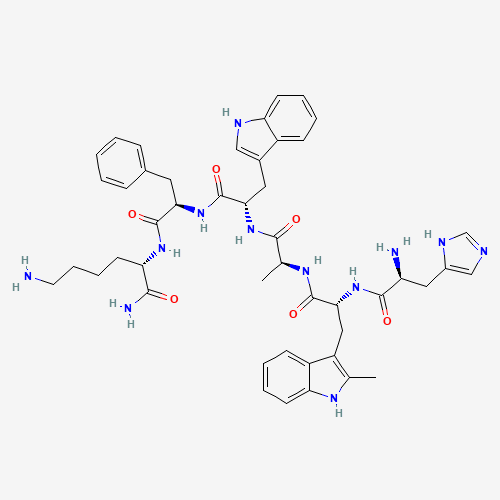
Hexarelin (His-D-2-methylTrp-Ala-Trp-D-Phe-Lys-NH2) is a synthetic analogue of GHRP-6, developed in Italy in the early 1990s. It is the most potent acute growth hormone releaser among the peptide secretagogues that have been tested head to head in people [4].
Acute effect. In 12 healthy young volunteers, 1 ug/kg intravenously released about twice as much growth hormone as 1 ug/kg of GHRH, and 2 ug/kg released more still. The same study measured every route: the subcutaneous route was about 77% as effective as intravenous, intranasal 4.8%, and oral 0.3% [1]. Intranasal hexarelin works, but needs about 20 times the intravenous dose [5].
In older people. The growth hormone response to hexarelin falls with age — about 2,100 vs 4,800 ug.min/L in elderly against young men — but it can be restored: adding arginine brought the elderly response back up to young levels, while adding GHRH potentiated both groups [6]. This is the same pattern seen with GHRP-6, where the response is far better preserved with age than the response to GHRH [7].
Long-term. This is where it falls down. Sixteen weeks of 1.5 ug/kg twice daily subcutaneously cut the growth hormone response to a test dose from 19.1 to 10.5 ug/L.h. Serum IGF-1 and IGF-binding protein-3 did not change over the whole 20-week period, and neither did total body fat, lean mass or bone mineral density. Four weeks after stopping, the growth hormone response was back to baseline [3].
As a diagnostic test. Low-dose hexarelin (0.25 ug/kg) with GHRH produced a mean growth hormone peak of 83.6 ug/L in healthy adults and 2.6 ug/L in hypopituitary adults, separating the groups as well as the insulin tolerance test [2]. Sequential GHRH followed by hexarelin has also been used to probe pituitary reserve [8].
Mechanism
Hexarelin acts at GHS-R1a, the ghrelin receptor, not at the GHRH receptor. The cleanest evidence for where it acts comes from people with a functional pituitary stalk disconnection: their growth hormone response to GHRH is normal, but the response to GH-releasing peptide is completely blocked, and the usual synergy between the two disappears. The main action is therefore hypothalamic [9].
That also explains the synergy with GHRH and with arginine, which works by suppressing somatostatin [6]. Selectivity is poor: at the same doses that release growth hormone, hexarelin raises prolactin, ACTH and cortisol, the last to about the same degree as CRH [4]. This is the difference between hexarelin and ipamorelin, which was designed to avoid it [10].
Beyond the pituitary, hexarelin binds cardiac tissue and has protected the heart in several animal models of infarction and cardiomyopathy [11][12]. None of this has been tested in humans.
- GHS-R1a (ghrelin receptor)activatesreleases growth hormone mainly through a hypothalamic action: in people whose pituitary stalk is functionally disconnected, the GH-releasing peptide response is abolished while the GHRH response is preserved [9]strong
- Growth hormone (acute)activates1 ug/kg intravenously gave an area under the curve of 3,175 ug.min/L against 1,544 for the same dose of GHRH, with a dose-dependent further rise at 2 ug/kg [1]strong
- IGF-1no bindingunchanged over 16 weeks of twice-daily subcutaneous hexarelin, along with IGF-binding protein-3 [3]moderate
- Prolactin, ACTH and cortisolactivateshexarelin and GHRP-2 raise prolactin, ACTH and cortisol to a similar degree; the ACTH and cortisol rise is comparable to that produced by CRH itself [4]moderate
Formulation
how the form changes blood levelsHexarelin is a hexapeptide supplied as an acetate salt. All four routes have been measured against each other in the same volunteers: subcutaneous injection retains about 77% of intravenous activity, a nasal spray about 5%, and an oral dose about 0.3% — which is why the oral studies used 20-40 mg against 1-2 ug/kg intravenously [1].
Dosing
as studied or commonly reported; not a recommendationDoses below are what studies used or, where marked, what is commonly reported. None is a recommendation.
Intravenous
- 1 or 2 ug/kg
- 0.25 ug/kg with GHRH 1 ug/kg
Subcutaneous injection
- 1.5 or 3 ug/kg
- 1.5 ug/kgadults; the only long-term study, looking at IGF-1, bone markers and body compositiontwice daily · 16 weekshuman study[3]
Nasal
- 20 ug/kg
Oral
- 20 or 40 mg
- Form
- Studied as an injection, a nasal spray and an oral dose; the oral dose needed is roughly 20,000 times the intravenous one [1].
- Time to effect
- Acute, within an hour [1]. Nothing measurable happened to IGF-1 or body composition over 16 weeks [3].
- Notes
- The only repeated-dosing study in the literature is 16 weeks of 1.5 ug/kg twice daily, and it found no change in IGF-1, body fat, lean mass or bone mineral density [3].
Pharmacokinetics
what the body does with it| Onset | Growth hormone rises within minutes of an intravenous bolus and the response is highly reproducible within a person [1] |
|---|---|
| Bioavailability | Measured against the intravenous route in healthy volunteers: about 77% subcutaneously, 4.8% intranasally and 0.3% orally [1] |
| Steady state | The opposite of accumulation: the growth hormone response falls progressively, to about half by week 16, and recovers to baseline four weeks after stopping [3] |
Safety
risks and cautions, not medical adviceHuman safety data amount to single doses in small volunteer groups and one 16-week study, which reported no notable problems but also no benefit [3]. Acutely, the main pharmacological concern is the parallel rise in ACTH and cortisol, which is of the same size as that produced by CRH [4], and the rise in prolactin [4].
Repeated dosing produces partial, reversible desensitisation of the pituitary response rather than escalating effect [3]. There is no long-term safety data, no data on glucose, and no data in people using it for body composition.
Interactions
documented pairs only, not exhaustiveHexarelin synergises strongly with GHRH — the combination released far more growth hormone than the sum of each alone in healthy people, and that synergy disappears when the hypothalamus is disconnected from the pituitary [6][9]. Arginine also potentiates it, but only in older people [6]. No interactions with other compounds on this site have been documented.
FAQ
- Is hexarelin stronger than GHRH?
- Acutely, yes — about twice the growth hormone response at the same intravenous dose in healthy young men [1].
- Does it stop working?
- Partly. Over 16 weeks of twice-daily dosing the growth hormone response fell by about half, and recovered four weeks after stopping [3].
- Can it be taken by mouth?
- Only at absurd doses. Oral bioavailability is about 0.3%, so the oral studies used 20-40 mg to approximate a 1-2 ug/kg injection [1].
References
entry last reviewed 2026-09-19- [1]Growth hormone-releasing activity of hexarelin, a new synthetic hexapeptide, after intravenous, subcutaneous, intranasal, and oral administration in man.Ghigo E, Arvat E, Gianotti L et al.J Clin Endocrinol Metab 1994other · humanPMID 8126144◌ unreviewed
- [2]Low dose hexarelin and growth hormone (GH)-releasing hormone as a diagnostic tool for the diagnosis of GH deficiency in adults: comparison with insulin-induced hypoglycemia test.Gasperi M, Aimaretti G, Scarcello G et al.J Clin Endocrinol Metab 1999other · humanPMID 10443652◌ unreviewed
- [3]Growth hormone status during long-term hexarelin therapy.Rahim A, O'Neill PA, Shalet SMJ Clin Endocrinol Metab 1998clinical trial · humanPMID 9589671◌ unreviewed
- [4]Effects of GHRP-2 and hexarelin, two synthetic GH-releasing peptides, on GH, prolactin, ACTH and cortisol levels in man. Comparison with the effects of GHRH, TRH and hCRH.Arvat E, di Vito L, Maccagno B et al.Peptides 1997other · humanPMID 9285939◌ unreviewed
- [5]Growth hormone releasing activity by intranasal administration of a synthetic hexapeptide (hexarelin).Laron Z, Frenkel J, Gil-Ad I et al.Clin Endocrinol (Oxf) 1994other · humanPMID 7955465◌ unreviewed
- [6]Arginine and growth hormone-releasing hormone restore the blunted growth hormone-releasing activity of hexarelin in elderly subjects.Arvat E, Gianotti L, Grottoli S et al.J Clin Endocrinol Metab 1994RCT · humanPMID 7962341◌ unreviewed
- [7]Growth hormone secretion after the administration of GHRP-6 or GHRH combined with GHRP-6 does not decline in late adulthood.Micic D, Popovic V, Kendereski A et al.Clin Endocrinol (Oxf) 1995RCT · humanPMID 7734029◌ unreviewed
- [8]The sequential administration of growth hormone-releasing hormone followed 120 minutes later by hexarelin, as an effective test to assess the pituitary GH reserve in man.Micic D, Popovic V, Kendereski A et al.Clin Endocrinol (Oxf) 1996clinical trial · humanPMID 8977750◌ unreviewed
- [9]Blocked growth hormone-releasing peptide (GHRP-6)-induced GH secretion and absence of the synergic action of GHRP-6 plus GH-releasing hormone in patients with hypothalamopituitary disconnection: evidence that GHRP-6 main action is exerted at the hypothalamic level.Popovic V, Damjanovic S, Micic D et al.J Clin Endocrinol Metab 1995other · humanPMID 7883854◌ unreviewed
- [10]Ipamorelin, the first selective growth hormone secretagogue.Raun K, Hansen BS, Johansen NL et al.Eur J Endocrinol 1998other · animalPMID 9849822◌ unreviewed
- [11]The growth hormone secretagogue hexarelin improves cardiac function in rats after experimental myocardial infarction.Tivesten A, Bollano E, Caidahl K et al.Endocrinology 2000other · animalPMID 10614623◌ unreviewed
- [12]Improvement of cardiomyocyte function by in vivo hexarelin treatment in streptozotocin-induced diabetic rats.Zhang X, Qu L, Chen L et al.Physiol Rep 2018other · animalPMID 29446246◌ unreviewed