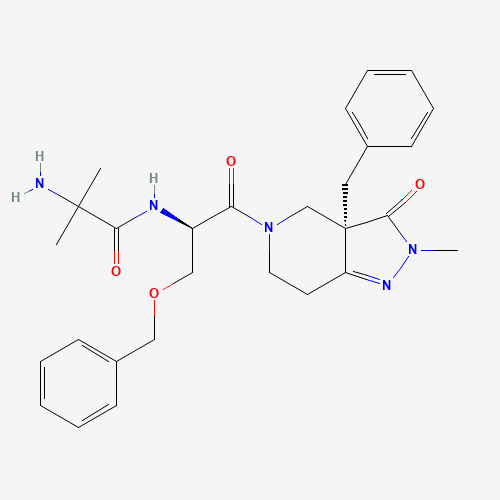
Capromorelin
also Capimorelin · CP-424391 · capromorelina · capromoreline · CP-424,391
Capromorelin is an orally active ghrelin-receptor agonist from the Pfizer pyrazolinone-piperidine series [1]. It has the best human trial of any compound in this group after MK-677: 395 adults aged 65-84 with mild functional limitation, randomised to four dose schedules or placebo. At six months, lean body mass had risen 1.4 kg against 0.3 kg on placebo, and — unusually for this class — a physical performance measure improved, with tandem walk better by 0.9 seconds at 6 months and stair climb by 12 months [2]. Fasting glucose, HbA1c and insulin resistance all rose, and fatigue and insomnia were reported. The human programme was stopped; capromorelin is instead approved as a veterinary appetite stimulant for dogs and cats [3].
The one growth hormone secretagogue that improved a measure of physical function in a large randomised trial in older adults — a finding that was never followed up in humans, though the drug is now sold for dogs.
- meta-analysis
- RCT
- trial
- observational
- preclinical / case
- review / patent / other
- retracted
- + 1.4 kg gain in lean body mass at 6 months against 0.3 kg on placebo, in 395 older adults
- + Tandem walk improved at 6 months and stair climb at 12 months
- + Dose-related, sustained rise in IGF-1 and in peak nocturnal growth hormone
- + Taken by mouth
- − Fasting glucose, HbA1c and insulin resistance all rose
- − Fatigue and insomnia were reported
- − The human programme ended; no trial has run beyond 12 months
- − Now developed and licensed as a veterinary drug, not a human one
Overview
Capromorelin (CP-424,391) came out of a Pfizer programme on pyrazolinone-piperidine dipeptide growth hormone secretagogues [1], and was characterised preclinically as an orally active agonist [4].
The human trial. Three hundred and ninety-five men and women aged 65-84 with mild functional limitation were randomised to one of four capromorelin schedules (10 mg three times weekly, 3 mg twice daily, 10 mg nightly, 10 mg twice daily) or placebo, intended for two years. It was stopped early under pre-specified treatment-effect criteria, but 315 people completed 6 months and 284 completed 12. IGF-1 rose in a sustained, dose-related way in every active group, and peak nocturnal growth hormone rose, most with the least frequent dosing. At 6 months, body weight was up 1.4 kg on capromorelin against a 0.2 kg fall on placebo, and lean body mass up 1.4 kg against 0.3 kg. Tandem walk improved by 0.9 seconds in the pooled treatment groups, and by 12 months stair climb had improved too [2].
That last part is what makes capromorelin unusual. The recurring failure of this whole class is that lean mass goes up and function does not: MK-677 added a kilogram of fat-free mass over a year and changed nothing measurable about strength, walking or stair climbing [5], and two hip-fracture trials missed their functional endpoints [6][7]. Capromorelin's trial reported two functional measures moving. Its own authors put it carefully — capromorelin "may improve body composition and physical function" [2] — and no confirmatory human trial was ever run.
Where it ended up. Human development stopped. Capromorelin was instead developed as a veterinary appetite stimulant, and is licensed for dogs [3]; a randomised study in healthy beagles showed four days of oral dosing raised food intake and body weight [8], and daily dosing has been assessed for safety in cats [9]; its veterinary discovery, efficacy and safety record has been reviewed [10]. It is also used off-label in laboratory primates [11].
Mechanism
Capromorelin is an agonist at GHS-R1a, the ghrelin receptor [1]. Like the other secretagogues it raises growth hormone in pulses, and from there IGF-1 [2]. The receptor's other main effect — appetite — is what the veterinary product is sold for [3].
One detail from the human trial is worth noting: peak nocturnal growth hormone rose most in the group dosed least often, three times a week [2]. That is consistent with the partial desensitisation seen with frequent dosing elsewhere in this class [12], and it suggests less frequent dosing may preserve the growth hormone response better.
Ghrelin-receptor agonists also lower blood pressure, and work in rodents suggests that this happens through a receptor other than GHS-R1a [13][14].
- GHS-R1a (ghrelin receptor)activatesstrong
- Growth hormoneactivatesevery dose raised peak nocturnal growth hormone, and the rise was largest with the least frequent dosing [2]strong
- IGF-1activatesa sustained, dose-related rise in every active treatment group over 12 months [2]strong
- Lean body massactivatesup 1.4 kg at 6 months against 0.3 kg on placebo, with body weight up 1.4 kg against a 0.2 kg loss [2]moderate
- Insulin sensitivityblockssmall increases in fasting glucose, HbA1c and indices of insulin resistance [2]moderate
- Appetiteactivatesfour days of oral capromorelin increased food consumption and body weight in healthy beagles, which is the basis of its veterinary licence [8]strong
Formulation
how the form changes blood levelsCapromorelin is a small molecule, not a peptide, and is orally active [1]. The only licensed product is a veterinary oral solution for dogs [3]. It is detectable in urine, including after dermal exposure — relevant to anyone handling the veterinary solution [15] — and its metabolites have been mapped for doping control [16].
Dosing
as studied or commonly reported; not a recommendationDoses below are what studies used or, where marked, what is commonly reported. None is a recommendation.
Oral
- 10 mgadults aged 65-84 with mild functional limitation (one of four arms)three times a week · up to 12 monthshuman study[2]
- 3 mg
- 10 mg
- 10 mg
- 3 mg/kg
- Form
- Oral; the licensed veterinary product is an oral solution [3].
- Time to effect
- Lean mass and tandem walk had changed by 6 months; stair climb by 12 [2].
- Notes
- The human trial intended two years of treatment but was stopped early under pre-specified treatment-effect criteria; 315 people completed 6 months and 284 completed 12 [2]. No human dose is licensed.
Pharmacokinetics
what the body does with it| Onset | Peak nocturnal growth hormone rose with dosing; the size of the rise was inversely related to how often the drug was given [2] |
|---|---|
| Steady state | IGF-1 rose in a sustained, dose-related way over 12 months of dosing, without the loss of effect seen with some peptide secretagogues [2] |
| Metabolism | Metabolites of capromorelin have been characterised for doping-control purposes [16]; it is also detectable in urine after dermal as well as oral exposure [15] |
Safety
risks and cautions, not medical adviceIn 395 older adults over up to 12 months, the reported adverse events were fatigue, insomnia, and small increases in fasting glucose, glycosylated haemoglobin and indices of insulin resistance [2]. The glucose findings are the same class effect seen with MK-677, where 12 months raised fasting glucose by about 5 mg/dL and HbA1c by 0.2% [5].
The trial was stopped early under pre-specified treatment-effect criteria rather than for safety [2]. There is no human data beyond 12 months. In cats, daily dosing has been evaluated for safety over longer periods [9], but that does not transfer.
Interactions
documented pairs only, not exhaustiveNo human interaction studies. No interactions with other compounds on this site have been documented.
FAQ
- Did capromorelin actually improve physical function?
- Tandem walk improved at 6 months and stair climb at 12, in pooled treatment groups against placebo, in a trial stopped early [2]. It is the only positive functional result in this class, and it was never confirmed.
- Why is it sold for dogs?
- Human development stopped, and the ghrelin receptor's appetite effect made it useful as a veterinary appetite stimulant; it is licensed for dogs [3][8].
- Does it affect blood sugar?
- Yes — fasting glucose, HbA1c and insulin resistance all rose over the trial [2].
References
entry last reviewed 2026-09-19- [1]Pyrazolinone-piperidine dipeptide growth hormone secretagogues (GHSs). Discovery of capromorelin.Carpino PA, Lefker BA, Toler SM et al.Bioorg Med Chem 2003other · animalPMID 12538023◌ unreviewed
- [2]Effects of an oral growth hormone secretagogue in older adults.White HK, Petrie CD, Landschulz W et al.J Clin Endocrinol Metab 2009RCT · humanPMID 19174493◌ unreviewed
- [3]Capromorelin: a ghrelin receptor agonist and novel therapy for stimulation of appetite in dogs.Rhodes L, Zollers B, Wofford JA et al.Vet Med Sci 2018reviewPMID 29468076◌ unreviewed
- [4]Preclinical pharmacology of CP-424,391, an orally active pyrazolinone-piperidine [correction of pyrazolidinone-piperidine] growth hormone secretagogue.Pan LC, Carpino PA, Lefker BA et al.Endocrine 2001other · animalPMID 11322494◌ unreviewed
- [5]Effects of an oral ghrelin mimetic on body composition and clinical outcomes in healthy older adults: a randomized trial.Nass R, Pezzoli SS, Oliveri MC et al.Ann Intern Med 2008RCT · humanPMID 18981485◌ unreviewed
- [6]The effects of MK-0677, an oral growth hormone secretagogue, in patients with hip fracture.Bach MA, Rockwood K, Zetterberg C et al.J Am Geriatr Soc 2004RCT · humanPMID 15066065◌ unreviewed
- [7]MK-0677 (ibutamoren mesylate) for the treatment of patients recovering from hip fracture: a multicenter, randomized, placebo-controlled phase IIb study.Adunsky A, Chandler J, Heyden N et al.Arch Gerontol Geriatr 2011RCT · humanPMID 21067829◌ unreviewed
- [8]Capromorelin oral solution (ENTYCE®) increases food consumption and body weight when administered for 4 consecutive days to healthy adult Beagle dogs in a randomized, masked, placebo controlled study.Zollers B, Rhodes L, Heinen EBMC Vet Res 2017RCT · animalPMID 28056951◌ unreviewed
- [9]Evaluation of the safety of daily administration of capromorelin in cats.Wofford JA, Zollers B, Rhodes L et al.J Vet Pharmacol Ther 2018RCT · animalPMID 29057482◌ unreviewed
- [10]Insights on discovery, efficacy, safety and clinical applications of ghrelin receptor agonist capromorelin in veterinary medicine.Rathore M, Das N, Ghosh N et al.Vet Res Commun 2024reviewPMID 37493940◌ unreviewed
- [11]Evaluating the Safety and Efficacy of Capromorelin in Rhesus Macaques (Macaca mulatta).Campellone GA, Easley KA, Jenkins JB et al.J Am Assoc Lab Anim Sci 2024other · animalPMID 38423529◌ unreviewed
- [12]Growth hormone status during long-term hexarelin therapy.Rahim A, O'Neill PA, Shalet SMJ Clin Endocrinol Metab 1998clinical trial · humanPMID 9589671◌ unreviewed
- [13]Hypotensive effects of ghrelin receptor agonists mediated through a novel receptor.Callaghan B, Kosari S, Pustovit RV et al.Br J Pharmacol 2014other · animalPMID 24670149◌ unreviewed
- [14]Sites of action of ghrelin receptor ligands in cardiovascular control.Callaghan B, Hunne B, Hirayama H et al.Am J Physiol Heart Circ Physiol 2012other · animalPMID 22886413◌ unreviewed
- [15]Detection of capromorelin in urine following oral and dermal routes of administration.Sobolevsky T, Walpurgis K, Goergens C et al.Drug Test Anal 2023other · humanPMID 37688359◌ unreviewed
- [16]Comprehensive insights into the formation of metabolites of the ghrelin mimetics capromorelin, macimorelin and tabimorelin as potential markers for doping control purposes.Lange T, Thomas A, Görgens C et al.Biomed Chromatogr 2021other · humanPMID 33458843◌ unreviewed