CJC-1295
also CJC 1295 · CJC1295 · GRF 1-29 (CJC1295)
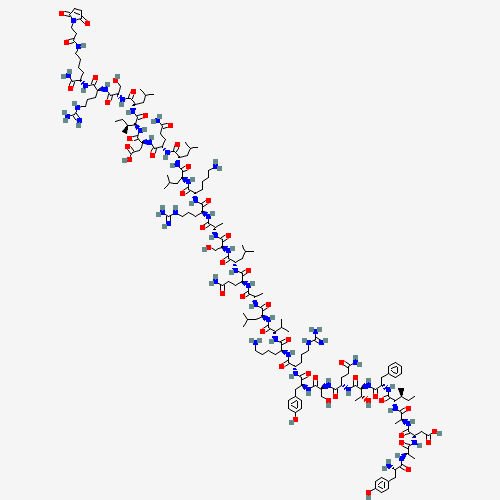
CJC-1295 is GHRH(1-29) with four amino acid substitutions and a maleimide group that makes it latch permanently onto albumin in the bloodstream, stretching a peptide with a four-minute half-life into one lasting almost a week [1]. In the one published human trial, single subcutaneous doses raised growth hormone 2- to 10-fold for six days or more and IGF-1 1.5- to 3-fold for 9-11 days, with an estimated half-life of 5.8-8.1 days [2]. That is the entire human efficacy literature: 28- and 49-day dose-ranging studies in healthy volunteers, with no measurement of muscle, fat, strength or anything else clinical. Confusingly, most of what is sold as "CJC-1295" is the version without the albumin-binding group, which is simply modified GHRH(1-29) and lasts hours, not days [3].
A genuinely clever piece of peptide engineering with one good pharmacology trial behind it and nothing else — and the name on the vial usually refers to a different, short-acting compound.
- meta-analysis
- RCT
- trial
- observational
- preclinical / case
- review / patent / other
- retracted
- + Raises growth hormone 2- to 10-fold for six days or more after a single injection
- + Raises IGF-1 1.5- to 3-fold for 9-11 days, and above baseline for up to 28 days with repeated doses
- + Half-life of about a week means weekly rather than daily injections
- + Works through the pituitary's own GHRH receptor, so secretion stays pulsatile
- − Only one published human trial, in healthy volunteers, with no clinical endpoint
- − Nothing is known about what months of use do
- − Most product sold under this name is the short-acting version without the albumin-binding group
- − Prohibited in sport
Overview
Native GHRH is destroyed in the blood within minutes, mainly by dipeptidyl peptidase-IV, which is why GHRH itself has never been a practical treatment [4]. CJC-1295 is the engineering answer: a tetrasubstituted GHRH(1-29) carrying a maleimide group that reacts with the free thiol on cysteine-34 of serum albumin, so the peptide is effectively carried around attached to a protein that circulates for weeks. In rats, the conjugate appeared on the albumin band within 15 minutes and was still there beyond 24 hours, and gave a fourfold larger growth hormone response than plain GHRH(1-29) [1].
The human trial. Two randomised, placebo-controlled, double-blind ascending-dose studies, of 28 and 49 days, in healthy adults aged 21-61. A single subcutaneous injection raised mean growth hormone 2- to 10-fold, dose-dependently, for six days or more, and IGF-1 1.5- to 3-fold for 9-11 days. The estimated half-life was 5.8-8.1 days. With repeated weekly or biweekly doses, IGF-1 stayed above baseline for up to 28 days, showing a cumulative effect. No serious adverse reactions were reported, and the authors singled out 30 and 60 ug/kg as the best tolerated [2]. A proteomics substudy in 11 young men looked for markers of the resulting GH/IGF-1 activation and found changes in apolipoprotein A1, transthyretin and albumin fragments [5].
That is all the human data there is. Nobody has published what CJC-1295 does to muscle, fat, strength, bone, glucose or any clinical outcome, at any duration.
A naming problem. Two different things are sold as CJC-1295. The compound described above is CJC-1295 with DAC (Drug Affinity Complex), the albumin-binding version that was trialled. "CJC-1295 without DAC" is modified GHRH(1-29) — the same backbone substitutions, no albumin anchor — with a duration of action measured in minutes to hours, and no trial of its own [3]. The pharmacokinetics above apply only to the DAC version. CJC-1295 has been found in seized unlabelled preparations [6] and is prohibited in sport under section S2 of the WADA list [6].
Mechanism
CJC-1295 activates the pituitary GHRH receptor, the same receptor as sermorelin and tesamorelin [1]. Because it works upstream, the pituitary still releases growth hormone in pulses and the normal negative feedback through IGF-1 and somatostatin remains in place — the usual argument for secretagogues over injected growth hormone.
Its novelty is entirely pharmacokinetic. Four substitutions in the GHRH(1-29) backbone block enzymatic degradation, and a maleimidopropionamide on the C-terminal lysine forms a covalent bond with albumin in the bloodstream [1]. A single D-Ala2 substitution alone already cuts metabolic clearance roughly in half and lengthens the half-life from 4.3 to 6.7 minutes [4]; the albumin conjugation takes it to days.
The open question is whether continuous stimulation of the GHRH receptor is a good idea. In children given GHRH(1-29) by continuous subcutaneous infusion, the 24-hour growth hormone output rose at first and then fell below where it started by six months, with pituitary desensitisation and GHRH antibodies among the suspected causes [7]. CJC-1295 holds GHRH receptor stimulation up for days at a time, and no study has run long enough to see whether the same thing happens.
- GHRH receptor (pituitary)activatesthe albumin conjugate is still active at the GHRH receptor on rat anterior pituitary cells, and gave a fourfold larger growth hormone area under the curve than unmodified GHRH(1-29) over two hours [1]strong
- Dipeptidyl peptidase-IVno bindingthe modifications make the peptide resistant to DPP-IV, the enzyme that destroys native GHRH within minutes [1]moderate
- Growth hormoneactivatesmean plasma growth hormone rose 2- to 10-fold in a dose-dependent way and stayed up for six days or more after one subcutaneous injection [2]strong
- IGF-1activatesrose 1.5- to 3-fold for 9-11 days after a single dose, and stayed above baseline for up to 28 days after repeated doses [2]strong
Formulation
how the form changes blood levelsCJC-1295 with DAC is a 29-amino-acid peptide with four substitutions plus an N-epsilon-3-maleimidopropionamide lysine at the C terminus, which is the part that binds albumin [1]. The version sold as "CJC-1295 without DAC", also called modified GRF(1-29), lacks that group and lasts hours rather than days [3]. Anything sold under the bare name CJC-1295 may be either; there is no way to tell from the label. Analytical methods now exist to detect GHRH analogues in urine at picogram levels [8].
Dosing
as studied or commonly reported; not a recommendationDoses below are what studies used or, where marked, what is commonly reported. None is a recommendation.
Subcutaneous injection
- ascending single doses; 30 or 60 ug/kg were best tolerated
- 30 or 60 ug/kghealthy adults; repeated dosing and cumulative IGF-1 effecttwo or three doses, weekly or every two weeks · 49-day studyhuman study[2]
- Form
- The trialled compound is CJC-1295 with the Drug Affinity Complex, the albumin-binding version. Product sold as CJC-1295 'without DAC' is modified GHRH(1-29) and does not share these pharmacokinetics [3].
- Time to effect
- Growth hormone within a day, IGF-1 within days, both from a single injection [2].
- Notes
- The only published human doses are the dose-ranging regimens above, given to healthy volunteers for at most 49 days. No human study has measured body composition, strength or any clinical outcome on CJC-1295, so no dose for those purposes has been established.
Pharmacokinetics
what the body does with it| Half-life | Estimated at 5.8-8.1 days in healthy adults, against about 4 minutes for unmodified GHRH(1-29) [2][4] |
|---|---|
| Onset | Growth hormone is raised within the first day and stays raised for six days or more after a single dose [2] |
| Steady state | Repeated weekly or biweekly dosing produced a cumulative effect, with IGF-1 above baseline for up to 28 days [2] |
| Metabolism | Binds covalently to cysteine-34 of circulating albumin within 15 minutes of injection and stays attached beyond 24 hours in rats, which is what produces the long half-life [1] |
Safety
risks and cautions, not medical adviceThe trial reported no serious adverse reactions across both studies, and named 30 and 60 ug/kg as the doses that were tolerated best — implying the higher doses were tolerated less well, though the abstract does not detail how [2]. The full text was not available for this entry.
Beyond that, human safety data do not exist. There is nothing on glucose, nothing on months of use, nothing on what sustained IGF-1 elevation does. A 2026 review of this whole class notes the adverse effects seen across GHRH analogues and secretagogues — fluid retention, joint and muscle pain, injection-site reactions, dysglycaemia, and raised prolactin and cortisol with some agents — and the general problem that products bought outside a pharmacy may not contain what the label says [3].
- One published human efficacy trial, in healthy volunteers, at most 49 days long [2]
- No human measurement of muscle, fat, strength, bone or glucose
- The long-acting version that was trialled is not usually what is sold under the name [3]
- Continuous GHRH receptor stimulation caused the growth hormone response to fall over months in a separate study of infused GHRH(1-29) [7]
Interactions
documented pairs only, not exhaustiveNo human interaction studies exist. GHRH analogues and ghrelin-receptor agonists are synergistic on growth hormone release [9], which is the basis for the common practice of combining CJC-1295 with ipamorelin, but no trial has tested that combination.
FAQ
- What is the difference between CJC-1295 with and without DAC?
- The DAC version carries a group that binds covalently to albumin, giving a half-life of about a week [1][2]. Without DAC it is modified GHRH(1-29), which acts for hours. Only the DAC version has human trial data [3].
- How long does one injection last?
- Growth hormone stayed raised for six days or more and IGF-1 for 9-11 days after a single subcutaneous dose [2].
- Does it build muscle?
- No published human study has measured muscle, fat or strength on CJC-1295. The trial data stop at growth hormone and IGF-1 [2].
References
entry last reviewed 2026-09-19- [1]Human growth hormone-releasing factor (hGRF)1-29-albumin bioconjugates activate the GRF receptor on the anterior pituitary in rats: identification of CJC-1295 as a long-lasting GRF analog.Jetté L, Léger R, Thibaudeau K et al.Endocrinology 2005other · humanPMID 15817669◌ unreviewed
- [2]Prolonged stimulation of growth hormone (GH) and insulin-like growth factor I secretion by CJC-1295, a long-acting analog of GH-releasing hormone, in healthy adults.Teichman SL, Neale A, Lawrence B et al.J Clin Endocrinol Metab 2006RCT · humanPMID 16352683◌ unreviewed
- [3]The emerging landscape of performance-enhancing peptides modulating GH-IGF1 axis: bridging the gap between clinical evidence and patient self-administration.Dominikowski A, Rękoś Z, Olejarz M et al.Front Endocrinol (Lausanne) 2026reviewPMID 42395176◌ unreviewed
- [4]Incorporation of D-Ala2 in growth hormone-releasing hormone-(1-29)-NH2 increases the half-life and decreases metabolic clearance in normal men.Soule S, King JA, Millar RPJ Clin Endocrinol Metab 1994other · humanPMID 7962295◌ unreviewed
- [5]Activation of the GH/IGF-1 axis by CJC-1295, a long-acting GHRH analog, results in serum protein profile changes in normal adult subjects.Sackmann-Sala L, Ding J, Frohman LA et al.Growth Horm IGF Res 2009other · humanPMID 19386527◌ unreviewed
- [6]Identification of CJC-1295, a growth-hormone-releasing peptide, in an unknown pharmaceutical preparation.Henninge J, Pepaj M, Hullstein I et al.Drug Test Anal 2010otherPMID 21204297◌ unreviewed
- [7]Growth hormone (GH) profiles in response to continuous subcutaneous infusion of GH-releasing hormone(1-29)-NH2 in children with GH deficiency.Tauber MT, Pienkowski C, Pigeon P et al.Acta Paediatr Suppl 1993clinical trial · humanPMID 8329829◌ unreviewed
- [8]An antibody-free, ultrafiltration-based assay for the detection of growth hormone-releasing hormones in urine at low pg/mL concentrations using nanoLC-HRMS/MS.Coppieters G, Deventer K, Polet M et al.J Pharm Biomed Anal 2022otherPMID 35298973◌ unreviewed
- [9]Blocked growth hormone-releasing peptide (GHRP-6)-induced GH secretion and absence of the synergic action of GHRP-6 plus GH-releasing hormone in patients with hypothalamopituitary disconnection: evidence that GHRP-6 main action is exerted at the hypothalamic level.Popovic V, Damjanovic S, Micic D et al.J Clin Endocrinol Metab 1995other · humanPMID 7883854◌ unreviewed