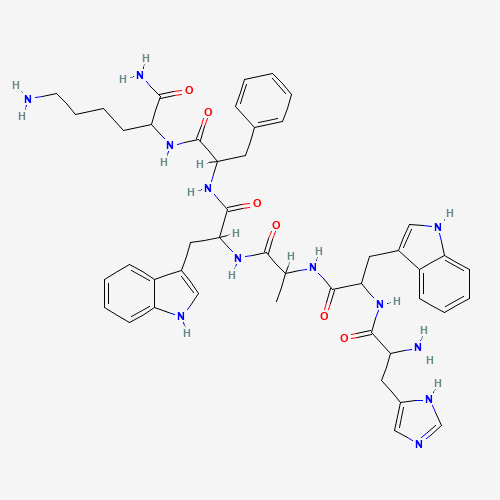
GHRP-6
also GHRP-2 Acetate · h-his-d-trp-ala-trp-d-phe-lys-nh2 · orb341840 · GTPL1093 · PGH-3694-PI
GHRP-6 is the original growth hormone-releasing peptide, the compound whose receptor turned out to be the ghrelin receptor. In people it releases about three times as much growth hormone as GHRH, and combining the two is strongly synergistic [1]. Unusually for a growth hormone stimulus, the response barely declines with age [2]. Its pharmacokinetics are known: after an intravenous bolus the distribution half-life is about 7.6 minutes and elimination about 2.5 hours [3]. What does not exist is any trial of what taking it for weeks or months does to IGF-1, muscle or fat in healthy people; it also raises ACTH and cortisol [4], and it makes people hungry.
Historically the most important compound in this class and pharmacologically well described, but the entire human literature is acute endocrine testing — nothing shows it changes body composition.
- meta-analysis
- RCT
- trial
- observational
- preclinical / case
- review / patent / other
- retracted
- + Releases about three times as much growth hormone as GHRH in healthy adults
- + The response is essentially undiminished in late adulthood, unlike GHRH
- + Strongly synergistic with GHRH
- + Human pharmacokinetics have been measured properly
- − Raises ACTH and cortisol
- − Stimulates appetite through the ghrelin receptor
- − No human study of IGF-1, lean mass or fat beyond acute testing
- − Requires injection; banned in sport and detectable in urine
Overview
GHRP-6 (His-D-Trp-Ala-Trp-D-Phe-Lys-NH2) is the compound that started this field. It was built from opioid peptide fragments in the search for a growth hormone releaser that did not work through GHRH, and the receptor it acts on — the growth hormone secretagogue receptor — was later shown to be the receptor for ghrelin.
How strong it is. In 11 healthy adults, 90 ug intravenously produced a growth hormone area under the curve of 1,435 against 484 for 100 ug of GHRH. Given together, the response was 3,772, significantly more than the sum of the two given separately [1].
Where it acts. The same study gave the answer. In 12 patients whose pituitary was functionally disconnected from the hypothalamus, the GHRH response was normal but the GHRP-6 response was completely blocked, and the synergy disappeared. The main site of action is therefore the hypothalamus [1].
Age. Growth hormone secretion declines with age, and so does the response to GHRH. The response to GHRP-6 does not: in young and late-adulthood groups, GHRP-6 alone and GHRP-6 plus GHRH produced statistically indistinguishable responses, while GHRH alone was weaker in the older group. The authors read this as evidence that the age-related decline is functional and reversible [2].
Pharmacokinetics. Nine healthy men received 100, 200 or 400 ug/kg intravenously. Disposition was biexponential with a distribution half-life of 7.6 minutes and an elimination half-life of 2.5 hours, and area under the curve rose in proportion to dose [3].
Other settings. GHRP-6 has been used with GHRH to probe pituitary reserve in polycystic ovary syndrome [5] and in type 2 diabetes, where hyperglycaemia blunted the response [6]. A Cuban group has pursued it as a tissue-protective agent, reporting benefit in animal models of acute lung injury [7]; none of that work has reached controlled human trials.
Mechanism
GHRP-6 activates GHS-R1a. Because most of its effect is hypothalamic [1], it works partly by opposing somatostatin and partly by releasing endogenous GHRH, which is why the combination with GHRH is supra-additive rather than simply additive. The same logic explains why arginine, which suppresses somatostatin, potentiates peptides of this class in older people [8].
The receptor's other job is appetite: it is ghrelin's receptor, so appetite stimulation comes with the growth hormone release. Selectivity for growth hormone is poor — ACTH and cortisol rise too [4] — and it was precisely this that later peptides were designed to avoid [9]. The pharmacology of the whole GH-releasing peptide family was reviewed in detail as it emerged [10]. Structure-activity studies across the family map which residues carry which effect [11].
- GHS-R1a (ghrelin receptor)activatesGHRP-6 was the peptide used to find this receptor; its growth hormone effect is exerted mainly at the hypothalamus, and is abolished in people with a functional pituitary stalk disconnection [1]strong
- Growth hormone (acute)activates90 ug intravenously gave a growth hormone area under the curve of 1,435 ug/L per 120 min against 484 for 100 ug GHRH; the two together gave 3,772, more than their sum [1]strong
- Growth hormone in older adultsactivatesthe response to GHRP-6, alone or with GHRH, did not differ significantly between adults around 22 and around 60, while the response to GHRH alone did fall with age [2]moderate
- ACTH and cortisolactivatesmoderate
Formulation
how the form changes blood levelsGHRP-6 is a hexapeptide of molecular weight about 872 Da, supplied as an acetate salt; the published human route is intravenous [3]. Products sold on the grey market as growth peptides frequently do not contain what their labels claim [12]. GHRP-6 and GHRP-2 are both detectable in urine and are prohibited in sport [13].
Dosing
as studied or commonly reported; not a recommendationDoses below are what studies used or, where marked, what is commonly reported. None is a recommendation.
Intravenous
- 90 ughealthy adults and patients with hypothalamic-pituitary disconnectionsingle bolus, alone or with GHRH 100 ug · acutehuman study[1]
- 90 ughealthy adults around 22 and around 60 years oldsingle bolus, alone or with GHRH 100 ug · acutehuman study[2]
- 100, 200 or 400 ug/kg
- 1 ug/kg
- 1 ug/kgpeople with type 2 diabetes during euglycaemic and hyperglycaemic clampsingle bolus with GHRH · acutehuman study[6]
- Time to effect
- Acute; growth hormone peaks within the first hour [1].
- Notes
- Every published human dose is a single injection given for endocrine testing. No human study has given GHRP-6 repeatedly to see what happens to IGF-1 or body composition, so no dose for that purpose has been studied.
Pharmacokinetics
what the body does with it| Half-life | Disposition after an intravenous bolus is biexponential: distribution half-life 7.6 ± 1.9 minutes, elimination half-life 2.5 ± 1.1 hours, averaged across 100, 200 and 400 ug/kg in nine healthy men [3] |
|---|---|
| Onset | Growth hormone rises within minutes of the bolus [1] |
| Peak level | Area under the curve rose roughly in proportion to dose over 100-400 ug/kg [3] |
| Metabolism | As a small peptide it is degraded by plasma and tissue peptidases; serum stability of GHRP-family peptides has been profiled for doping-control purposes [14] |
| Excretion | Excreted in urine in amounts detectable by the tests used in sport [13] |
Safety
risks and cautions, not medical adviceThe human record is single intravenous doses, up to 400 ug/kg, in small groups of healthy volunteers and patients, with no serious adverse effects reported [1][3]. That is not a safety dataset for repeated use.
The known pharmacological effects to expect are increased appetite, and a rise in ACTH and cortisol at growth hormone-releasing doses [4]. Hexarelin, a close analogue, loses about half its growth hormone effect over 16 weeks of twice-daily dosing [15], and the same is likely here, though it has not been measured. There is no data on glucose, IGF-1 over time, or long-term outcomes.
- Raises ACTH and cortisol [4]
- Increases appetite, through the same receptor ghrelin uses
- Not approved for any use; detectable in urine and banned in sport [13]
- Acute growth hormone release is well documented; nothing beyond it is
Interactions
documented pairs only, not exhaustiveGHRP-6 and GHRH are strongly synergistic, and that synergy depends on an intact hypothalamus [1]. High blood glucose blunts the growth hormone response to the combination [6]. No interactions with other compounds on this site have been documented.
FAQ
- What makes GHRP-6 different from GHRH?
- It acts at the ghrelin receptor, mostly in the hypothalamus, rather than at the GHRH receptor in the pituitary — which is why the two together release far more growth hormone than either alone [1].
- Does it still work in older people?
- Acutely, yes. Unlike GHRH, the growth hormone response to GHRP-6 did not differ significantly between adults around 22 and around 60 [2].
- How long does it stay in the blood?
- Distribution half-life about 7.6 minutes, elimination half-life about 2.5 hours after an intravenous bolus [3].
References
entry last reviewed 2026-09-19- [1]Blocked growth hormone-releasing peptide (GHRP-6)-induced GH secretion and absence of the synergic action of GHRP-6 plus GH-releasing hormone in patients with hypothalamopituitary disconnection: evidence that GHRP-6 main action is exerted at the hypothalamic level.Popovic V, Damjanovic S, Micic D et al.J Clin Endocrinol Metab 1995other · humanPMID 7883854◌ unreviewed
- [2]Growth hormone secretion after the administration of GHRP-6 or GHRH combined with GHRP-6 does not decline in late adulthood.Micic D, Popovic V, Kendereski A et al.Clin Endocrinol (Oxf) 1995RCT · humanPMID 7734029◌ unreviewed
- [3]Pharmacokinetic study of Growth Hormone-Releasing Peptide 6 (GHRP-6) in nine male healthy volunteers.Cabrales A, Gil J, Fernández E et al.Eur J Pharm Sci 2013clinical trial · humanPMID 23099431◌ unreviewed
- [4]Effects of GHRP-2 and hexarelin, two synthetic GH-releasing peptides, on GH, prolactin, ACTH and cortisol levels in man. Comparison with the effects of GHRH, TRH and hCRH.Arvat E, di Vito L, Maccagno B et al.Peptides 1997other · humanPMID 9285939◌ unreviewed
- [5]Growth hormone response to GHRH, GHRP-6 and GHRH + GHRP-6 in patients with polycystic ovary syndrome.Micić D, Kendereski A, Popović V et al.Clin Endocrinol (Oxf) 1996other · humanPMID 8959075◌ unreviewed
- [6]Growth hormone response to GHRH + GHRP-6 in type 2 diabetes during euglycemic and hyperglycemic clamp.Micic D, Kendereski A, Sumarac-Dumanovic M et al.Diabetes Res Clin Pract 2004clinical trial · humanPMID 14693411◌ unreviewed
- [7]Growth hormone releasing peptide-6 (GHRP-6) ameliorates acute lung injury and its subsequent evolvement to interstitial fibrosis.Wang L, Berlanga-Acosta J, Yu H et al.Int Immunopharmacol 2026other · animalPMID 41534456◌ unreviewed
- [8]Arginine and growth hormone-releasing hormone restore the blunted growth hormone-releasing activity of hexarelin in elderly subjects.Arvat E, Gianotti L, Grottoli S et al.J Clin Endocrinol Metab 1994RCT · humanPMID 7962341◌ unreviewed
- [9]Ipamorelin, the first selective growth hormone secretagogue.Raun K, Hansen BS, Johansen NL et al.Eur J Endocrinol 1998other · animalPMID 9849822◌ unreviewed
- [10]Growth hormone-releasing peptides and their analogs.Camanni F, Ghigo E, Arvat EFront Neuroendocrinol 1998reviewPMID 9465289◌ unreviewed
- [11]Structure-activity relationship for peptídic growth hormone secretagogues.Ferro P, Krotov G, Zvereva I et al.Drug Test Anal 2017other · cellPMID 26811125◌ unreviewed
- [12]Analysis of new growth promoting black market products.Krug O, Thomas A, Malerød-Fjeld H et al.Growth Horm IGF Res 2018other · humanPMID 29864719◌ unreviewed
- [13]Detection of GHRP-2 and GHRP-6 in urine samples from athletes.Cox HD, Hughes CM, Eichner DDrug Test Anal 2015other · humanPMID 25809000◌ unreviewed
- [14]In-house standards derived from doping peptides: Enzymatic and serum stability and degradation profile of GHRP and GHRH-related peptides.González-López NM, Guerra-Acero-Turizo LM, Blanco-Medina I et al.Biomed Chromatogr 2023other · cellPMID 37688464◌ unreviewed
- [15]Growth hormone status during long-term hexarelin therapy.Rahim A, O'Neill PA, Shalet SMJ Clin Endocrinol Metab 1998clinical trial · humanPMID 9589671◌ unreviewed