GHRP-2
also Pralmorelin · KP-102 · pralmorelina · pralmoreline · KP 102
GHRP-2 (pralmorelin) is a synthetic hexapeptide that releases growth hormone through the ghrelin receptor, about as strongly as hexarelin and more strongly than GHRH [1]. Japan licensed it as a single-dose diagnostic test for growth hormone deficiency, and that is essentially its whole clinical career. It is not selective: at growth hormone-releasing doses it also raises prolactin, and raises ACTH and cortisol about as much as CRH does [1]. Repeated dosing over days to weeks produces complex changes in the growth hormone axis, including desensitisation depending on dose and frequency [2]. There is no controlled trial of GHRP-2 for muscle, fat or strength in healthy people.
A potent, well-characterised acute growth hormone releaser used as a diagnostic agent, with no controlled evidence for any of the body-composition claims made for it and a documented effect on cortisol.
- meta-analysis
- RCT
- trial
- observational
- preclinical / case
- review / patent / other
- retracted
- + Releases more growth hormone acutely than an equal dose of GHRH
- + The response is largely preserved in older people, unlike the response to GHRH
- + Synergises strongly with GHRH and with arginine
- − Raises ACTH and cortisol about as much as CRH
- − Raises prolactin
- − The growth hormone response can desensitise with repeated dosing
- − No controlled trial of body composition, strength or IGF-1 over time in healthy adults
Overview
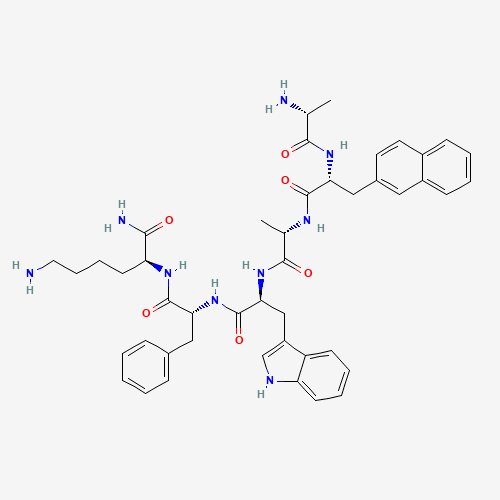
GHRP-2 (D-Ala-D-beta-Nal-Ala-Trp-D-Phe-Lys-NH2), also called pralmorelin, is a synthetic "super-analogue" of GHRP-6 [1]. Like the rest of the family it acts at the ghrelin receptor, mostly at the hypothalamic level [3].
Acute potency. Compared head to head with hexarelin in six healthy young adults, 1 and 2 ug/kg intravenously produced near-identical growth hormone responses, both larger than the response to 1 ug/kg GHRH. In healthy people aged 66-73, both peptides again performed similarly [1]. In pigs, GHRP-2 was the most potent of the family tested, though with a lower maximum response than GHRP-6 or ipamorelin [4].
Synergy. GHRP-2 combines supra-additively with L-arginine in men and women, at rest and during exercise, with the rank order arginine+GHRP-2 > GHRP-2 > arginine > saline [5]. The same synergy holds with GHRH [2].
Repeated dosing. Bowers gave healthy younger and older adults GHRP-2, GHRH or both for 7-30 days. Chronic dosing with either changed the relationship between them, turning an additive combined response into a synergistic one, and whether the response desensitised depended on how much was given and how often [2].
In illness. A 21-hour infusion in patients with prolonged critical illness restored the normal temporal coupling between growth hormone, TSH and prolactin secretion, which infusions of GHRH or TRH did not [6].
What is missing is any trial of the thing people take it for. There is no controlled study of GHRP-2 on lean mass, fat mass, strength or sustained IGF-1 in healthy adults.
Mechanism
GHRP-2 is a GHS-R1a agonist. The receptor sits in both the pituitary and the hypothalamus, and the hypothalamic component dominates: in patients with a functional stalk disconnection, GH-releasing peptide produces essentially no growth hormone while GHRH still works normally, and the usual synergy between the two vanishes [3].
Selectivity is the weak point of this generation of peptides. Structure-activity work across the family shows growth hormone release and ACTH release can be separated by small changes in the peptide [7], but GHRP-2 itself has not been separated: its ACTH and cortisol response is about as large as CRH's [1]. In mice, GHRP-2 stimulates both secretion and synthesis of ACTH in the pituitary directly [8].
- GHS-R1a (ghrelin receptor)activatesreleases growth hormone largely through a hypothalamic action; the response is abolished in people whose pituitary is functionally disconnected from the hypothalamus [3]strong
- Growth hormone (acute)activates1 ug/kg intravenously produced a larger growth hormone response than 1 ug/kg GHRH in young adults, and 2 ug/kg more still; the response in elderly subjects was similar to hexarelin's [1]strong
- ACTH and cortisolactivatesrose about as much as after CRH, at the same doses used to release growth hormone [1]moderate
- Prolactinactivatesrises, though less than after TRH [1]weak
- Pituitary hormone synchronymodulatesa 21-hour infusion in prolonged critical illness re-synchronised growth hormone, TSH and prolactin release, which GHRH and TRH infusions did not [6]moderate
Formulation
how the form changes blood levelsGHRP-2 is a hexapeptide, usually supplied as the acetate. The published human route is intravenous, by bolus or infusion [1][6]; in Japan it has been used as a single-dose diagnostic injection. Peptides in this family are routinely found in grey-market "growth" products, and an analysis of such products found contents that did not match their labels [9]. Urinary tests for GHRP-2 and GHRP-6 exist and are used in sport [10].
Dosing
as studied or commonly reported; not a recommendationDoses below are what studies used or, where marked, what is commonly reported. None is a recommendation.
Intravenous
Subcutaneous injection
- not reported in a form usable herehealthy younger and older men and women; interaction with GHRH and somatostatindaily for 7-30 days · 7-30 dayshuman study[2]
- Time to effect
- Acute. No study has followed IGF-1 or body composition on GHRP-2 over months.
- Notes
- The 7-30 day study reports the design but not a dose in a form that can be quoted here, and its full text was not available [2]. No human trial has tested GHRP-2 for muscle, fat or strength, so no dose for those purposes has been studied.
Pharmacokinetics
what the body does with it| Onset | Growth hormone rises within minutes of an intravenous bolus, peaking within the first hour [1] |
|---|---|
| Steady state | Whether the response desensitises with continued dosing depends on dose and frequency; chronic GHRP-2 also changes the way the axis responds to GHRH, converting an additive response into a synergistic one [2] |
Safety
risks and cautions, not medical adviceHuman exposure in the published literature is almost entirely single intravenous doses in small volunteer groups, plus infusions in intensive care and up to 30 days of dosing in Bowers's studies [1][2][6]. No serious adverse effects are reported in those settings, but they are far too small and short to establish safety for ongoing use.
The predictable pharmacological problems are the cortisol and prolactin rises that come with every dose [1], and desensitisation of the growth hormone response with frequent dosing [2] — the same pattern hexarelin shows clearly over 16 weeks [11]. There are no published data on glucose, on IGF-1 over months, or on any long-term outcome.
- Not approved outside its diagnostic use; everything sold for body composition is unlicensed
- Detectable in urine and banned in sport [10]
Interactions
documented pairs only, not exhaustiveGHRP-2 synergises with GHRH and with L-arginine on growth hormone release [2][5], and exercise potentiates its effect while shrinking the relative size of the synergy [5]. Its action requires an intact hypothalamus [3]. No interactions with other compounds on this site have been documented.
FAQ
- Does GHRP-2 raise cortisol?
- Yes. At the doses that release growth hormone it raises ACTH and cortisol about as much as CRH does [1].
- Is it better than GHRP-6?
- It is more potent per microgram, but in a direct comparison in pigs its maximum growth hormone response was lower [4], and no human study compares them for anything beyond an acute spike.
- Does it build muscle?
- No human trial has measured that. The claim rests entirely on the acute growth hormone response [1].
References
entry last reviewed 2026-09-19- [1]Effects of GHRP-2 and hexarelin, two synthetic GH-releasing peptides, on GH, prolactin, ACTH and cortisol levels in man. Comparison with the effects of GHRH, TRH and hCRH.Arvat E, di Vito L, Maccagno B et al.Peptides 1997other · humanPMID 9285939◌ unreviewed
- [2]GHRP-2, GHRH and SRIF interrelationships during chronic administration of GHRP-2 to humans.Bowers CY, Granda-Ayala RJ Pediatr Endocrinol Metab 1996clinical trial · humanPMID 8887169◌ unreviewed
- [3]Blocked growth hormone-releasing peptide (GHRP-6)-induced GH secretion and absence of the synergic action of GHRP-6 plus GH-releasing hormone in patients with hypothalamopituitary disconnection: evidence that GHRP-6 main action is exerted at the hypothalamic level.Popovic V, Damjanovic S, Micic D et al.J Clin Endocrinol Metab 1995other · humanPMID 7883854◌ unreviewed
- [4]Ipamorelin, the first selective growth hormone secretagogue.Raun K, Hansen BS, Johansen NL et al.Eur J Endocrinol 1998other · animalPMID 9849822◌ unreviewed
- [5]Synergy of L-arginine and GHRP-2 stimulation of growth hormone in men and women: modulation by exercise.Wideman L, Weltman JY, Patrie JT et al.Am J Physiol Regul Integr Comp Physiol 2000clinical trial · humanPMID 11004017◌ unreviewed
- [6]Growth hormone-releasing peptide-2 infusion synchronizes growth hormone, thyrotrophin and prolactin release in prolonged critical illness.Van den Berghe G, Wouters P, Bowers CY et al.Eur J Endocrinol 1999RCT · humanPMID 10037246◌ unreviewed
- [7]Structure-activity relationship for peptídic growth hormone secretagogues.Ferro P, Krotov G, Zvereva I et al.Drug Test Anal 2017other · cellPMID 26811125◌ unreviewed
- [8]Growth hormone-releasing peptide-2 stimulates secretion and synthesis of adrenocorticotropic hormone in mouse pituitary.Kageyama K, Kushibiki M, Hanada K et al.Regul Pept 2009other · animalPMID 19682503◌ unreviewed
- [9]Analysis of new growth promoting black market products.Krug O, Thomas A, Malerød-Fjeld H et al.Growth Horm IGF Res 2018other · humanPMID 29864719◌ unreviewed
- [10]Detection of GHRP-2 and GHRP-6 in urine samples from athletes.Cox HD, Hughes CM, Eichner DDrug Test Anal 2015other · humanPMID 25809000◌ unreviewed
- [11]Growth hormone status during long-term hexarelin therapy.Rahim A, O'Neill PA, Shalet SMJ Clin Endocrinol Metab 1998clinical trial · humanPMID 9589671◌ unreviewed