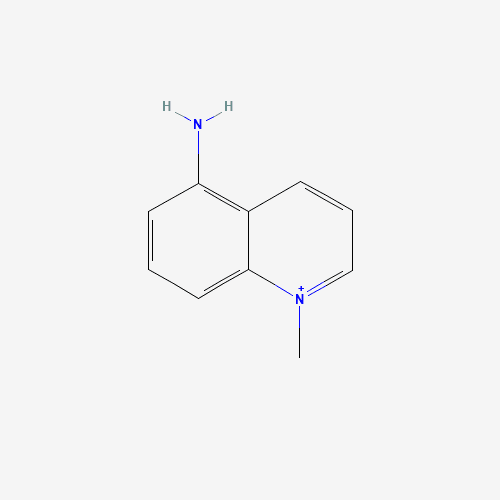
5-Amino-1MQ
also 5-Amino-1-methylquinolinium · 5A1MQ · 5-AMQ · 5A-1MQ
5-Amino-1MQ is a small-molecule inhibitor of nicotinamide N-methyltransferase (NNMT) [1], an enzyme that is more active in the fat and liver of obese mice [2]. In obese mice, injections reduced body weight and fat without lowering food intake [3][4]. In old mice they improved muscle repair and grip strength [5][6]. No study has given it to people, and nearly all of the published work comes from one group linked to the company developing it [4].
A tidy mouse story from essentially one lab, with no human data and a real question over whether the capsules sold online are absorbed at all.
- meta-analysis
- RCT
- trial
- observational
- preclinical / case
- review / patent / other
- retracted
- + Reduced body weight and fat in obese mice without changing food intake
- + Improved muscle regeneration and grip strength in old mice
- + Reduced fatty liver and high insulin in obese mice
- − Never tested in humans
- − Oral bioavailability was 3.5% in mice
- − Almost all studies come from the developer's own group
Overview
5-Amino-1MQ (5-amino-1-methylquinolinium) came out of a University of Texas programme that screened small quinolinium molecules against NNMT. The quinoliniums were the most potent scaffold, inhibiting the enzyme at around 1 µM [1]. 5-Amino-1MQ crossed cell membranes well, did not inhibit related methyltransferases or NAD+ salvage enzymes, and was chosen for animal work [3].
Obesity and fatty liver in mice.
- In diet-induced obese mice given 20 mg/kg three times a day for 11 days, controls gained about 1.4% of body weight and treated mice lost about 5.1%. Food intake did not differ, fat pads and fat cells were smaller, and plasma cholesterol was lower [3].
- Over 30 days, 32 mg/kg once daily held weight gain to 0.9 g against 5.4 g in controls. It also improved glucose tolerance, reduced fatty liver and normalised liver enzymes. The 10 mg/kg dose did not limit weight gain [4].
- Added to a switch from a high-fat to a lean diet, it roughly doubled weight loss and increased fat loss about tenfold compared with the diet switch alone (about 29% versus 3% of fat mass) [7].
Ageing muscle in mice. In 24-month-old mice with an injured leg muscle, treatment increased muscle stem cell activity, nearly doubled the size of regenerating fibres and raised peak torque by about 70% [5]. In a later study, 8 weeks of treatment gave old sedentary mice about 40% more grip strength than controls, against 20% for exercise alone and 60% for the two combined [6].
Human evidence. None. No trial has given 5-amino-1MQ to people. A 2026 review of NNMT inhibitors says the field has been held back by weak target engagement, poor bioavailability and unknown safety, and that newer compounds are trying to fix this [8].
Who did the research. Almost every study above comes from the same University of Texas group. Several authors are employees or founders of Ridgeline Therapeutics, which develops NNMT inhibitors [4][6][7].
Mechanism
NNMT transfers a methyl group from S-adenosylmethionine (SAM) to nicotinamide, a form of vitamin B3. The product, 1-methylnicotinamide, cannot be recycled into NAD+. In mice, NNMT is more active in the fat and liver of obese animals, and knocking the enzyme down with antisense drugs protected against diet-induced obesity by raising energy expenditure. Fat tissue SAM and NAD+ rose [2]. Knocking out the gene gave a less clear picture. It improved insulin sensitivity in male mice on a high-fat diet, and cut weight gain in female mice on a Western diet, but did not improve glucose tolerance [9].
5-Amino-1MQ is meant to copy the knockdown with a drug. In fat cells in culture it lowered 1-methylnicotinamide, raised NAD+ and SAM, and suppressed fat synthesis [3]. In muscle cells it shifted the NAD+/NADH balance and promoted differentiation [5]. After injection in mice it reached fat, muscle and liver. At 1 hour after a dose, 1-methylnicotinamide was about 70% lower in fat and 40% lower in muscle, and levels recovered within hours [4].
- NNMT (nicotinamide N-methyltransferase)blocksmoderate
Formulation
how the form changes blood levelsThe oral data conflict. A rat study reported 38.4% oral bioavailability [10]. A later mouse study from the developers found only 3.5%, with a peak blood level about 500 times lower than after a similar injected dose. The authors blamed poor absorption from the gut and fast breakdown in the liver [4]. Every efficacy study in mice used injections under the skin [3][4][6].
Dosing
as studied or commonly reported; not a recommendationDoses below are what studies used or, where marked, what is commonly reported. None is a recommendation.No peer-reviewed human dosing data. The doses below come from animal studies or company filings; animal doses do not translate directly to people.
Subcutaneous injection
- 20 mg/kg (human equivalent ≈1.6 mg/kg, or ≈97 mg at 60 kg)
- 10 or 32 mg/kg (human equivalent ≈0.81 or 2.6 mg/kg, or ≈49 or 160 mg at 60 kg)
- 5 or 10 mg/kg (human equivalent ≈0.41 or 0.81 mg/kg, or ≈24 or 49 mg at 60 kg)
- 10 mg/kg (human equivalent ≈0.81 mg/kg, or ≈49 mg at 60 kg)
Pharmacokinetics
what the body does with it| Half-life | 3.8 hours intravenously and 6.9 hours orally in rats [10]. In mice, 6.3 hours after an intravenous dose [4] and about 7 hours after subcutaneous doses, with no build-up on repeat dosing [6] |
|---|---|
| Time to peak | About 15 minutes after a subcutaneous dose in mice; about 4 hours after an oral dose [4] |
| Peak level | 7,010 ng/mL after 25 mg/kg subcutaneously in mice, but only 14.5 ng/mL after 30 mg/kg by mouth [4]. 2,252 ng/mL after an oral dose in rats [10] |
| Bioavailability | The two animal studies disagree: 38.4% orally in rats [10] but 3.5% in mice, which the authors put down to poor gut absorption and heavy first-pass metabolism in the liver [4] |
| Metabolism | Broken down quickly by mouse liver cells in culture (half-life under 7 minutes) [4] |
Safety
risks and cautions, not medical adviceThere are no human safety data. In a small dose-escalation in two obese mice (10 up to 150 mg/kg a day), 60 mg/kg a day was well tolerated with no visible adverse effects [3]. Twice-daily dosing in 24-month-old mice caused no systemic toxicity or behavioural changes [5]. At the highest concentration tested (600 µM) it killed about 40% of fat-precursor cells in culture [3].
NNMT also methylates drugs and other foreign compounds [1], so inhibiting it could in principle change how they are handled. This has not been studied.
- Not studied in humans
- Unapproved research chemical with unknown human safety [8]
- Products sold online are unregulated and unverified
FAQ
References
entry last reviewed 2026-09-19- [1]Structure-Activity Relationship for Small Molecule Inhibitors of Nicotinamide N-Methyltransferase.Neelakantan H, Wang HY, Vance V et al.J Med Chem 2017preclinical · cellPMID 28548833◌ unreviewed
- [2]Nicotinamide N-methyltransferase knockdown protects against diet-induced obesity.Kraus D, Yang Q, Kong D et al.Nature 2014preclinical · animalPMID 24717514◌ unreviewed
- [3]Selective and membrane-permeable small molecule inhibitors of nicotinamide N-methyltransferase reverse high fat diet-induced obesity in mice.Neelakantan H, Vance V, Wetzel MD et al.Biochem Pharmacol 2018preclinical · animalPMID 29155147◌ unreviewed
- [4]Nicotinamide N-methyltransferase inhibition mitigates obesity-related metabolic dysfunction.Babula JJ, Bui D, Stevenson HL et al.Diabetes Obes Metab 2024preclinical · animalPMID 39161060◌ unreviewed
- [5]Small molecule nicotinamide N-methyltransferase inhibitor activates senescent muscle stem cells and improves regenerative capacity of aged skeletal muscle.Neelakantan H, Brightwell CR, Graber TG et al.Biochem Pharmacol 2019preclinical · animalPMID 30753815◌ unreviewed
- [6]Nicotinamide N-methyltransferase inhibition mimics and boosts exercise-mediated improvements in muscle function in aged mice.Dimet-Wiley AL, Latham CM, Brightwell CR et al.Sci Rep 2024preclinical · animalPMID 38969654◌ unreviewed
- [7]Combined nicotinamide N-methyltransferase inhibition and reduced-calorie diet normalizes body composition and enhances metabolic benefits in obese mice.Sampson CM, Dimet AL, Neelakantan H et al.Sci Rep 2021preclinical · animalPMID 33707534◌ unreviewed
- [8]Emerging opportunities for nicotinamide N-methyltransferase (NNMT) inhibitor clinical translation.Puleo N, Allega MF, Niemann CU et al.Trends Pharmacol Sci 2026reviewPMID 42067476◌ unreviewed
- [9]Genetic Nicotinamide N-Methyltransferase (Nnmt) Deficiency in Male Mice Improves Insulin Sensitivity in Diet-Induced Obesity but Does Not Affect Glucose Tolerance.Brachs S, Polack J, Brachs M et al.Diabetes 2019preclinical · animalPMID 30552109◌ unreviewed
- [10]Development & validation of LC-MS/MS assay for 5-amino-1-methyl quinolinium in rat plasma: Application to pharmacokinetic and oral bioavailability studies.Awosemo O, Neelakantan H, Watowich S et al.J Pharm Biomed Anal 2021preclinical · animalPMID 34304009◌ unreviewed
- [11]A simple practice guide for dose conversion between animals and human.Nair AB, Jacob SJ Basic Clin Pharm 2016reviewPMID 27057123◌ unreviewed
- [12]Dose translation from animal to human studies revisited.Reagan-Shaw S, Nihal M, Ahmad NFASEB J 2008reviewPMID 17942826◌ unreviewed