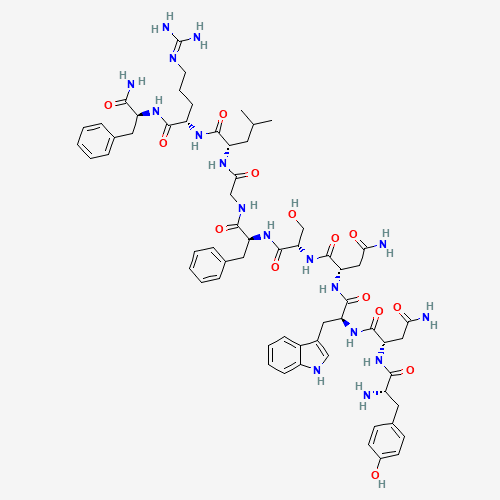
Kisspeptin-10
also Kisspeptin-10 (human) · Human metastin 45-54 · Metastin 45-54 · KP-10
Kisspeptin-10 is the shortest natural form of kisspeptin, the hypothalamic hormone that switches on the reproductive axis. It is the ten amino acids at the end of the longer kisspeptins and keeps their full activity at the kisspeptin receptor [1][2]. A single injection releases GnRH and so LH within minutes, and infusions raise testosterone in healthy men and in men with type 2 diabetes and low testosterone [1][3]. It clears from the blood in about 4 minutes, so studies have used infusions, and its effects in women depend on the phase of the menstrual cycle [4]. It is not approved for any use.
A well-characterised research tool that reliably stimulates LH and testosterone in men, with no adverse events reported in the human studies. There are no trials of kisspeptin-10 as a treatment; the sexual-desire and IVF work that gets attached to "kisspeptin" used the longer kisspeptin-54.
- meta-analysis
- RCT
- trial
- observational
- preclinical / case
- review / patent / other
- retracted
- + Raises LH within 30 minutes and testosterone during infusion in healthy men
- + Also works in men with type 2 diabetes and low testosterone
- + Restored LH pulses in patients whose hypogonadism comes from a defect upstream of kisspeptin
- + Daily 8-hour infusions kept LH and testosterone raised for 12 days
- + No adverse events reported in the published human studies
- − Half-life of about 4 minutes; needs infusion or repeated dosing
- − Continuous exposure blunts the LH response within days
- − Little or no effect in women early in the menstrual cycle
- − No trials of any clinical outcome
Kisspeptins are made by neurons in the hypothalamus and are the main switch for the reproductive axis: they stimulate the neurons that release GnRH, which in turn drives the pituitary to release LH and FSH. People born with loss-of-function variants in the kisspeptin receptor do not go through puberty [5][6]. The kisspeptin gene produces peptides of 54, 14, 13 and 10 amino acids that share the same C-terminal ten; kisspeptin-10 is that shared end (sequence YNWNSFGLRF-amide) [2][7].
Men. The first dose-finding study in healthy men found that intravenous boluses raised LH within 30 minutes, most strongly at 1 µg/kg (4.1 to 12.4 IU/L); 3 µg/kg gave a smaller rise. A 22.5-hour infusion raised testosterone from 16.6 to 24.0 nmol/L, and a lower-dose infusion increased the number and size of LH pulses [1]. In five obese men with type 2 diabetes and low testosterone, the LH response to a bolus was similar to that of healthy men, and an 11-hour infusion raised testosterone from 8.5 to 11.4 nmol/L [3]. The authors proposed kisspeptin agonists as a way to raise the body's own testosterone in such men [3].
Longer use. A 2026 randomised, single-blind study tested ways of giving it under the skin by pump. Continuous infusion for 5 days kept testosterone up, but LH and FSH fell back to placebo levels. Eight hours a day for 12 days, however, kept LH raised throughout, and a bolus on day 12 still worked, showing that the receptor had not shut down [8]. A 24-hour intravenous infusion in three men raised LH five- to eightfold, peaking at 12–20 hours and then drifting down 13–47% while the infusion continued [9].
Women. Responses depend on the menstrual cycle. Early in the follicular phase, even large intravenous or subcutaneous doses of kisspeptin-10 did not change LH or FSH, while the same dose worked in the preovulatory phase [4]. Another study found LH pulses after a bolus in every woman in the luteal and preovulatory phases but in only half of those in the early follicular phase [10].
Upstream defects. In four patients whose puberty failed because of mutations in neurokinin B or its receptor, a continuous kisspeptin-10 infusion restored LH pulses and raised sex steroids, showing that kisspeptin acts downstream of neurokinin B [11].
What kisspeptin-10 has not been tested for. The trials of kisspeptin for sexual desire and arousal, IVF egg maturation and hypothalamic amenorrhoea all used the longer kisspeptin-54, which lasts longer in the blood [12][13][14]. In 32 men with low sexual desire, a 75-minute kisspeptin-54 infusion increased penile rigidity in response to erotic video by up to 56% over placebo and changed activity in sexual-processing brain regions [12]; a matching trial in 32 women changed brain responses to erotic and attraction cues [15]. Earlier imaging work in healthy men found kisspeptin-54 enhanced limbic responses to sexual and couple-bonding images [16][17][18]. As an IVF trigger, kisspeptin-54 matured eggs in 95% of 60 women at high risk of hyperstimulation, none of whom developed moderate or severe OHSS [13]. Reviews see a therapeutic future for kisspeptins in these areas [5][6][19], but whether kisspeptin-10 shares these effects is untested.
Kisspeptin-10 binds the kisspeptin receptor (KISS1R, also called GPR54) on GnRH neurons, which release GnRH into the pituitary portal blood; LH follows within minutes [1][5]. Continuous infusion increased LH pulse frequency in healthy men, so kisspeptin speeds up the GnRH pulse generator rather than only triggering single releases [1], and it restored pulsatility in patients who lack neurokinin B signalling [11]. Testosterone follows the rise in LH over hours [1].
Why kisspeptin-10 is weaker than kisspeptin-54 in the body is partly explained by pharmacokinetics: in mice, kisspeptin-10 had a half-life of about 4 minutes against 32 minutes for kisspeptin-54, and only kisspeptin-54 activated GnRH neurons behind the blood-brain barrier after injection. Repeated injections of kisspeptin-10 every 10 minutes still did not reproduce the long LH release, suggesting that clearance is not the whole story [2].
With continuous exposure the receptor response fades: LH returned to baseline after 5 days of continuous subcutaneous infusion, and declined within the first day of intravenous infusion, while intermittent 8-hour exposure preserved it [8][9].
- Kisspeptin receptor (KISS1R, GPR54) on GnRH neuronsactivatesstrong
- LHactivatesrose from 4.1 to 12.4 IU/L 30 minutes after a 1 µg/kg bolus in healthy men, and pulse frequency increased during infusion [1]strong
- Testosteroneactivatesmoderate
- weak
Dosing
as studied or commonly reported; not a recommendationDoses below are what studies used or, where marked, what is commonly reported. None is a recommendation.
Intravenous
- 0.01–3 µg/kghealthy men; dose-response for LH, with the largest response at 1 µg/kg and a smaller one at 3 µg/kgsingle bolushuman study[1]
- 1.5–4 µg/kg per hourhealthy men; LH pulse frequency and testosteronecontinuous infusion · up to 22.5 hourshuman study[1]
- 0.3 µg/kg bolus; 4 µg/kg per hour infusionmen with type 2 diabetes and low testosteronesingle bolus, then a separate 11-hour infusionhuman study[3]
- 1.5 µg/kg per hourpatients with hypogonadism caused by neurokinin B or NK3 receptor mutationscontinuous infusionhuman study[11]
- 0.24–0.72 nmol/kg
Subcutaneous injection
- 1.25–10 nmol/kg per hour
- 150 nmol per hourhealthy men; sustained gonadotropin stimulation8-hour infusion by pump each day · 12 dayshuman study[8]
- Timing and food
- Because of its short half-life, the human studies used boluses to probe the axis or infusions lasting hours; a 12-day protocol gave 8 hours a day followed by 16 hours off to avoid desensitisation [8].
- Notes
- Doses are often reported per kilogram in micrograms (1 µg/kg of kisspeptin-10 is about 0.77 nmol/kg, from its molecular weight of 1,302). No trial has tested kisspeptin-10 against a clinical outcome such as fertility or sexual function.
Pharmacokinetics
what the body does with it| Half-life | About 4 minutes in plasma after intravenous infusion in men and women, roughly seven times shorter than kisspeptin-54 [4][8]. |
|---|---|
| Onset | LH rose within 30 minutes of an intravenous bolus in healthy men [1]. |
| Metabolism | Kisspeptin-10 breaks down quickly in plasma, mainly by loss of its first amino acid (tyrosine); in rat plasma at body temperature the breakdown half-life was 1.7 minutes, and it was undetectable 30 minutes after an intravenous dose [7]. |
Safety
risks and cautions, not medical adviceNo adverse events were reported in the first dose-finding study in men [1]. The published human studies are small and short, so there is no evidence either way on long-term use. The kisspeptin-54 trials in men and women with low sexual desire reported no side effects or adverse events [12][15].
The expected effects come from the hormones it raises: LH, FSH and testosterone. Continuous exposure desensitises the LH response within days [8]. In women, the effect varies with the menstrual cycle [4]. Kisspeptin-10 is not approved for any medical use.
- Every human study is a small physiology study; none tested a clinical outcome [1][8]
- The sexual-function, IVF and amenorrhoea trials used kisspeptin-54, not kisspeptin-10 [12][13][14]
- Very short half-life, and responses fade with continuous exposure [4][8]
- Almost no effect in women early in the menstrual cycle [4]
- Does kisspeptin-10 raise testosterone?
- Yes, during infusions in healthy men and in men with type 2 diabetes and low testosterone, by roughly a third to a half over several hours [1][3]. No study has tested it over months.
References
entry last reviewed 2026-09-25- [1]Kisspeptin-10 is a potent stimulator of LH and increases pulse frequency in men.George JT, Veldhuis JD, Roseweir AK et al.J Clin Endocrinol Metab 2011clinical trial · humanPMID 21632807◌ unreviewed
- [2]Mechanistic insights into the more potent effect of KP-54 compared to KP-10 in vivo.d'Anglemont de Tassigny X, Jayasena CN, Murphy KG et al.PLoS One 2017preclinical · animalPMID 28464043◌ unreviewed
- [3]Exploring the pathophysiology of hypogonadism in men with type 2 diabetes: kisspeptin-10 stimulates serum testosterone and LH secretion in men with type 2 diabetes and mild biochemical hypogonadism.George JT, Veldhuis JD, Tena-Sempere M et al.Clin Endocrinol (Oxf) 2013clinical trial · humanPMID 23153270◌ unreviewed
- [4]The effects of kisspeptin-10 on reproductive hormone release show sexual dimorphism in humans.Jayasena CN, Nijher GM, Comninos AN et al.J Clin Endocrinol Metab 2011clinical trial · humanPMID 21976724◌ unreviewed
- [5]Use of kisspeptin to trigger oocyte maturation during in vitro fertilisation (IVF) treatment.Sharma B, Koysombat K, Comninos AN et al.Front Endocrinol (Lausanne) 2022reviewPMID 36147569◌ unreviewed
- [6]Clinical Potential of Kisspeptin in Reproductive Health.Abbara A, Clarke SA, Dhillo WSTrends Mol Med 2021reviewPMID 34210598◌ unreviewed
- [7]LC-MS/MS quantification of a neuropeptide fragment kisspeptin-10 (NSC 741805) and characterization of its decomposition product and pharmacokinetics in rats.Liu Z, Ren C, Jones W et al.J Chromatogr B Analyt Technol Biomed Life Sci 2013preclinical · animalPMID 23524040◌ unreviewed
- [8]Chronic subcutaneous kisspeptin-10 stimulates gonadotropin secretion for 12 days in healthy men.Yeung AC, Phylactou M, Koysombat K et al.Eur J Endocrinol 2026RCT · humanPMID 42549827◌ unreviewed
- [9]Dynamic modulation of LH secretion by continuous kisspeptin infusion in healthy men.Naveed A, Lippincott MF, Stamou M et al.Hormones (Athens) 2026clinical trial · humanPMID 42230485◌ unreviewed
- [10]Kisspeptin administration to women: a window into endogenous kisspeptin secretion and GnRH responsiveness across the menstrual cycle.Chan YM, Butler JP, Sidhoum VF et al.J Clin Endocrinol Metab 2012clinical trial · humanPMID 22577171◌ unreviewed
- [11]Kisspeptin restores pulsatile LH secretion in patients with neurokinin B signaling deficiencies: physiological, pathophysiological and therapeutic implications.Young J, George JT, Tello JA et al.Neuroendocrinology 2013clinical trial · humanPMID 22377698◌ unreviewed
- [12]Effects of Kisspeptin on Sexual Brain Processing and Penile Tumescence in Men With Hypoactive Sexual Desire Disorder: A Randomized Clinical Trial.Mills EG, Ertl N, Wall MB et al.JAMA Netw Open 2023RCT · humanPMID 36735255◌ unreviewed
- [13]Efficacy of Kisspeptin-54 to Trigger Oocyte Maturation in Women at High Risk of Ovarian Hyperstimulation Syndrome (OHSS) During In Vitro Fertilization (IVF) Therapy.Abbara A, Jayasena CN, Christopoulos G et al.J Clin Endocrinol Metab 2015RCT · humanPMID 26192876◌ unreviewed
- [14]Increasing LH pulsatility in women with hypothalamic amenorrhoea using intravenous infusion of Kisspeptin-54.Jayasena CN, Abbara A, Veldhuis JD et al.J Clin Endocrinol Metab 2014clinical trial · humanPMID 24517142◌ unreviewed
- [15]Effects of Kisspeptin Administration in Women With Hypoactive Sexual Desire Disorder: A Randomized Clinical Trial.Thurston L, Hunjan T, Ertl N et al.JAMA Netw Open 2022RCT · humanPMID 36287566◌ unreviewed
- [16]Kisspeptin modulates sexual and emotional brain processing in humans.Comninos AN, Wall MB, Demetriou L et al.J Clin Invest 2017RCT · humanPMID 28112678◌ unreviewed
- [17]Modulations of human resting brain connectivity by kisspeptin enhance sexual and emotional functions.Comninos AN, Demetriou L, Wall MB et al.JCI Insight 2018RCT · humanPMID 30333302◌ unreviewed
- [18]Kisspeptin enhances brain responses to olfactory and visual cues of attraction in men.Yang L, Demetriou L, Wall MB et al.JCI Insight 2020RCT · humanPMID 32051344◌ unreviewed
- [19]Can kisspeptin be a new treatment for sexual dysfunction?Bakker JTrends Endocrinol Metab 2025reviewPMID 40189467◌ unreviewed