Bremelanotide (PT-141)
also PT-141 · PT 141 · Vyleesi
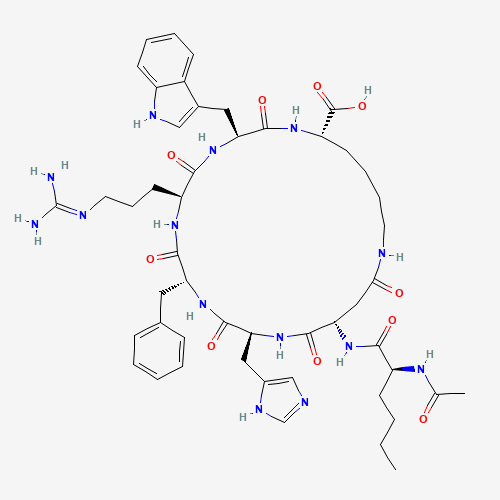
Bremelanotide (PT-141, Vyleesi) is a cyclic seven-amino-acid analogue of α-MSH that activates melanocortin receptors in the brain, chiefly MC4R [1][2]. It is approved in the US for low sexual desire (hypoactive sexual desire disorder) in premenopausal women, based on two phase 3 trials of 1,267 women in which an as-needed 1.75 mg injection modestly increased desire and reduced distress [3][4]. It was first developed as a nasal spray for erectile dysfunction, where it produced erections in men who did not respond well to sildenafil [1]. Nausea affects about 40% of users [4].
An approved, well-studied drug that acts on desire in the brain rather than on blood flow. The average effect in trials was modest, and nausea, flushing and a small, brief rise in blood pressure are common.
- meta-analysis
- RCT
- trial
- observational
- preclinical / case
- review / patent / other
- retracted
- + Increased sexual desire and reduced related distress in two phase 3 trials
- + Benefits were maintained over a 52-week open-label extension
- + Taken only when needed, about 45 minutes before sex
- + Produced erections in men with an inadequate response to sildenafil
- + No interaction with alcohol
- − Nausea in about 40%, flushing in 20%, headache in 11%
- − Small, short-lived rise in blood pressure after each dose
- − Darkened skin patches with repeated daily dosing
- − Injection under the skin
- − Average improvement over placebo was modest
Bremelanotide is a synthetic cyclic heptapeptide derived from α-melanocyte-stimulating hormone (α-MSH) [1] that acts on the brain's melanocortin receptors [5]. It is approved by the US FDA for acquired, generalised hypoactive sexual desire disorder (HSDD) in premenopausal women [4].
Animal work. In female rats, it selectively increased solicitation, the behaviour by which a female initiates mating, without changing lordosis, pacing, general activity or the rewarding value of sex. This was the first drug shown to act on sexual appetite rather than sexual reflexes [5].
Women. In a phase 2b trial of 327 premenopausal women with sexual dysfunction, 1.25–1.75 mg injected as desired for 12 weeks increased satisfying sexual events by 0.7 a month against 0.2 on placebo, and improved sexual function and distress scores [2]. At 1.75 mg, responder rates beat placebo on all seven endpoints [6]. The two phase 3 RECONNECT trials randomised 1,267 women with HSDD to 1.75 mg or placebo as needed for 24 weeks. Desire scores rose by 0.30 and 0.42 points more than placebo, and distress about low desire fell by 0.37 and 0.29 points more [3]. Results held across age, weight, testosterone level and contraceptive use [7]. Of 684 women who entered a 52-week open-label extension, 272 completed it; desire and distress kept improving [8]. Reviews describe the benefit as statistically clear but clinically modest [9][10].
Men. Bremelanotide was first developed for erectile dysfunction. Subcutaneous doses above 1 mg produced erections in healthy men without sexual stimulation, and 4–6 mg worked in men who did not respond well to 100 mg sildenafil [1]. A nasal spray produced erections at doses above 7 mg, starting about 30 minutes after dosing [11], and a low nasal dose added to 25 mg sildenafil gave a stronger response than sildenafil alone [12]. A 2008 trial in 342 sildenafil non-responders reported positive results in 33.5% vs 8.5% on placebo with 10 mg intranasally, but the journal issued an expression of concern about it in 2023 [13]. It was never approved for men.
Bremelanotide activates melanocortin receptors, chiefly MC4R [2], on neurons in the brain rather than acting on blood vessels, which is why it affects desire in women and can produce erections without sexual stimulation in men [1][5]. In rats the effect was specific to appetitive (motivational) sexual behaviour [5].
MC4R agonists can raise blood pressure. In 397 women, 1.25–1.75 mg raised ambulatory systolic pressure by about 2–3 mmHg in the 4 hours after dosing, with peaks lasting under 15 minutes, and lowered heart rate by about 5 beats a minute [14]. Repeated daily dosing can darken patches of skin [4].
- Melanocortin 4 receptor (MC4R) in the brainactivatesstrong
- Sexual desire (appetitive sexual behaviour)activatesmoderate
- Erectionactivatescaused erections measured by RigiScan in healthy men at subcutaneous doses above 1 mg [1]moderate
- Blood pressureactivatesraised systolic pressure by about 3 mmHg for up to 4 hours after dosing, with peaks lasting under 15 minutes, and lowered heart rate [14]weak
Dosing
as studied or commonly reported; not a recommendationDoses below are what studies used or, where marked, what is commonly reported. None is a recommendation.
Subcutaneous injection
- 1.75 mg
- 0.75, 1.25 or 1.75 mgpremenopausal women with female sexual dysfunction (phase 2b dose-finding)as desired before sex · 12 weekshuman study[2]
- 0.3–10 mg (healthy men); 4 or 6 mg (men with erectile dysfunction)
Nasal
- above 7 mg for an erectile effect
- 7.5 mg, with sildenafil 25 mgmen with erectile dysfunction who responded to PDE5 inhibitors (crossover, 19 men)single dosehuman study[12]
- Form
- The approved product is a subcutaneous autoinjector [7]. Early trials used a nasal spray, abandoned because absorption was too variable [14].
- Timing and food
- Label guidance is no more than one dose in 24 hours and no more than 8 doses a month, stopping after 8 weeks without benefit [9].
- Time to effect
- Works on the day it is taken; in the phase 3 trials, desire and distress were assessed as change over 24 weeks of as-needed use [3].
Pharmacokinetics
what the body does with it| Half-life | 1.85–2.09 hours after intranasal dosing in healthy men [11]. |
|---|---|
| Onset | Erections began about 30 minutes after an intranasal dose [11]. In the phase 3 trials, women injected it about 45 minutes before expected sexual activity [3]. |
| Time to peak | About 0.5 hours after intranasal dosing [11]. With subcutaneous dosing, the blood-pressure trial timed ECGs about 2 hours after injection as the expected time of peak concentration [14]. |
| Peak level | Mean peak plasma levels of 37.5, 60.0 and 77.2 ng/mL after subcutaneous 0.75, 1.25 and 1.75 mg, rising in proportion to dose [14]. |
| Bioavailability | Intranasal absorption varied widely between people, which is why development switched to subcutaneous injection [14]. Oral absorption in dogs was minimal [15]. |
Safety
risks and cautions, not medical adviceAcross 3,500 people in 43 studies, the most common adverse events in the phase 3 trials were nausea (40% vs 1.3% on placebo), flushing (20% vs 1.3%), headache (11% vs 1.9%) and injection-site reactions (5.4% vs 0.5%). Nausea was the main reason people stopped. There were no deaths and few serious adverse events [4]; one woman was hospitalised overnight with vomiting and headache [3]. In the phase 2b trial, 4% vomited [2]. No new safety signals appeared over 52 weeks of open-label use [8].
Focal hyperpigmentation was rare with as-needed use but occurred in more than a third of people given up to 16 consecutive daily doses. The blood pressure rise is small and transient, but the authors of the safety review advise caution in people at cardiovascular risk and keeping blood pressure controlled [4]. It did not interact with alcohol [16], but it lowered blood levels of indomethacin and naltrexone [4].
- How is PT-141 different from Viagra?
- Sildenafil works on blood flow in the penis; bremelanotide acts on melanocortin receptors in the brain, and produced erections even in men who responded poorly to sildenafil [1].
- How well does it work for low desire?
- In the phase 3 trials, desire scores rose by 0.30–0.42 points more than placebo and distress fell by about a third of a point [3]. Reviews call the benefit modest [9].
- Why does it cause nausea?
- Nausea is the most common side effect, in about 40% of users in the phase 3 trials, and the main reason people stopped [4].
References
entry last reviewed 2026-09-25- [1]Evaluation of the safety, pharmacokinetics and pharmacodynamic effects of subcutaneously administered PT-141, a melanocortin receptor agonist, in healthy male subjects and in patients with an inadequate response to Viagra.Rosen RC, Diamond LE, Earle DC et al.Int J Impot Res 2004RCT · humanPMID 14999221◌ unreviewed
- [2]Bremelanotide for female sexual dysfunctions in premenopausal women: a randomized, placebo-controlled dose-finding trial.Clayton AH, Althof SE, Kingsberg S et al.Womens Health (Lond) 2016RCT · humanPMID 27181790◌ unreviewed
- [3]Bremelanotide for the Treatment of Hypoactive Sexual Desire Disorder: Two Randomized Phase 3 Trials.Kingsberg SA, Clayton AH, Portman D et al.Obstet Gynecol 2019RCT · humanPMID 31599840◌ unreviewed
- [4]Safety Profile of Bremelanotide Across the Clinical Development Program.Clayton AH, Kingsberg SA, Portman D et al.J Womens Health (Larchmt) 2022RCT · humanPMID 35147466◌ unreviewed
- [5]Selective facilitation of sexual solicitation in the female rat by a melanocortin receptor agonist.Pfaus JG, Shadiack A, Van Soest T et al.Proc Natl Acad Sci U S A 2004preclinical · animalPMID 15226502◌ unreviewed
- [6]Responder Analyses from a Phase 2b Dose-Ranging Study of Bremelanotide.Althof S, Derogatis LR, Greenberg S et al.J Sex Med 2019RCT · humanPMID 31277966◌ unreviewed
- [7]Prespecified and Integrated Subgroup Analyses from the RECONNECT Phase 3 Studies of Bremelanotide.Simon JA, Kingsberg SA, Portman D et al.J Womens Health (Larchmt) 2022RCT · humanPMID 35230162◌ unreviewed
- [8]Long-Term Safety and Efficacy of Bremelanotide for Hypoactive Sexual Desire Disorder.Simon JA, Kingsberg SA, Portman D et al.Obstet Gynecol 2019clinical trial · humanPMID 31599847◌ unreviewed
- [9]Bremelanotide: New Drug Approved for Treating Hypoactive Sexual Desire Disorder.Mayer D, Lynch SEAnn Pharmacother 2020reviewPMID 31893927◌ unreviewed
- [10]An evaluation of bremelanotide injection for the treatment of hypoactive sexual desire disorder.Cipriani S, Alfaroli C, Maseroli E et al.Expert Opin Pharmacother 2023reviewPMID 36242769◌ unreviewed
- [11]Double-blind, placebo-controlled evaluation of the safety, pharmacokinetic properties and pharmacodynamic effects of intranasal PT-141, a melanocortin receptor agonist, in healthy males and patients with mild-to-moderate erectile dysfunction.Diamond LE, Earle DC, Rosen RC et al.Int J Impot Res 2004RCT · humanPMID 14963471◌ unreviewed
- [12]Co-administration of low doses of intranasal PT-141, a melanocortin receptor agonist, and sildenafil to men with erectile dysfunction results in an enhanced erectile response.Diamond LE, Earle DC, Garcia WD et al.Urology 2005RCT · humanPMID 15833522◌ unreviewed
- [13]Salvage of sildenafil failures with bremelanotide: a randomized, double-blind, placebo controlled study.Safarinejad MR, Hosseini SYJ Urol 2008RCT · humanPMID 18206919◌ unreviewedEXPRESSION OF CONCERN: J Urol. 2023 Jan 10:101097JU0000000000003117. doi: 10.1097/JU.0000000000003117.36626345
- [14]Usefulness of ambulatory blood pressure monitoring to assess the melanocortin receptor agonist bremelanotide.White WB, Myers MG, Jordan R et al.J Hypertens 2017RCT · humanPMID 27977473◌ unreviewed
- [15]Ultra-sensitive quantification of the therapeutic cyclic peptide bremelanotide utilizing UHPLC-MS/MS for evaluation of its oral plasma pharmacokinetics.Sauter M, Uhl P, Burhenne J et al.J Pharm Biomed Anal 2020preclinical · animalPMID 32353679◌ unreviewed
- [16]Phase I Randomized Placebo-controlled, Double-blind Study of the Safety and Tolerability of Bremelanotide Coadministered With Ethanol in Healthy Male and Female Participants.Clayton AH, Lucas J, DeRogatis LR et al.Clin Ther 2017RCT · humanPMID 28189361◌ unreviewed