BPAP
also (−)-BPAP · R-(−)-BPAP · (-)-BPAP · 1-(Benzofuran-2-yl)-2-propylaminopentane · Benzofuranylpropylaminopentane
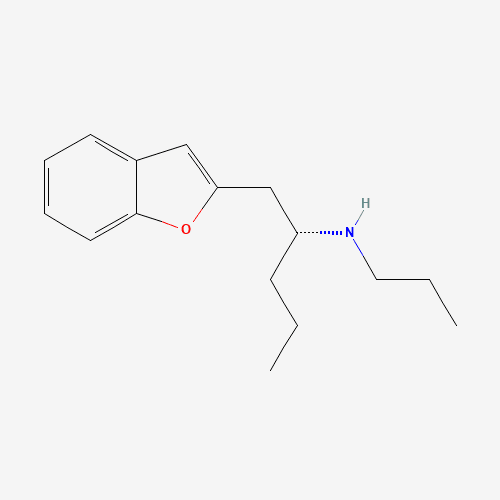
BPAP ((−)-1-(benzofuran-2-yl)-2-propylaminopentane) is a research compound made by Joseph Knoll's Budapest group and Fujimoto Pharmaceutical by swapping the phenyl ring of PPAP for a benzofuran, and chosen from 65 analogs as a possible successor to selegiline [1]. In rat tissue it raised the release of dopamine, norepinephrine and serotonin evoked by nerve impulses at femtomolar to picomolar concentrations, without releasing them at rest, and in the shuttle box it was about 130 times as potent as selegiline [1][2]. It also blocks dopamine and norepinephrine reuptake more potently than cocaine [3]. No human has been studied at any dose, a 2016 longevity benefit in rats was not reproduced in a 2024 study of aged rats, and almost all of the work comes from the inventors and their industrial partner [4][5].
The most potent of Knoll's "enhancer" compounds, with antidepressant-like, antiparkinsonian and anti-relapse effects in rodents; there is no human data at all, its potency figures come from bell-shaped curves in the developers' own assays, and a second, differently designed aging study in rats found no benefit.
- meta-analysis
- RCT
- trial
- observational
- preclinical / case
- review / patent / other
- retracted
- + Raised impulse-evoked dopamine, norepinephrine and serotonin release in rat brain tissue at femtomolar to picomolar concentrations and after injections of 0.1 µg/kg, without releasing them from resting nerve endings
- + About 130 times as potent as selegiline at reversing the tetrabenazine learning deficit in the rat shuttle box
- + Reversed reserpine-induced immobility in rats and let a sub-threshold dose of L-DOPA work
- + Antidepressant-like effects in two rodent models from a Nagoya University group, and reduced relapse to methamphetamine seeking in rats in a study with no developer among its authors
- + Not an MAO-B inhibitor, and structurally unrelated to the amphetamines
- − Never tested in people, so there is no human dose, pharmacokinetic or safety data
- − Most of the pharmacology comes from the Knoll laboratory and Fujimoto Pharmaceutical, its manufacturer
- − Its effects follow bell-shaped dose curves, so higher doses can do less or the opposite
- − In a 2024 study of aged, cognitively trained rats it improved neither cognition nor lifespan
- − It is also a potent dopamine and norepinephrine reuptake inhibitor, which complicates the "enhancer" explanation of its effects
- − No toxicology study was found
BPAP is PPAP with its phenyl ring replaced by a benzofuran. Joseph Knoll's group in Budapest, which had made selegiline and then PPAP, worked with Fujimoto Pharmaceutical in Japan to change PPAP's aromatic ring. Of 65 new compounds they picked the benzofuran analog, both as a candidate to follow selegiline into the clinic and as a reference compound for studying what they called the catecholaminergic and serotonergic activity enhancer mechanism [1][6]. The compound studied is the (−) enantiomer, whose R configuration was confirmed by X-ray crystallography [7]; Fujimoto's code for it is FPFS-1169 [8]. The group calls it tryptamine-derived, because the program began after they found that tryptamine, the indole analog of phenylethylamine, is itself an enhancer [1].
The founding paper, published in 1999, described a compound active at extraordinarily low concentrations. Brain regions taken from rats injected with 0.1 µg/kg released more dopamine, norepinephrine and serotonin than tissue from saline-treated rats, and freshly excised tissue responded to BPAP in the bath down to 10⁻¹⁴ M. In the shuttle box, where rats given tetrabenazine fail to learn an avoidance task, 0.05 mg/kg restored learning, against 2.5 mg/kg of (−)-PPAP and 5 mg/kg of selegiline; allowing for molecular weight, the authors put BPAP at about 130 times selegiline's potency and called selegiline and PPAP "relatively weak" enhancers by comparison [1]. Unlike selegiline, BPAP does not inhibit MAO-B and is structurally unrelated to the amphetamines; it is a weak MAO-A inhibitor [1].
The early behavioral work came from Fujimoto's own laboratories. BPAP raised locomotor activity in rats at 0.3–10 mg/kg, an effect reduced by a D1 receptor antagonist; it reversed the immobility and drooping eyelids caused by reserpine, where apomorphine and amantadine did not help the eyelids; and it made rats with a one-sided dopamine lesion turn toward the lesion, a sign of release from surviving dopamine terminals [9]. It also let a sub-threshold dose of L-DOPA restore activity in reserpine-treated rats, and it failed when new catecholamine synthesis was blocked as well [10]. Fujimoto described it as a candidate for early Parkinson's disease [3].
Two groups outside Budapest tested it on behavior. At Nagoya University, with a Fujimoto co-author, a single dose reduced immobility in the mouse forced swimming test but repeated dosing did not, while repeated dosing, and not a single dose, restored social interaction in mice stressed by forced swimming; in rats with the olfactory bulbs removed, a model of depression, repeated BPAP restored social interaction, prepulse inhibition and fear learning, and tended to improve sexual function where imipramine did not [11]. At Kyushu University, with no developer among the authors, BPAP reduced cue- and drug-primed relapse to methamphetamine seeking in rats, whether given repeatedly during extinction or once on the test day, without itself reinstating drug seeking or changing methamphetamine self-administration [12].
Later work turned to aging. In a 2016 longevity study, male Wistar rats given 0.1 or 50 µg/kg three times a week from 10 weeks of age lived significantly longer than saline-treated rats, BPAP did better than selegiline, and at 18 months the low-dose rats learned as well as 3-month-old controls [4]. A 2017 report from the same work counted a spontaneous fibromyxosarcoma in 20 of 40 saline-treated rats against 8 and 7 of 40 in the two BPAP groups [13], and a pathology group at the same university, with Knoll and Miklya as co-authors, then found that both doses slowed the growth of transplanted lung adenocarcinoma in mice [14]. The test that did not agree came in 2024, from a behavioral pharmacology group in the same department: 15 aged, food-restricted rats trained on four cognitive tasks received BPAP on weekdays from 27 months of age until death, and neither their cognition nor their lifespan differed from 15 saline-treated rats [5].
The literature has no human data at all. Knoll proposed lifelong daily BPAP in 2001 [15], the 2017 paper suggested testing it in people against the spread of cancer [13], and the developers' reviews describe it as a promising treatment for depression, Parkinson's disease and Alzheimer's disease [16][17], but no trial, case report or human pharmacokinetic study was found. Most of the papers have Knoll, his successor Ildikó Miklya or Fujimoto staff among the authors, and the recent ones say Fujimoto supplied the compound or funded the work [2][5]. Many of the papers are in Elsevier journals and were read for this page from their abstracts; the 1999 founding paper, the 2005 midbrain-slice paper, the 2022 and 2025 receptor papers, the lung-cancer paper and the 2024 aging study were read in full.
The enhancer effect is measured on stimulated release. In Knoll's assays a nerve preparation is loaded with labeled transmitter and stimulated electrically, and an "enhancer" raises the amount released by each burst without changing what leaks out between bursts. BPAP did this for norepinephrine and dopamine at 0.18 µM and for serotonin at 36 nM in isolated rat brain stem [1]. Desipramine, fluoxetine, clorgyline, lazabemide and the dopamine agonists pergolide and bromocriptine did not, which the group took as evidence that the effect is not reuptake or MAO inhibition or receptor stimulation [18]. The 2022 and 2025 papers repeated the finding in rat striatal slices: BPAP raised stimulated dopamine release and left resting release untouched at every concentration from 10⁻¹⁵ to 10⁻⁵ M [2][19]. Methamphetamine, by contrast, raised resting release, which is what makes it a releaser [2].
The dose curves are bell-shaped, twice over. Effects appear in a low window and a high one, with nothing in between. Norepinephrine release from the locus coeruleus rose from 10⁻¹⁶ M, peaked at 10⁻¹³ M, vanished at 10⁻¹⁰ M, and returned between 10⁻⁸ and 10⁻⁶ M before vanishing again at 10⁻⁵ M; in living rats, 0.5 µg/kg raised it from 4.7 to 15.4 nmol/g while 50 µg/kg did nothing [20]. The developers proposed high- and low-affinity "enhancer receptors" and suggested they might be the trace amine receptors cloned shortly before [20].
A receptor has been proposed: TAAR1. Trace amine-associated receptor 1 is an intracellular receptor for phenylethylamine, tyramine and the amphetamines. In striatal slices the TAAR1 antagonist EPPTB abolished BPAP's effect on stimulated dopamine release, as did blocking protein kinase C, and the DAT blocker nomifensine also abolished it, which the authors read as BPAP entering the nerve ending through the dopamine transporter before acting on TAAR1 inside [2]. They propose that TAAR1 has one site for releasers with small groups on the nitrogen and α-carbon and another for enhancers with bulky propyl groups, such as PPAP and BPAP, and that BPAP also strengthens VMAT2, the pump that fills vesicles [2]. The 2025 paper suggested that the falling half of each bell curve comes from TAAR1 pairing with dopamine D2 receptors and switching its own signal off [19]. The papers read for this page report no binding assay and no study in cells engineered to express TAAR1, and an earlier paper from the same group had named VMAT2 itself as the main site of action [13].
It is also a potent reuptake inhibitor. The 1999 paper said BPAP does not inhibit the plasma membrane transporter [1]. A 2003 Fujimoto study, supported by the US National Institute on Drug Abuse, measured it in cells expressing the human transporters and found the opposite: IC50 values of 42 nM for dopamine uptake and 52 nM for norepinephrine uptake, both more potent than cocaine, and 640 nM for serotonin, weaker than cocaine [3]. These concentrations are far higher than the femtomolar-to-picomolar enhancer window. How much of BPAP's behavioral effect at milligram doses comes from reuptake inhibition rather than "enhancement" has not been settled. Like a reuptake inhibitor, and unlike tyramine, it blocked tyramine-induced norepinephrine release rather than causing release itself [1][3].
It does not work exactly like selegiline. A weak analog, 3-F-BPAP, blocked BPAP's reversal of tetrabenazine in the shuttle box but left the effects of selegiline and PPAP intact, which the developers called the first evidence that the phenylethylamine-derived and tryptamine-derived enhancers act differently [21]. BPAP also acts strongly on serotonin neurons, where selegiline acts mainly on catecholamine neurons [1][16]. BPAP inhibits MAO-A weakly (IC50 0.4 µM in mouse brain) and MAO-B hardly at all (280 µM) [1].
Little else binds. At 10 µM it bound only α2-adrenoceptors among the catecholamine and serotonin receptors screened, and the α2 blocker yohimbine did not mimic it [1]. In the striatum it also raised stimulated GABA release in two windows, an effect the D2 blocker sulpiride abolished [19]. Over three weeks, low doses raised phosphorylated AMPA (GluR1) and NMDA (GluN2B) receptor subunits in the rat prefrontal cortex and lowered night-time corticosterone, and high doses tended to reduce anxiety-like behavior on the elevated plus maze; the paper reports these effects for the low doses of BPAP and selegiline together, and for their high doses together [22]. In chronically stressed rats, a Slovak-Hungarian group found lower GluR1 expression in the prefrontal cortex and no change in stress hormones or anxiety [23].
Protection of cells in culture. BPAP raised the survival of rat hippocampal neurons exposed to β-amyloid from about 20% to 70%, again in two windows peaking at 10⁻¹⁴ and 10⁻⁸ M; the racemate was used [1][6]. It kept cortical neurons alive in serum-free culture through sigma receptors [24], protected human dopaminergic SH-SY5Y cells from an endogenous neurotoxin by stabilizing mitochondria and inducing Bcl-2 [8], and protected human brain endothelial cells and rat PC12 cells after hypoxia [25]. It raised BDNF and its receptor trkB in rat midbrain slice cultures at 10⁻⁹–10⁻⁷ M [26]; in isolated mouse astrocytes it raised NGF, BDNF and GDNF only at micromolar to millimolar concentrations, with no effect in the femtomolar range [27][28].
- Resting (non-vesicular) dopamine releaseno bindingmoderate
- Dopamine transporter (DAT)blocksin cells expressing the human transporter, IC50 42 nM for dopamine uptake and Ki 16 nM for binding, against 524 nM and 469 nM for cocaine; in striatal slices the DAT blocker nomifensine abolished BPAP's enhancer effect, which the authors read as BPAP entering the nerve ending through the transporter [2][3]strong
- Norepinephrine transporter (NET)blocksIC50 52 nM for norepinephrine uptake in cells expressing the human transporter, more potent than cocaine [3]strong
- Serotonin transporter (SERT)blocksIC50 640 nM for serotonin uptake, weaker than cocaine [3]weak
- Trace amine-associated receptor 1 (TAAR1)activatesunclear
- Monoamine oxidase AblocksIC50 0.4 µM in mouse brain, against 280 µM for MAO-B; the developers judged this too weak to explain its effects, since it was 10,000 times weaker than clorgyline at MAO-A but 10 times more potent in the shuttle box [1]weak
- Catecholamine and serotonin receptorsno bindingat 10 µM it bound only α2-adrenoceptors among the catecholamine and serotonin receptors screened, and the α2 blocker yohimbine did not reproduce its effect on norepinephrine release [1]moderate
- Sigma receptorsactivateskept cortical neurons alive in serum-free culture, an effect blocked by the sigma antagonist BD1063; it displaced the sigma ligand pentazocine only weakly [24]weak
- Impulse-evoked monoamine release (catecholaminergic and serotonergic activity enhancer effect)activatesraised electrically evoked release of labeled norepinephrine and dopamine from isolated rat brain stem at 0.18 µM and of serotonin at 36 nM, and the release of dopamine, norepinephrine and serotonin from freshly excised rat brain regions at 10⁻¹⁴–10⁻¹² M; in striatal slices the effect appeared in two windows, 10⁻¹²–10⁻¹¹ M and 10⁻⁶–10⁻⁵ M, with no effect in between [1][2][19]moderate
- Tyramine-induced norepinephrine releaseblocksmoderate
- Neurotrophic factor synthesis (BDNF, NGF, GDNF)activatesweak
- Striatal GABA releaseactivatesraised stimulated GABA release from rat striatal slices at 10⁻¹³–10⁻¹² M and 10⁻⁹–10⁻⁷ M; the D2 blocker sulpiride abolished the effect at 10⁻⁸ M [19]unclear
Formulation
how the form changes blood levelsBPAP has been studied only as the hydrochloride of the R-(−) enantiomer, dissolved in saline [5][10]. The developers published two enantioselective syntheses, one starting from an (R)-aziridine and one from an (R)-norvaline amide, and confirmed the configuration by X-ray crystallography [7]. Some of the earliest experiments used the racemate [6].
No clinical formulation is described in the papers read for this page. The only absorption data come from rats given carbon-14-labeled BPAP, in which radioactivity was well absorbed whether given by mouth, under the skin or into the abdomen, peaked at 30–60 minutes and reached the brain [29]. Because only total radioactivity was measured, those figures cannot separate BPAP from its metabolites.
Dosing
as studied or commonly reported; not a recommendationDoses below are what studies used or, where marked, what is commonly reported. None is a recommendation.No peer-reviewed human dosing data. The doses below come from animal studies or company filings; animal doses do not translate directly to people.
Subcutaneous injection
- 0.1 µg/kg (human equivalent ≈0.016 µg/kg)
- 0.1–50 µg/kg (human equivalent ≈0.016–8.1 µg/kg)
- 50 µg/kg (human equivalent ≈8.1 µg/kg)
- 0.3–3 mg/kg (human equivalent ≈0.048–0.48 mg/kg)
- 0.1 or 50 µg/kg (human equivalent ≈0.016 or 8.1 µg/kg)
- 0.2 µg/kg for 7 weeks, then 1 µg/kg (human equivalent ≈0.032 then 0.16 µg/kg)
- 1 mg/kg (human equivalent ≈0.16 mg/kg)
Oral
- 50–300 µglow to high range of reported useper dose, earlier in the daycommonly reported, not from trials
- Form
- Studied as the hydrochloride of the R-(−) enantiomer, dissolved in saline and injected under the skin [5][10]. Fujimoto Pharmaceutical supplied it for the studies of the last decade [2][5][14].
- Time to effect
- In rats, brain tissue released more transmitter 30 minutes after an injection [1], and the longevity and aging studies dosed for life [4][5]. Nothing is known about onset in people.
- Notes
- No human dose has been studied. No clinical trial, case report or human pharmacokinetic study of BPAP was found. The human equivalents in the rows above are body-surface-area arithmetic from rat doses [31], not doses anyone has taken under study. The 50–300 µg row is not from a study either. It is a practice range per dose, not a tested dose. Knoll proposed in 2001 that 0.1 mg of BPAP a day, taken from sexual maturity until death, might slow brain aging [15]. That was a proposal in a review, with no human data behind it. The rat doses cover five orders of magnitude, from 0.1 µg/kg to 10 mg/kg [1][21], and the response is not proportional to dose. After a single injection, 0.5 µg/kg more than tripled norepinephrine release from the locus coeruleus while 50 µg/kg left it unchanged [20], and 2.5 µg/kg left it slightly below control [1]. The developers describe a "specific" effect at about 0.1 µg/kg and a "non-specific" one at about 50 µg/kg [4]. Behavioral stimulation, by contrast, needed 0.3–10 mg/kg [9]. The mouse lung adenocarcinoma experiments used 0.1 and 50 µg/kg daily without stating the route [14], so they have no row above.
Pharmacokinetics
what the body does with it| Half-life | 5.5–5.8 hours (elimination phase) for total radioactivity after carbon-14-labeled BPAP in rats [29]. No human figure exists. |
|---|---|
| Onset | Brain radioactivity peaked 30 minutes after a subcutaneous dose in rats [29], and brain tissue taken 30 minutes after 0.1 µg/kg already released more transmitter [1]. |
| Time to peak | 30–60 minutes after intraperitoneal, subcutaneous or oral dosing in rats, with a second peak at 4 hours that the authors attribute to enterohepatic circulation [29]. |
| Bioavailability | Radioactivity was well absorbed by mouth in rats [29]; no absolute bioavailability of the parent drug was reported. |
| Metabolism | Not studied. The rat study measured total radioactivity, not BPAP itself, so how much of it is metabolized, and into what, is unknown [29]. BPAP is structurally unrelated to the amphetamines [1]. |
| Excretion | More than 90% of the radioactivity was recovered within 72 hours in rats, mostly in urine and the rest in feces [29]. |
Safety
risks and cautions, not medical adviceThere is no human safety data. No trial, case report or human pharmacokinetic study was found, and the developers' descriptions of BPAP as safe, well tolerated and of low toxicity [14][16] are not backed by any toxicology study in the papers read for this page: no lethal dose, repeat-dose toxicity, genetic toxicity or cardiovascular data appear.
In animals it has been given for life. Rats received it three times a week from 10 weeks of age until death in the 2016 longevity study and lived longer [4], and aged rats received it on weekdays from 27 months until death in the 2024 study and lived as long as controls [5]. These were not designed as safety studies.
Its pharmacology points to the questions any dopamine and norepinephrine reuptake inhibitor raises. It blocks both transporters more potently than cocaine in cell assays [3] and raised locomotor activity in rats at 0.3 mg/kg and above [9][10]. It did not support methamphetamine self-administration or reinstate drug seeking in rats [12], which is reassuring about abuse liability but is a single rat study. It blocked, rather than caused, tyramine-induced norepinephrine release [3].
- No adverse effect has been reported in a human, because it has never been tested in one
- Raised locomotor activity in rats at 0.3–10 mg/kg [9]
- It blocks dopamine and norepinephrine reuptake more potently than cocaine in cell assays, and no cardiovascular measurements appear in the sources read [3]
- Responses follow bell-shaped curves: a dose a hundred times higher can have no effect, or the opposite effect, on transmitter release [1][20]
- Repeated higher doses lowered serotonin release from the rat raphe while lower doses raised it [1]
- Never tested in people: no trial, case report or human pharmacokinetic study was found, so no human dose, efficacy or safety is known
- Almost all of the work comes from the Knoll laboratory and Fujimoto Pharmaceutical, which supplied the compound and funded some studies [2][5]
- The life extension reported in 2016 was not reproduced in aged, food-restricted rats in 2024, which also found no cognitive benefit [4][5]
- The enhancer effect is defined by the developers' own release assays, and its bell-shaped dose curves make potency claims depend on picking the right concentration [20]
- BPAP blocks dopamine and norepinephrine reuptake at nanomolar concentrations, which the founding paper did not detect and which may explain part of its behavioral effect [1][3]
- The TAAR1 mechanism rests on antagonist experiments in brain slices; no binding or receptor-expressing cell study has been published [2]
- The pharmacokinetic study measured total radioactivity, so the half-life and absorption of BPAP itself are unknown [29]
- Most of the Elsevier papers, including the rat pharmacokinetic study, the 2016 longevity study and the Nagoya and Kyushu behavioral studies, were read from their abstracts because the full texts are paywalled
Interactions
documented pairs only, not exhaustive- any mao inhibitorcaution
- Adderallcaution
- Vyvansecaution
Selegiline was made in Knoll's laboratory in the 1960s, and in the early 1990s the group made PPAP, an analog without MAO-B inhibition, to show that selegiline's stimulant-like "enhancer" effect did not depend on the enzyme [1][32]. After finding that tryptamine also acted as an enhancer, they began a structure-activity program with Fujimoto Pharmaceutical, replacing PPAP's phenyl ring with other ring systems, and in 1999 reported BPAP as the selected compound [1][6].
Fujimoto's laboratories published its motor effects, its L-DOPA-sparing effect and its transporter profile between 2001 and 2003 [3][9][10], and independent groups in Nagoya and Kyushu tested it in models of depression and drug relapse in 2008 and 2010 [11][12]. From 2016 the Budapest group published longevity and tumor data [4][13][14], and from 2022 linked its action to TAAR1 [2][19]. A 2024 study from the same department found no effect on aging rats [5]. A 2016 review from the laboratory still called selegiline the only enhancer available as a drug [32].
- Has BPAP been tested in humans?
- No. No clinical trial, case report or human pharmacokinetic study was found. Its inventor proposed a daily dose of 0.1 mg in 2001 [15], but that was never tested.
- How is BPAP different from selegiline?
- BPAP does not inhibit MAO-B and is structurally unrelated to the amphetamines, it acts on serotonin neurons as well as catecholamine neurons, and in the rat shuttle box it was about 130 times as potent [1]. A BPAP analog that blocked BPAP's effect left selegiline's untouched, suggesting the two act differently [21].
References
entry last reviewed 2026-10-14- [1](-)1-(Benzofuran-2-yl)-2-propylaminopentane, [(-)BPAP], a selective enhancer of the impulse propagation mediated release of catecholamines and serotonin in the brain.Knoll J, Yoneda F, Knoll B et al.Br J Pharmacol 1999preclinical · animalPMID 10588928◌ unreviewed
- [2]Enhancer Regulation of Dopaminergic Neurochemical Transmission in the Striatum.Harsing LG, Knoll J, Miklya IInt J Mol Sci 2022preclinical · animalPMID 35955676◌ unreviewed
- [3]Transporter-mediated actions of R-(-)-1-(benzofuran-2-yl)-2-propylaminopentane.Shimazu S, Tsunekawa H, Yoneda F et al.Eur J Pharmacol 2003preclinical · cellPMID 14659999◌ unreviewed
- [4]Longevity study with low doses of selegiline/(-)-deprenyl and (2R)-1-(1-benzofuran-2-yl)-N-propylpentane-2-amine (BPAP).Knoll J, Miklya ILife Sci 2016preclinical · animalPMID 27777099◌ unreviewed
- [5]Age-related decline of various cognitive functions in well-experienced male rats treated with the putative anti-aging compound (2R)-1-(1-benzofuran-2-yl)-N-propylpentane-2-amine ((-)BPAP).Ernyey AJ, Kassai F, Kozma K et al.Geroscience 2024preclinical · animalPMID 37306892◌ unreviewed
- [6]Structure-activity studies leading to (-)1-(benzofuran-2-yl)-2-propylaminopentane, ((-)BPAP), a highly potent, selective enhancer of the impulse propagation mediated release of catecholamines and serotonin in the brain.Yoneda F, Moto T, Sakae M et al.Bioorg Med Chem 2001preclinical · animalPMID 11377178◌ unreviewed
- [7]Enantioselective synthesis and absolute configuration of (-)-1-(benzofuran-2-yl)-2-propylaminopentane, ((-)-BPAP), a highly potent and selective catecholaminergic activity enhancer.Oka T, Yasusa T, Ando T et al.Bioorg Med Chem 2001otherPMID 11377179◌ unreviewed
- [8]Neuroprotective function of R-(-)-1-(benzofuran-2-yl)-2-propylaminopentane, [R-(-)-BPAP], against apoptosis induced by N-methyl(R)salsolinol, an endogenous dopaminergic neurotoxin, in human dopaminergic neuroblastoma SH-SY5Y cells.Maruyama W, Yi H, Takahashi T et al.Life Sci 2004preclinical · cellPMID 15102525◌ unreviewed
- [9](-)-1-(Benzofuran-2-yl)-2-propylaminopentane enhances locomotor activity in rats due to its ability to induce dopamine release.Shimazu S, Takahata K, Katsuki H et al.Eur J Pharmacol 2001preclinical · animalPMID 11516435◌ unreviewed
- [10]The L-DOPA-sparing effect of R-(-)-1-(benzofuran-2-yl)-2-propylaminopentane hydrochloride [(-)-BPAP] in reserpine-pretreated rats.Shimazu S, Tamashiro A, Yoneda F et al.Life Sci 2003preclinical · animalPMID 12527038◌ unreviewed
- [11]Effects of (R)-(-)-1-(benzofuran-2-yl)-2-propylaminopentane hydrochloride [(-)-BPAP] in animal models of mood disorders.Tsunekawa H, Noda Y, Miyazaki M et al.Behav Brain Res 2008preclinical · animalPMID 18243357◌ unreviewed
- [12]A tryptamine-derived catecholaminergic enhancer, (-)-1-(benzofuran-2-yl)-2-propylaminopentane [(-)-BPAP], attenuates reinstatement of methamphetamine-seeking behavior in rats.Hiranita T, Yamamoto T, Nawata YNeuroscience 2010preclinical · animalPMID 19883738◌ unreviewed
- [13]A longevity study with enhancer substances (selegiline, BPAP) detected an unknown tumor-manifestation-suppressing regulation in rat brain.Knoll J, Baghy K, Eckhardt S et al.Life Sci 2017preclinical · animalPMID 28623006◌ unreviewed
- [14]Inhibitory Effect of (2R)-1-(1-Benzofuran-2-yl)-N-propylpentan-2-amine on Lung Adenocarcinoma.Mervai Z, Reszegi A, Miklya I et al.Pathol Oncol Res 2020preclinical · animalPMID 30734151◌ unreviewed
- [15]
- [16]Major depression and the synthetic enhancer substances, (-)-deprenyl and R-(-)-1-(benzofuran-2-yl)-2-propylaminopentane.Gaszner P, Miklya IProg Neuropsychopharmacol Biol Psychiatry 2006reviewPMID 16023777◌ unreviewed
- [17]Pharmacological studies with endogenous enhancer substances: beta-phenylethylamine, tryptamine, and their synthetic derivatives.Shimazu S, Miklya IProg Neuropsychopharmacol Biol Psychiatry 2004reviewPMID 15093948◌ unreviewed
- [18]Analysis of the effect of (-)-BPAP, a selective enhancer of the impulse propagation mediated release of catecholamines and serotonin in the brain.Miklya I, Knoll JLife Sci 2003preclinical · animalPMID 12697274◌ unreviewed
- [19]Regulation by Trace Amine-Associated Receptor 1 (TAAR1) of Dopaminergic-GABAergic Interaction in the Striatum: Effects of the Enhancer Drug (-)BPAP.Harsing LG, Szénási G, Fehér B et al.Neurochem Res 2025preclinical · animalPMID 39903411◌ unreviewed
- [20]Stimulation of the catecholaminergic and serotoninergic neurons in the rat brain by R-(-)-1-(benzofuran-2-yl)-2-propylaminopentane, (-)-BPAP.Knoll J, Miklya I, Knoll BLife Sci 2002preclinical · animalPMID 12204771◌ unreviewed
- [21]1-(Benzofuran-2-yl)-2-(3,3,3-trifluoropropyl)aminopentane HCl, 3-F-BPAP, antagonizes the enhancer effect of (-)-BPAP in the shuttle box and leaves the effect of (-)-deprenyl unchanged.Knoll J, Miklya I, Knoll B et al.Life Sci 2002preclinical · animalPMID 12175892◌ unreviewed
- [22]Synthetic enhancer compounds, besides acting on biogenic amine system, influence the glutamate transmission and stress response.Knoll J, Zelena D, Timar J et al.Behav Brain Res 2020preclinical · animalPMID 31610214◌ unreviewed
- [23]Chronic treatment with enhancer drugs modifies the gene expression of selected parameters related to brain plasticity in rats under stress conditions.Hrivikova K, Zelena D, Graban J et al.Neurochem Int 2022preclinical · animalPMID 35853552◌ unreviewed
- [24](-)1-(Benzofuran-2-yl)-2-propylaminopentane shows survival effect on cortical neurons under serum-free condition through sigma receptors.Hamabe W, Fujita R, Yasusa T et al.Cell Mol Neurobiol 2000preclinical · cellPMID 11100977◌ unreviewed
- [25]Cytoprotective effect of two synthetic enhancer substances, (-)-BPAP and (-)-deprenyl, on human brain capillary endothelial cells and rat PC12 cells.Denes L, Szilágyi G, Gál A et al.Life Sci 2006preclinical · cellPMID 16624331◌ unreviewed
- [26]Effects of R-(-)-BPAP on the expressions of neurotrophins and their receptors in mesencephalic slices.Hirami C, Takahata K, Shimazu S et al.Biol Pharm Bull 2005preclinical · cellPMID 16079507◌ unreviewed
- [27]Enhancer substances: selegiline and R-(-)-1-(benzofuran-2-yl)-2-propylaminopentane [(-)-BPAP] enhance the neurotrophic factor synthesis on cultured mouse astrocytes.Shimazu S, Tanigawa A, Sato N et al.Life Sci 2003preclinical · cellPMID 12679194◌ unreviewed
- [28]The novel catecholaminergic and serotoninergic activity enhancer R-(-)-1-(benzofuran-2-yl)-2-propylaminopentane up-regulates neurotrophic factor synthesis in mouse astrocytes.Ohta K, Ohta M, Mizuta I et al.Neurosci Lett 2002preclinical · cellPMID 12147307◌ unreviewed
- [29]The fate of (-)1-(benzofuran-2-yl)-2-propylaminopentane . HCl, (-)-BPAP, in rats, a potent enhancer of the impulse-evoked release of catecholamines and serotonin in the brain.Magyar K, Lengyel J, Bolehovszky A et al.Eur J Drug Metab Pharmacokinet 2002preclinical · animalPMID 12365195◌ unreviewed
- [30]A pharmacological analysis elucidating why, in contrast to (-)-deprenyl (selegiline), alpha-tocopherol was ineffective in the DATATOP study.Miklya I, Knoll B, Knoll JLife Sci 2003preclinical · animalPMID 12672509◌ unreviewed
- [31]A simple practice guide for dose conversion between animals and human.Nair AB, Jacob SJ Basic Clin Pharm 2016reviewPMID 27057123◌ unreviewed
- [32]The significance of selegiline/(-)-deprenyl after 50 years in research and therapy (1965-2015).Miklya IMol Psychiatry 2016reviewPMID 27480491◌ unreviewed