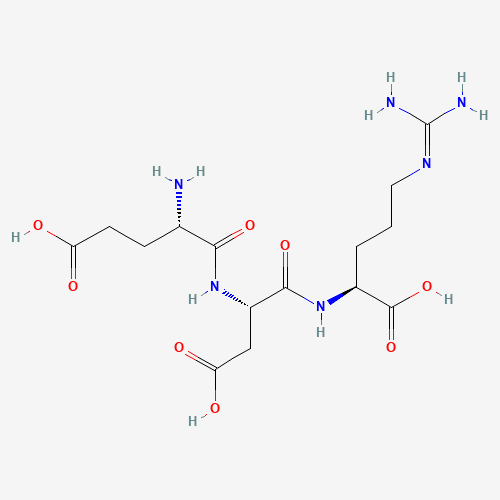
Pinealon
also EDR peptide · Glu-Asp-Arg · Pinealone
Pinealon is a three-amino-acid peptide, Glu-Asp-Arg, from the same St Petersburg programme that produced Epitalon — designed for the brain rather than the pineal gland despite the name. The cell work is real: it cuts reactive oxygen species and necrotic death in cerebellar granule neurons, neutrophils and PC12 cells, and its labelled form reaches the nucleus and binds DNA sequence-selectively [1][2]. The animal work is more mixed than the marketing suggests. In old rats given it before carotid occlusion, survival improved but position-finding, motivational behaviour and motor performance all fell and brain caspase-3 rose [3]. The one human study — 32 patients, open, Russian-language — found Pinealon less effective than its sister peptide Vesugen, with prooxidant activity on chemiluminescence and a fall in circulating CD34+ cells that the authors read as inhibition of haemopoiesis [4].
A short peptide with a coherent neuroprotective story in cells and a genuinely mixed one in animals and the single small human study, all of it from one research programme.
- meta-analysis
- RCT
- trial
- observational
- preclinical / case
- review / patent / other
- retracted
- + Dose-dependent suppression of reactive oxygen species and necrotic death in neurons, neutrophils and PC12 cells
- + The most active of four short peptides tested against hypobaric hypoxia in rodents
- + Enters the cell nucleus and binds DNA with sequence selectivity, a plausible route to gene regulation
- + Reported to improve memory complaints in elderly patients within the developing group's own literature
- − The single human study found it weaker than Vesugen and reported prooxidant activity and reduced CD34+ cells
- − In old rats before carotid occlusion it worsened several behavioural measures and raised brain caspase-3
- − No pharmacokinetic study in any species
- − Almost the entire literature is from one group, much of it in Russian-language journals
- − Not approved as a medicine outside Russia
Overview
Pinealon is Glu-Asp-Arg, a tripeptide from Vladimir Khavinson's short-peptide programme at the St Petersburg Institute of Bioregulation and Gerontology — the same programme that produced Epitalon and Cartalax. In that literature it is usually called the EDR peptide and it is presented as the brain's bioregulator, studied for neuroprotection, hypoxia tolerance and age-related cognitive decline [5].
The cell work is the strongest part. In a 2011 paper in Rejuvenation Research, pinealon produced dose-dependent restriction of reactive oxygen species in cerebellar granule cells, neutrophils and PC12 cells under both receptor-dependent and receptor-independent oxidative stress, and reduced necrotic cell death. The protection came with a delayed ERK1/2 time course and a modified cell cycle — and because the cell-cycle effect kept increasing at concentrations where the antioxidant effect had already saturated, the authors concluded the peptide acts on the genome directly as well as on radicals [1]. Separately, fluorescently labelled pinealon was found in the nucleus and nucleolus of HeLa cells and bound CNG- and CAG-containing oligonucleotides selectively, discriminating even their methylation status [2].
The animal work is mixed, and the mixture is informative. Against hypobaric hypoxia, pinealon was the most active of four short peptides tested [6]. Under acute hypoxic hypoxia in old rats it was described as increasing neurogenesis and returning neuroinflammatory markers towards reference values [7]. But in a head-to-head with Cortexin under hypoxia and hypothermia, Cortexin had the more pronounced effect on free-radical processes and caspase-3 [8]. And in old rats dosed before carotid artery occlusion, the result was two-sided: survival improved, but behavioural sleep time went up while position-finding, motivational behaviour and motor performance all went down, and caspase-3 activity rose moderately in the brain of both operated and sham animals [3]. A further study of peptide geroprotectors looked at navigation learning and caspase-3 across ages [9].
The human evidence is one study. Thirty-two people aged 41 to 83 with chronic polymorbidity and organic brain syndrome in remission were given Pinealon or Vesugen. The authors report a significant anabolic effect and improved central nervous system activity, slowing the rate of ageing on biological-age indicators — and they also report that Vesugen did more than Pinealon, that chemiluminescence showed prooxidant activity, and that circulating CD34+ haematopoietic cells fell, which they interpreted as significant inhibition of haemopoiesis. Chromatin condensation was unaffected, which they took as reassurance at the nuclear genetic level [4]. There is no control group described in the abstract, the article is in Russian, and no dose is given.
The 2020 review states that the EDR peptide "improves memory issues in elderly patients" [5]; the study above is the kind of evidence that statement rests on.
Mechanism
The proposed mechanism is the one shared across this family of peptides: small enough to enter the cell and the nucleus, binding chromatin and nucleic acids in a sequence-selective way, and changing which genes are transcribed [2][10].
For pinealon specifically, the 2020 review assembles a long downstream list — MAPK/ERK signalling, the proapoptotic proteins caspase-3 and p53, the antioxidant enzymes SOD2 and GPX1, the transcription factors PPARA and PPARG, serotonin and calmodulin — and notes that the peptide prevents the elimination of dendritic spines in neuronal cultures from mice with Alzheimer's and Huntington's models [5]. It is proposed to bind histones and RNA to do this. The same general framework has been set out for the whole peptide family [10][11][12].
Two gaps are worth naming. The list of affected proteins is largely a list of things measured after treatment, not a demonstrated chain of causation from a binding event. And the whole scheme requires an injected or swallowed tripeptide with free termini to survive peptidases, cross membranes and reach chromatin — which has been shown for labelled peptide added to cells in a dish [2] and never in a living animal, because no pharmacokinetic study exists.
There is also a real tension inside the mechanism. The cell work has pinealon suppressing ROS and necrosis [1]; the single human study found prooxidant activity by chemiluminescence and classified the peptide as a geroprotector of the "anabolic neuroprotective and no antioxidant type" [4]. Those are not the same picture.
- Reactive oxygen species in neuronsblocksdose-dependent restriction of ROS accumulation in cerebellar granule cells, neutrophils and PC12 cells under receptor-dependent and receptor-independent oxidative stress, with less necrotic cell death [1]moderate
- ERK1/2 (MAPK) signalling and the cell cyclemodulatesprotection was accompanied by a delayed time course of ERK1/2 activation and a modified cell cycle, and the cell-cycle effect continued at concentrations above those that saturated the antioxidant effect [1]weak
- Chromatin and DNAmodulatesfluorescently labelled pinealon appeared in the nucleus and nucleolus of HeLa cells and bound preferentially to CNG- and CAG-containing oligonucleotides, distinguishing their cytosine methylation status [2]weak
- Antioxidant enzymes (SOD2, GPX1)activatesweak
- Caspase-3 in brain tissuemodulatesunclear
- NMDA receptor excitotoxicityblocksproposed as a contributor to the antihypoxic effect in prenatal hypoxia experiments, but stated as a possibility rather than a measured result [6]weak
Formulation
how the form changes blood levelsPinealon is the free tripeptide Glu-Asp-Arg, molecular weight 418, supplied lyophilised. In Russia it is marketed both as an injectable and as an oral capsule product; the research literature uses injected routes in animals and does not report an absorption study for either form.
The peptide is one of a numbered family designed on the same principle — Vesugen (Lys-Glu-Asp), Testagen (Lys-Glu-Asp-Gly), Bronchogen (Ala-Glu-Asp-Leu), Epitalon (Ala-Glu-Asp-Gly) — and the DNA-binding study compared several of them side by side, finding that the sequence determines which oligonucleotide motifs they prefer [2].
Dosing
as studied or commonly reported; not a recommendationDoses below are what studies used or, where marked, what is commonly reported. None is a recommendation.
Intraperitoneal (animals)
- not stated in the available abstracts18-month-old rats, acute hypobaric hypoxia and mild hypothermia; behaviour and brain neurochemistrybefore the insult · single or short courseanimal study[8]
- not stated in the available abstractsold rats; survival, behaviour and brain caspase-3before carotid artery occlusion · single courseanimal study[3]
Oral
- not stated in the available abstract32 patients aged 41-83 with chronic polymorbidity and organic brain syndrome in remission; biological-age indicescourse treatment · not statedhuman study[4]
- Notes
- No dose is stated in a usable form anywhere in the published literature available in English. The rodent studies are Russian-language reports whose English abstracts omit the dose, and the single human study does the same [3][4]. Full texts were not obtainable for this entry. Anything quoted as a Pinealon protocol is community practice, not a studied dose.
Pharmacokinetics
what the body does with it| Half-life | No pharmacokinetic study of Pinealon has been published in any species |
|---|---|
| Bioavailability | Unknown. It is sold for subcutaneous injection and as an oral capsule in Russia; no study compares routes or measures absorption |
| Metabolism | Not characterised. A tripeptide with free termini would be expected to be cleaved quickly by plasma and tissue peptidases, and the proposed mechanism requires the intact peptide to reach the cell nucleus [2] — a step that has not been demonstrated in a living animal |
Safety
risks and cautions, not medical adviceNo adverse events are reported in the animal literature, and the human study reported none directly. What it did report deserves more attention than it usually gets.
In 32 patients, the authors found prooxidant activity by chemiluminescence, and a decrease in circulating CD34+ haematopoietic polypotent cells that they described as significant inhibition of haemopoiesis — noting the cells "have not been involved in the adaptive reactions". They found no effect on chromatin condensation and concluded the peptides are safe at the nuclear genetic level, while recommending that the haemopoietic finding be studied further [4]. That is an author-flagged open question in the only human study there is.
The rat carotid occlusion study is the other thing to weigh: survival improved, but the treated animals did worse on position-finding, motivational behaviour and motor performance, and brain caspase-3 — a measure of apoptotic machinery — rose moderately [3].
Beyond that, the usual limits of this category apply. No pharmacokinetics in any species. No long-term data. No independent replication of anything, and a literature concentrated in Advances in Gerontology and a small number of related journals, largely in Russian.
- One human study, open, 32 patients, Russian-language, with no dose reported [4]
- That study found Pinealon less effective than Vesugen, with prooxidant activity and reduced CD34+ cells [4]
- In old rats before carotid occlusion it worsened behavioural measures and raised brain caspase-3 [3]
- Cortexin outperformed it on free radicals and caspase-3 in a direct comparison [8]
- No pharmacokinetic study exists in any species
- No dose can be given from any published source
Interactions
documented pairs only, not exhaustiveNo interaction studies exist. In the human study Pinealon was compared with, not combined with, Vesugen [4], and in the rat work it was compared with Cortexin rather than given alongside it [3][8].
Nothing documents an interaction with any compound on this site.
History
Pinealon comes out of the same design principle as the rest of the Khavinson short peptides: take the amino acid composition of an organ extract, build a short peptide from it, and test whether it reproduces the extract's tissue-specific activity [10]. The DNA-binding work that underpins the family's proposed mechanism was published in 2011 alongside epithalon and testagen [2], and the Rejuvenation Research paper on ROS and cell viability appeared the same year [1].
The rodent hypoxia and stroke-model work ran through the 2010s from Rostov-on-Don and St Petersburg [3][7][8], the single human geroprotection study was published in 2015 [4], and a 2020 review in Molecules gathered the mechanistic claims under the Alzheimer's heading [5].
FAQ
- Is Pinealon a melatonin or pineal compound?
- Despite the name it is studied as a brain peptide — neuroprotection, hypoxia tolerance and cognition — not as a pineal hormone regulator. That role belongs to Epitalon in the same programme [5].
- Has it been tested in people?
- Once, in 32 patients aged 41 to 83 with polymorbidity and organic brain syndrome. It was reported to slow biological-age indicators, and also to show prooxidant activity and to reduce circulating CD34+ cells [4].
References
entry last reviewed 2026-09-19- [1]Pinealon increases cell viability by suppression of free radical levels and activating proliferative processes.Khavinson V, Ribakova Y, Kulebiakin K et al.Rejuvenation Res 2011other · cellPMID 21978084◌ unreviewed
- [2]Penetration of short fluorescence-labeled peptides into the nucleus in HeLa cells and in vitro specific interaction of the peptides with deoxyribooligonucleotides and DNA.Fedoreyeva LI, Kireev II, Khavinson VKh et al.Biochemistry (Mosc) 2011other · cellPMID 22117547◌ unreviewed
- [3][Effects of introduction of short peptides before carotid artery occlusion on behaviour and caspase-3 activity in the brain of old rats].Mendzheritskiĭ AM, Karantysh GV, Ivonina KOAdv Gerontol 2011other · animalPMID 21809624in Russian◌ unreviewed
- [4][EFFECT OF SYNTHETIC PEPTIDES ON AGING OF PATIENTS WITH CHRONIC POLYMORBIDITY AND ORGANIC BRAIN SYNDROME OF THE CENTRAL NERVOUS SYSTEM IN REMISSION].Meshchaninov VN, Tkachenko EL, Zharkov SV et al.Adv Gerontol 2015clinical trial · humanPMID 26390612in Russian◌ unreviewed
- [5]EDR Peptide: Possible Mechanism of Gene Expression and Protein Synthesis Regulation Involved in the Pathogenesis of Alzheimer's Disease.Khavinson V, Linkova N, Kozhevnikova E et al.Molecules 2020reviewPMID 33396470◌ unreviewed
- [6][Investigation of antihypoxic properties of short peptides].Kozina LSAdv Gerontol 2008other · animalPMID 18546825in Russian◌ unreviewed
- [7][Regulation of content of cytokines in blood serum and of caspase-3 activity in brains of old rats in model of sharp hypoxic hypoxia with Cortexin and Pinealon].Mendzheritskiĭ AM, Karantysh GV, Ryzhak GA et al.Adv Gerontol 2014other · animalPMID 25051764in Russian◌ unreviewed
- [8][Pinealon and Cortexin influence on behavior and neurochemical processes in 18-month aged rats within hypoxia and hypothermia].Mendzheritsky AM, Karantysh GV, Ryzhak GA et al.Adv Gerontol 2015other · animalPMID 28509493in Russian◌ unreviewed
- [9][Effect of peptide geroprotectors on the navigation system learning and caspase-3 in brain structures in rats of different age].Mendzheritski AM, Karantysh GV, Abramchuk VA et al.Adv Gerontol 2013other · animalPMID 28976148in Russian◌ unreviewed
- [10]Peptide Regulation of Gene Expression: A Systematic Review.Khavinson VK, Popovich IG, Linkova NS et al.Molecules 2021reviewPMID 34834147◌ unreviewed
- [11]Peptide Regulation of Cell Differentiation.Khavinson V, Linkova N, Diatlova A et al.Stem Cell Rev Rep 2020reviewPMID 31808038◌ unreviewed
- [12]Neuroepigenetic Mechanisms of Action of Ultrashort Peptides in Alzheimer's Disease.Ilina A, Khavinson V, Linkova N et al.Int J Mol Sci 2022reviewPMID 35457077◌ unreviewed