Orforglipron
also LY3502970 · LY-3502970 · GLP-1 receptor agonist 1 · Foundayo · Orforglipron (USAN)
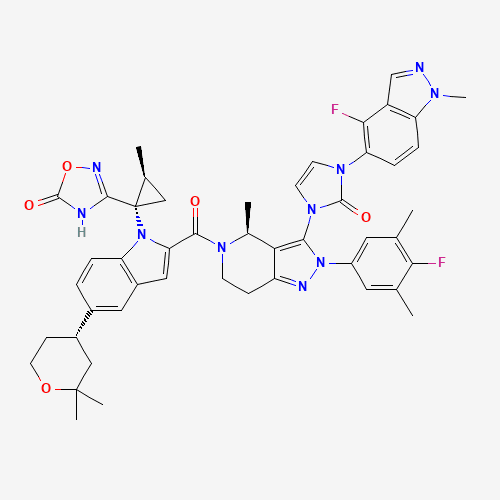
Orforglipron is the first GLP-1 receptor agonist that is not a peptide. That matters for a practical reason: a small molecule can be made by ordinary chemical synthesis rather than fermentation, and swallowed as a normal tablet with no food or water restrictions - unlike oral semaglutide, which needs an absorption enhancer and an empty stomach [1]. In ATTAIN-1, 72 weeks of 36 mg daily gave a mean 11.2% weight loss against 2.1% on placebo [1]; in ATTAIN-2, in people with obesity and type 2 diabetes, 9.6% against 2.5% [2]. That places it below injected semaglutide and well below tirzepatide on weight, and roughly where oral semaglutide sits - while being far easier to take and, in principle, far easier to manufacture at scale.
The first oral small-molecule GLP-1 agonist to reach phase 3, trading some efficacy for a tablet you can swallow with breakfast and a supply chain that does not depend on peptide manufacturing.
- meta-analysis
- RCT
- trial
- observational
- preclinical / case
- review / patent / other
- retracted
- + A true tablet with no food, water or timing restrictions
- + 11.2% mean weight loss at 72 weeks at the 36 mg dose
- + HbA1c reductions up to 2.1% in phase 2 in type 2 diabetes
- + Chemically synthesised, so manufacturing capacity is not limited by peptide production
- − Less weight loss than injected semaglutide or tirzepatide
- − Gastrointestinal adverse events in the majority, as with the rest of the class
- − Discontinuation for adverse events up to 10.3% at the higher doses
- − No cardiovascular outcome trial has reported
Overview
Every GLP-1 receptor agonist before orforglipron was a peptide. That has two consequences: it has to be injected, or swallowed with an absorption enhancer and an elaborate fasting ritual, and it has to be manufactured by fermentation and solid-phase synthesis, which is why supply has repeatedly failed to meet demand. Orforglipron is a small molecule designed to activate the same receptor, made by ordinary chemical synthesis and taken as an ordinary tablet [1].
Phase 2. In 272 adults with obesity, 36 weeks of orforglipron gave weight changes ranging from -9.4% to -14.7% across doses against -2.3% on placebo [3]. In 383 adults with type 2 diabetes, 26 weeks gave HbA1c reductions up to 2.10% and weight loss up to 10.1 kg, against 0.43% and 2.2 kg on placebo and 1.10% on dulaglutide [4]. Those numbers looked like they might match the injectables.
Phase 3 brought them down. ATTAIN-1 randomised 3127 adults with obesity. At 72 weeks, mean weight change was -7.5% at 6 mg, -8.4% at 12 mg and -11.2% at 36 mg, against -2.1% on placebo; in the 36 mg group, 54.6% lost at least 10%, 36.0% at least 15% and 18.4% at least 20% [1]. ATTAIN-2, in 1613 people with obesity and type 2 diabetes, gave -9.6% at 36 mg against -2.5% on placebo [2]. Weight loss is reliably smaller in people with type 2 diabetes across this whole drug class, so that drop is expected.
Where that leaves it. Around 11% is below injected semaglutide's 15% [5] and well below tirzepatide. It sits close to oral semaglutide's territory - an indirect comparison of oral semaglutide 25 mg against orforglipron 36 mg has been published, though indirect comparisons are weak evidence [6]. The argument for orforglipron is not that it works better. It is that a scalable tablet with no dosing ritual reaches people that injections and fasting rules do not.
What is missing. No cardiovascular outcome trial has reported. Improvements in risk biomarkers were seen in phase 2 [7], which is not the same thing at all - semaglutide's standing rests on SELECT, not on biomarkers [8].
Mechanism
Orforglipron binds and activates the GLP-1 receptor as a non-peptide agonist. The downstream biology is the class biology: glucose-dependent insulin secretion, glucagon suppression, slowed gastric emptying and central appetite suppression [9].
The interesting question is whether a small molecule engages the receptor in exactly the same way a peptide does. GLP-1 is a class B G-protein-coupled receptor, which normally binds its long peptide ligand across a large extracellular domain; getting a small molecule to reproduce that was the hard medicinal chemistry problem. The phase 3 efficacy - real, but consistently a few percentage points below injected semaglutide - is consistent with a partial or differently biased activation, although the trials were not designed to answer that.
The practical mechanism that matters most is pharmaceutical rather than pharmacological. Oral semaglutide needs SNAC to get any peptide across the gastric epithelium, and its absorption is destroyed by food or water [10]. A small molecule is absorbed the way small molecules are, which removes the ritual and much of the variability.
- GLP-1 receptoractivatesstrong
- Body weightblocksdose-dependent: -7.5%, -8.4% and -11.2% at 6, 12 and 36 mg over 72 weeks against -2.1% on placebo, with 18.4% of the 36 mg group losing 20% or more [1]strong
- HbA1cblocksin phase 2 in type 2 diabetes, reductions up to 2.10% (1.67% placebo-adjusted) at 26 weeks, against 0.43% on placebo and 1.10% on dulaglutide [4]strong
- Cardiovascular risk markersmodulatesimprovements in cardiovascular risk biomarkers were reported across the phase 2 programme, but no outcome trial has reported [7]weak
Formulation
how the form changes blood levelsAn ordinary tablet. No cold chain, no injection device, no absorption enhancer, no fasting window [1]. Manufacturing is conventional small-molecule chemistry, which is the supply-side argument for the drug: peptide manufacturing capacity has been the binding constraint on GLP-1 availability worldwide.
Dosing
as studied or commonly reported; not a recommendationDoses below are what studies used or, where marked, what is commonly reported. None is a recommendation.
Oral
- Form
- An ordinary oral tablet, taken once daily.
- Timing and food
- No restriction on food, water or time of day - the practical difference from oral semaglutide [1].
- Time to effect
- Weight loss was still accumulating at 72 weeks in phase 3 [1].
- Notes
- Dose escalation is used to manage gastrointestinal effects, as with the injected agonists. A phase 3b maintenance trial has examined whether a lower dose holds the weight off after a weight-loss phase [11].
Pharmacokinetics
what the body does with it| Half-life | Long enough to support once-daily dosing without the food and timing restrictions oral semaglutide requires [1] |
|---|---|
| Onset | Weight loss accumulates across the 72-week trial period; dose escalation runs over several months [1] |
| Bioavailability | Oral, and not dependent on an absorption enhancer or fasting state - the central practical advantage over oral semaglutide [1][10] |
| Metabolism | As a small molecule it is metabolised by ordinary hepatic routes rather than by peptidases |
Safety
risks and cautions, not medical adviceThe adverse-effect profile is the class profile, and it is dose-related. In ATTAIN-1, adverse events led to discontinuation in 5.3% to 10.3% across the orforglipron groups against 2.7% on placebo [1]. In phase 2 in diabetes, treatment-emergent adverse events ran from 61.8% to 88.9% across doses against 61.8% on placebo and 56.0% on dulaglutide, the majority gastrointestinal and mostly mild to moderate [4].
Three things are genuinely unknown. There is no cardiovascular outcome trial. There is no long-term exposure data beyond the trial durations. And as a small molecule it has a metabolic and drug-interaction profile that peptides do not have - hepatic metabolism creates interaction possibilities that injected peptides largely avoid - which will only be characterised properly with wider use.
The class-wide perioperative concern about delayed gastric emptying and residual gastric content should be assumed to apply [12][13].
Interactions
documented pairs only, not exhaustiveNo interaction data of note have been published. Unlike the peptide agonists, orforglipron is a small molecule subject to hepatic metabolism, so pharmacokinetic drug interactions are possible in a way they are not for semaglutide.
Delayed gastric emptying can slow the absorption of other oral drugs, and combining with insulin or a sulfonylurea raises hypoglycaemia risk, as for the rest of the class [4].
- SemaglutideavoidBoth activate the GLP-1 receptor; combining them adds adverse effects, not benefit [1].
- TirzepatideavoidOverlapping GLP-1 receptor agonism, and tirzepatide produces substantially more weight loss on its own [14].
History
Orforglipron came out of Chugai and was licensed to Eli Lilly. Phase 2 results in obesity and in type 2 diabetes were published together in 2023 and were the first demonstration that a small molecule could produce GLP-1-like weight loss [3][4]. The ATTAIN phase 3 programme reported in 2025 and 2026 [1][2], alongside a maintenance trial [11].
FAQ
- How much weight does orforglipron cause?
- About 11.2% at 36 mg over 72 weeks in people with obesity, and 9.6% in people who also have type 2 diabetes [1][2].
- Is it better than oral semaglutide?
- Not on weight loss - oral semaglutide 50 mg gave about 15% [10]. Orforglipron's advantage is that it is a normal tablet with no food or water restrictions [1].
- Why does a small molecule matter?
- Two reasons: no injection and no fasting ritual, and conventional chemical manufacturing rather than peptide synthesis, which has been the limiting factor in GLP-1 supply [1].
- Does it protect the heart?
- Unknown. Only risk biomarkers have been reported; no cardiovascular outcome trial has read out [7].
References
entry last reviewed 2026-09-19- [1]Orforglipron, an Oral Small-Molecule GLP-1 Receptor Agonist for Obesity Treatment.Wharton S, Aronne LJ, Stefanski A et al.N Engl J Med 2025RCT · humanPMID 40960239◌ unreviewed
- [2]Orforglipron, an oral small-molecule GLP-1 receptor agonist, for the treatment of obesity in people with type 2 diabetes (ATTAIN-2): a phase 3, double-blind, randomised, multicentre, placebo-controlled trial.Horn DB, Ryan DH, Kis SG et al.Lancet 2026RCT · humanPMID 41275875◌ unreviewed
- [3]Daily Oral GLP-1 Receptor Agonist Orforglipron for Adults with Obesity.Wharton S, Blevins T, Connery L et al.N Engl J Med 2023RCT · humanPMID 37351564◌ unreviewed
- [4]Efficacy and safety of oral orforglipron in patients with type 2 diabetes: a multicentre, randomised, dose-response, phase 2 study.Frias JP, Hsia S, Eyde S et al.Lancet 2023RCT · humanPMID 37369232◌ unreviewed
- [5]Once-Weekly Semaglutide in Adults with Overweight or Obesity.Wilding JPH, Batterham RL, Calanna S et al.N Engl J Med 2021RCT · humanPMID 33567185◌ unreviewed
- [6]Oral Semaglutide 25 mg Versus Orforglipron 36 mg in Obesity: A Population-Adjusted Indirect Treatment Comparison.Michalak W, Bøg M, Bendixen T et al.Diabetes Obes Metab 2026other · humanPMID 42225305◌ unreviewed
- [7]Treatment with orforglipron, an oral glucagon like peptide-1 receptor agonist, is associated with improvements of CV risk biomarkers in participants with type 2 diabetes or obesity without diabetes.Wharton S, Rosenstock J, Konige M et al.Cardiovasc Diabetol 2025RCT · humanPMID 40481478◌ unreviewed
- [8]Semaglutide and Cardiovascular Outcomes in Obesity without Diabetes.Lincoff AM, Brown-Frandsen K, Colhoun HM et al.N Engl J Med 2023RCT · humanPMID 37952131◌ unreviewed
- [9]Novel GLP-1-based Medications for Type 2 Diabetes and Obesity.Son JW, le Roux CW, Blüher M et al.Endocr Rev 2026reviewPMID 41054801◌ unreviewed
- [10]Oral semaglutide 50 mg taken once per day in adults with overweight or obesity (OASIS 1): a randomised, double-blind, placebo-controlled, phase 3 trial.Knop FK, Aroda VR, do Vale RD et al.Lancet 2023RCT · humanPMID 37385278◌ unreviewed
- [11]Orforglipron for maintenance of body weight reduction: the double-blind, randomized phase 3b ATTAIN-MAINTAIN trial.Aronne LJ, Horn DB, le Roux CW et al.Nat Med 2026RCT · humanPMID 42120723◌ unreviewed
- [12]Glucagon-Like Peptide-1 Receptor Agonist Use and Residual Gastric Content Before Anesthesia.Sen S, Potnuru PP, Hernandez N et al.JAMA Surg 2024observational · humanPMID 38446466◌ unreviewed
- [13]Association between glucagon-like peptide-1 receptor agonist use and peri-operative pulmonary aspiration: a systematic review and meta-analysis.Elkin J, Rele S, Sumithran P et al.Anaesthesia 2025meta-analysis · humanPMID 40230298◌ unreviewed
- [14]Tirzepatide as Compared with Semaglutide for the Treatment of Obesity.Aronne LJ, Horn DB, le Roux CW et al.N Engl J Med 2025RCT · humanPMID 40353578◌ unreviewed