Tirzepatide
also LY3298176 · Mounjaro · Zepbound
Tirzepatide is a once-weekly injected peptide that activates two gut-hormone receptors, GIP and GLP-1. It is approved for type 2 diabetes [1] and, as Zepbound, for chronic weight management [2]. In a 72-week trial in adults with obesity, the top dose lowered body weight by 20.9%, against 3.1% on placebo [3]. In a head-to-head trial it caused more weight loss than semaglutide (20.2% vs 13.7%) [4]. Most side effects are gastrointestinal, and the weight comes back when treatment stops [5].
One of the best-tested drugs on this site. Large phase 3 trials show big effects on weight and blood glucose, but gut side effects are common and the weight returns when treatment stops.
- meta-analysis
- RCT
- trial
- observational
- preclinical / case
- review / patent / other
- retracted
- + 15–21% average weight loss over 72 weeks in adults with obesity
- + Lowers HbA1c and weight more than semaglutide 1 mg in type 2 diabetes
- + Fewer heart-failure events in people with obesity and HFpEF
- + Fewer breathing interruptions in sleep apnoea with obesity
- − Nausea, diarrhoea and vomiting are common, mostly while the dose is being raised
- − Most of the lost weight returns after stopping
- − More gallbladder and bile-duct disease than placebo in trials
Overview
Tirzepatide is a single peptide that activates both the glucose-dependent insulinotropic polypeptide (GIP) receptor and the glucagon-like peptide-1 (GLP-1) receptor. It is injected under the skin once a week [6]. It is approved for type 2 diabetes [1], and the US FDA approved it for chronic weight management in November 2023 under the name Zepbound [2].
Obesity. In SURMOUNT-1, 2,539 adults with obesity or overweight but no diabetes took 5, 10 or 15 mg or placebo for 72 weeks. Weight fell by 15.0%, 19.5% and 20.9% on the three doses, against 3.1% on placebo, and half or more of those on 10 or 15 mg lost at least 20% of their body weight [3]. Among participants who also had prediabetes, three years of treatment kept weight 12–20% lower. Only 1.3% developed type 2 diabetes, against 13.3% on placebo [7]. In SURMOUNT-5, an open-label head-to-head trial in 751 adults, tirzepatide lowered weight by 20.2% and semaglutide by 13.7% at 72 weeks [4].
Type 2 diabetes. Used alone, all three doses lowered HbA1c by about 1.9–2.1 points over 40 weeks without clinically significant hypoglycaemia [8]. Against semaglutide 1 mg it lowered HbA1c and weight more [9]. A meta-analysis of seven trials found larger, dose-dependent HbA1c and weight reductions than placebo, GLP-1 agonists or basal insulin [10]. In 13,299 people with diabetes and heart disease, tirzepatide was non-inferior to dulaglutide on heart attack, stroke and cardiovascular death, but did not prove superior (hazard ratio 0.92) [11].
Complications of obesity. In heart failure with preserved ejection fraction and obesity, fewer patients on tirzepatide died of cardiovascular causes or had worsening heart failure (9.9% vs 15.3%). Cardiovascular deaths alone were few and did not differ [12]. In sleep apnoea with obesity, it cut 20–24 more breathing events per hour than placebo [13].
Mechanism
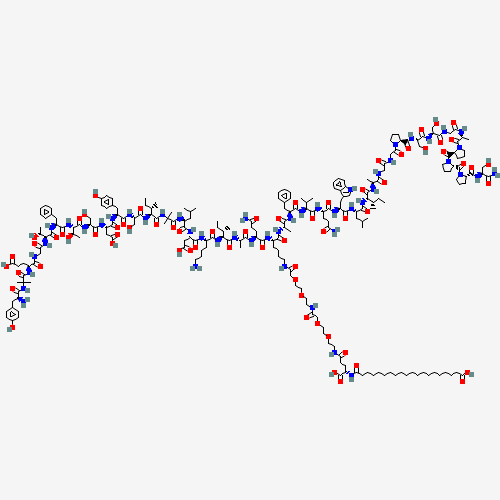
Tirzepatide is a 39-amino-acid peptide with a fatty acid chain that binds albumin, which lets it last a week. It binds the GIP receptor about as strongly as native GIP does, and the GLP-1 receptor about five times more weakly than GLP-1 [6]. At clinically effective doses it occupies the GIP receptor more than the GLP-1 receptor. At the GIP receptor it behaves like native GIP. At the GLP-1 receptor it is biased: it drives the cAMP signal but recruits less β-arrestin and internalises the receptor less than GLP-1 does. In islet experiments, β-arrestin limited the insulin response to GLP-1 but not to tirzepatide [14].
In obese mice it lowered food intake and body weight more than a GLP-1 agonist alone [6]. In people with type 2 diabetes, it improved markers of insulin sensitivity and beta-cell function more than dulaglutide, and weight loss explained only part of the improvement [15]. Like GLP-1 agonists, it slows stomach emptying after the first dose, but this effect largely fades with repeated dosing [16].
Dosing
as studied or commonly reported; not a recommendationDoses below are what studies used or, where marked, what is commonly reported. None is a recommendation.
Subcutaneous injection
- 5, 10 or 15 mgadults with obesity or overweight without diabetes (SURMOUNT-1)once weekly, reached over a 20-week dose escalation · 72 weekshuman study[3]
- 5, 10 or 15 mgtype 2 diabetes managed with diet and exercise alone (SURPASS-1)once weekly · 40 weekshuman study[8]
- 2.5 mg, raised by 2.5 mg every 4 weeks to 10 or 15 mgmoderate-to-severe obstructive sleep apnoea with obesity (SURMOUNT-OSA)once weekly · 52 weekshuman study[13]
- up to 15 mgheart failure with preserved ejection fraction and obesity (SUMMIT)once weekly · at least 52 weeks (median follow-up 104 weeks)human study[12]
- Form
- A 39-amino-acid peptide with two non-standard Aib residues and an amidated end, with a C20 fatty diacid attached through a linker to lysine 20 [6].
- Timing and food
- Once weekly. The labelled schedule starts at 2.5 mg, goes up to 5 mg after 4 weeks, then rises in 2.5 mg steps at least 4 weeks apart to a maximum of 15 mg [1]. In a model, a dose taken 4 days late gave a brief 20% rise in levels after the next scheduled dose [1].
- Time to effect
- Weight fell throughout the 72-week SURMOUNT-1 trial. Gastrointestinal side effects clustered in the dose-escalation period [3].
- Notes
- Doses above 5 mg are reached by stepping up gradually. This was already done in the first human study [6].
Pharmacokinetics
what the body does with it| Half-life | About 5 days: a mean of 116.7 hours in the first human study [6] and 5.4 days in a pooled population model [1] |
|---|---|
| Time to peak | 24–48 hours after a subcutaneous dose [6] |
| Bioavailability | About 80% after subcutaneous injection [1] |
| Steady state | Levels build up about 1.7-fold with weekly dosing [1] |
| Metabolism | A C20 fatty diacid chain lets it bind albumin, which lengthens its half-life [6]. Markers of kidney and liver function had no clinically relevant effect on exposure [1] |
Safety
risks and cautions, not medical adviceThe common side effects are gastrointestinal: nausea, diarrhoea, vomiting and constipation. They are mostly mild to moderate and happen mainly while the dose is being raised [3]. On 15 mg the odds of nausea were 5.6 times those on placebo, and more people on 15 mg stopped treatment because of side effects than on any comparator [10]. In SURMOUNT-1, 4.3–7.1% stopped because of side effects, against 2.6% on placebo [3].
A meta-analysis of nine trials found no significant increase in pancreatitis. Gallbladder or bile-duct disease was about twice as common as on placebo or basal insulin [17]. Hypoglycaemia was no more frequent than on placebo, and less frequent than on basal insulin [10].
Stopping leads to regain. In SURMOUNT-4, people who switched to placebo after 36 weeks regained 14% of their weight over the next year, while those who continued lost a further 5.5% [5].
- Weight is largely regained after stopping [5]
- Compounded and online "research" tirzepatide is not the approved product and its content is unverified
Interactions
documented pairs only, not exhaustiveTirzepatide slows gastric emptying after the first doses [16]. No trial has combined it with another drug acting on the same receptors, such as Retatrutide.
- Retatrutideavoid
FAQ
- Is tirzepatide stronger than semaglutide?
- In the one head-to-head obesity trial, tirzepatide lowered weight by 20.2% and semaglutide by 13.7% over 72 weeks [4]. In type 2 diabetes it also lowered HbA1c and weight more than semaglutide 1 mg [9].
- What happens if I stop taking it?
- In a withdrawal trial, people switched to placebo regained 14% of their body weight over a year; those who continued lost a further 5.5% [5].
- Why does it last a week?
- A fatty acid chain on the peptide binds albumin in the blood, giving a half-life of about five days [6].
References
entry last reviewed 2026-09-19- [1]Population pharmacokinetics of the GIP/GLP receptor agonist tirzepatide.Schneck K, Urva SCPT Pharmacometrics Syst Pharmacol 2024other · humanPMID 38356317◌ unreviewed
- [2]FDA Green-Lights Tirzepatide, Marketed as Zepbound, for Chronic Weight Management.Abbasi JJAMA 2023otherPMID 37966831◌ unreviewed
- [3]Tirzepatide Once Weekly for the Treatment of Obesity.Jastreboff AM, Aronne LJ, Ahmad NN et al.N Engl J Med 2022RCT · humanPMID 35658024◌ unreviewed
- [4]Tirzepatide as Compared with Semaglutide for the Treatment of Obesity.Aronne LJ, Horn DB, le Roux CW et al.N Engl J Med 2025RCT · humanPMID 40353578◌ unreviewed
- [5]Continued Treatment With Tirzepatide for Maintenance of Weight Reduction in Adults With Obesity: The SURMOUNT-4 Randomized Clinical Trial.Aronne LJ, Sattar N, Horn DB et al.JAMA 2024RCT · humanPMID 38078870◌ unreviewed
- [6]LY3298176, a novel dual GIP and GLP-1 receptor agonist for the treatment of type 2 diabetes mellitus: From discovery to clinical proof of concept.Coskun T, Sloop KW, Loghin C et al.Mol Metab 2018RCT · humanPMID 30473097◌ unreviewed
- [7]Tirzepatide for Obesity Treatment and Diabetes Prevention.Jastreboff AM, le Roux CW, Stefanski A et al.N Engl J Med 2025RCT · humanPMID 39536238◌ unreviewed
- [8]Efficacy and safety of a novel dual GIP and GLP-1 receptor agonist tirzepatide in patients with type 2 diabetes (SURPASS-1): a double-blind, randomised, phase 3 trial.Rosenstock J, Wysham C, Frías JP et al.Lancet 2021RCT · humanPMID 34186022◌ unreviewed
- [9]Tirzepatide versus Semaglutide Once Weekly in Patients with Type 2 Diabetes.Frías JP, Davies MJ, Rosenstock J et al.N Engl J Med 2021RCT · humanPMID 34170647◌ unreviewed
- [10]Management of type 2 diabetes with the dual GIP/GLP-1 receptor agonist tirzepatide: a systematic review and meta-analysis.Karagiannis T, Avgerinos I, Liakos A et al.Diabetologia 2022meta-analysis · humanPMID 35579691◌ unreviewed
- [11]Cardiovascular Outcomes with Tirzepatide versus Dulaglutide in Type 2 Diabetes.Nicholls SJ, Pavo I, Bhatt DL et al.N Engl J Med 2025RCT · humanPMID 41406444◌ unreviewed
- [12]Tirzepatide for Heart Failure with Preserved Ejection Fraction and Obesity.Packer M, Zile MR, Kramer CM et al.N Engl J Med 2025RCT · humanPMID 39555826◌ unreviewed
- [13]Tirzepatide for the Treatment of Obstructive Sleep Apnea and Obesity.Malhotra A, Grunstein RR, Fietze I et al.N Engl J Med 2024RCT · humanPMID 38912654◌ unreviewed
- [14]Tirzepatide is an imbalanced and biased dual GIP and GLP-1 receptor agonist.Willard FS, Douros JD, Gabe MB et al.JCI Insight 2020preclinical · cellPMID 32730231◌ unreviewed
- [15]Dual GIP and GLP-1 Receptor Agonist Tirzepatide Improves Beta-cell Function and Insulin Sensitivity in Type 2 Diabetes.Thomas MK, Nikooienejad A, Bray R et al.J Clin Endocrinol Metab 2021RCT · humanPMID 33236115◌ unreviewed
- [16]The novel dual glucose-dependent insulinotropic polypeptide and glucagon-like peptide-1 (GLP-1) receptor agonist tirzepatide transiently delays gastric emptying similarly to selective long-acting GLP-1 receptor agonists.Urva S, Coskun T, Loghin C et al.Diabetes Obes Metab 2020clinical trial · humanPMID 32519795◌ unreviewed
- [17]Safety issues of tirzepatide (pancreatitis and gallbladder or biliary disease) in type 2 diabetes and obesity: a systematic review and meta-analysis.Zeng Q, Xu J, Mu X et al.Front Endocrinol (Lausanne) 2023meta-analysis · humanPMID 37908750◌ unreviewed
- [18]LY3437943, a novel triple GIP, GLP-1, and glucagon receptor agonist in people with type 2 diabetes: a phase 1b, multicentre, double-blind, placebo-controlled, randomised, multiple-ascending dose trial.Urva S, Coskun T, Loh MT et al.Lancet 2022RCT · humanPMID 36354040◌ unreviewed