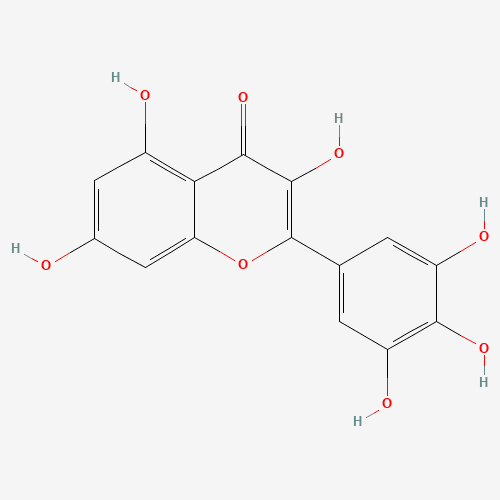
Myricetin
also Cannabiscetin · Myricetol · 3,3',4',5,5',7-Hexahydroxyflavone
Myricetin is a flavonol found in berries, vegetables, tea and wine [1]. It is studied for glucose regulation, mitochondrial function and neuroprotection, but the evidence for the isolated molecule remains preclinical. Small human trials have used blends containing myricetin; none separates its contribution from the other ingredients [2][3][4][5].
Promising animal data for endurance and metabolism; human blend trials do not establish what myricetin alone does.
- meta-analysis
- RCT
- trial
- observational
- preclinical / case
- review / patent / other
- retracted
- + Improved treadmill endurance and mitochondrial measures in mice
- + Glucose and lipid improvements across multiple mouse disease models
- + Defined molecular targets beyond antioxidant activity
- − Human trials use blends rather than isolated myricetin
- − Low oral bioavailability demonstrated in rats
- − Human pharmacokinetics and long-term safety remain unresolved
- − Laboratory platelet and drug-metabolism effects complicate combinations
Human data concern blends. In the Blueberin trial, 42 women with type 2 diabetes were randomized to placebo or three daily tablets containing blueberry leaf extract and myricetin for four weeks, alongside a controlled 1700-kcal diet. Fasting glucose, CRP and liver enzymes fell in the active group. The paper reports glucose units as mg/L despite values that appear inconsistent with that unit; no corrected absolute glucose values are presented here. A significant within-group change in one arm and a nonsignificant change in the other do not by themselves establish a between-group treatment effect [3].
Emulin was tested in 40 adults with diabetes for one week. Some glucose measures improved, especially in the metformin-plus-blend group, but isolated myricetin was not tested [4].
A 2024 single-blind pilot in 20 young adults tested a silymarin/PQQ/myricetin-containing product after red wine. The full-text table reports blood ethanol of 0.015 versus 0.020 g/L at 120 minutes, about 25% lower in the active group relative to placebo; the abstract's 33% figure instead corresponds to placebo being higher relative to the active group. Urinary ethyl glucuronide and the primary plasma ROS measure did not differ significantly between groups. CoQ10 and several other markers were also unchanged. This small blend study does not establish an alcohol-clearance effect of myricetin alone or reduced intoxication [5].
The clearer efficacy signals are in animals. A 2017 study gave male mice 50 mg/kg/day orally for three weeks and reported roughly twice the treadmill time and distance to exhaustion, with ten mice per group. Muscle and brown-fat mitochondrial measures improved, but body weight and food intake were unchanged; liver citrate synthase activity did not increase [6].
A 2024 meta-analysis pooled 21 studies involving 514 mice with metabolic disease models. Glucose, insulin, triglycerides, total cholesterol and LDL were lower overall, while the pooled HDL effect was not significant. Heterogeneity was substantial, reporting of randomization and blinding was weak, and publication-bias analyses suggested benefits could be overestimated. This is an animal meta-analysis, not clinical confirmation [2].
In a 2025 study, female 3xTg Alzheimer's-model mice given 50 mg/kg/day showed better object recognition and water-maze performance, fewer amyloid plaques and lower phosphorylated tau and neuroinflammatory markers. Behavioral groups contained ten mice; the human component was analysis of existing single-cell sequencing data, not a trial administering myricetin to patients [7].
Myricetin has several experimentally described actions. Its phenolic groups support radical-scavenging and metal-chelating chemistry, but it can also promote oxidation under some assay conditions. Antioxidant activity in a test tube does not establish a net clinical benefit [1].
In mouse muscle, increased SIRT1 expression, NAD-related changes and reduced PGC-1α acetylation accompanied mitochondrial biogenesis. SIRT1 knockdown attenuated the cell response, and the lifespan effect in worms was lost in a sir-2.1 mutant. These experiments support a SIRT1-dependent pathway; they do not establish myricetin as a directly binding SIRT1 agonist or show lifespan extension in humans [6].
Direct biochemical evidence includes inhibition of PDI and ERp5, enzymes involved in platelet function. Human blood exposed to myricetin in vitro formed fewer thrombi on collagen, but platelet spreading on fibrinogen was unaffected and ERp57/ERp72 reductase activity was not inhibited [8].
The Alzheimer's-model study measured binding to RORγt and interference with its interaction with the IL17 promoter. Lower Th17 polarization and IL-17 production offer a mechanistic explanation for the mouse neuroinflammation findings; human target engagement remains untested [7].
- Protein disulfide isomerase (PDI) and ERp5blocksBound purified thiol isomerases and inhibited PDI and ERp5 reductase activity; human platelets exposed in vitro showed reduced aggregation and thrombus formation. ERp57 and ERp72 activity was not inhibited at the tested concentrations [8].moderate
- RORγtblocksBound purified RORγt with a reported dissociation constant of 6.40 µM and blocked its recruitment to the IL17 promoter in cell experiments, reducing Th17 polarization. This has not been demonstrated after dosing people [7].moderate
- SIRT1–PGC-1α pathwayactivatesIncreased SIRT1 expression and PGC-1α deacetylation in mouse muscle; SIRT1 knockdown in cultured myotubes largely blocked PGC-1α induction. This supports pathway involvement, not proof of direct SIRT1 binding [6].moderate
Formulation
how the form changes blood levelsPlain myricetin is poorly water-soluble, and the rat PK experiment found low oral availability. The reviewed formulation literature treats poor absorption and stability as obstacles to development. Improved delivery cannot be assumed to confer a human clinical benefit or to share the safety of ordinary dietary exposure [1][2][9].
Dosing
as studied or commonly reported; not a recommendationDoses below are what studies used or, where marked, what is commonly reported. None is a recommendation.
Oral
- 50 mg myricetin within a 300 mg Blueberin tablet42 women with type 2 diabetes; blend also contained 250 mg blueberry leaf extract, providing at least 50 mg chlorogenic acid per tabletthree times daily, 15–30 minutes before meals with 100 mL water · 4 weekshuman study[3]
- 250 mg Emulin blend; myricetin portion not disclosed40 adults with type 2 diabetes, with or without metformin; blend of myricetin, quercetin and chlorogenic acidthree times daily, 15 minutes before meals · 1 weekhuman study[4]
- 50 mg/kg
- 50 mg/kgeight-month-old female 3xTg Alzheimer's-model mice; learning, memory and neuroinflammationonce daily by gavage · 8 weeks, as specified in the methodsanimal study[7]
- Form
- The human rows describe multi-ingredient products, not equivalent doses of isolated myricetin. Myricitrin is its rhamnoside glycoside, and dihydromyricetin is a different, structurally related molecule; studies of either cannot be substituted for myricetin evidence [1][2].
- Timing and food
- Before-meal administration belongs to the two glucose-blend protocols above. Neither compared food timing for isolated myricetin [3][4].
- Time to effect
- Mouse endurance was assessed after three weeks and cognition after eight weeks of dosing. These do not establish an onset of benefit in people [6][7].
- Notes
- No human dose of isolated myricetin was tested in the cited clinical trials. Blueberin provided 150 mg/day of myricetin alongside other active ingredients; this is not a validated standalone dose [3][4][5]. The alcohol pilot's accessible full text does not report the amount of myricetin in AGfit3, so it has no numerical dose row [5]. The Alzheimer's mouse paper's abstract says 8.5 weeks, whereas its dosing methods specify eight weeks; the row follows the methods [7].
Pharmacokinetics
what the body does with it| Half-life | No human half-life is established in the cited literature. The rat PK paper's full text could not be accessed from its publisher during this review, so no terminal half-life is quoted here [2][9]. |
|---|---|
| Bioavailability | In rats, absolute oral bioavailability was 9.62% after 50 mg/kg and 9.74% after 100 mg/kg. The assay used β-glucuronidase and sulfatase hydrolysis before measurement, so these values are not simply measurements of unconjugated circulating myricetin. They are not human absorption estimates [9]. |
| Metabolism | The rat analytical method measured myricetin after hydrolysis of glucuronide and sulfate conjugates; the clinical blend trials do not characterize the isolated molecule's human metabolic profile [3][4][5][9]. |
Safety
risks and cautions, not medical adviceShort studies provide some reassuring observations. All Blueberin participants completed four weeks and the authors reported no indication of adverse toxic effects, but that was a blend study [3]. The one-week Emulin study reported gastrointestinal issues in one participant in each metformin-containing arm, with no attribution to myricetin [4]. The alcohol pilot had no dropouts and no significant changes in its measured liver laboratory parameters over one week [5]. These studies do not establish the long-term safety of isolated myricetin.
In the endurance experiment, 50 mg/kg/day for three weeks produced no reported overt toxicity or changes in the assessed liver/kidney histology and serum measures; the methods describe histology from only one mouse per group [6]. In a separate experiment, 25 or 50 mg/kg orally for three days did not prolong mouse tail-bleeding time despite the strong in vitro antiplatelet findings [8].
High-concentration cell experiments are less reassuring: the review reports injury to isolated guinea-pig intestinal cells at 450 µM and pro-oxidant effects in particular metal-containing assay systems. These are toxicity signals in experimental systems, not demonstrated adverse-event rates in supplement users [1].
- Gastrointestinal complaints occurred in both metformin-containing arms of the Emulin trial; causation by myricetin was not established [4].
- Intestinal-cell injury and pro-oxidant effects have been observed at high concentrations in experimental systems; their relevance to oral human doses is unknown [1].
- Possible interactions with CYP3A4/CYP2C9 or P-glycoprotein substrates are supported by laboratory work and a rat losartan study, without a measured human interaction effect [10].
- Possible additive platelet inhibition with blood-thinning drugs is an inference from cell experiments; oral myricetin did not prolong bleeding time in the short mouse experiment [8].
- Pregnancy and breastfeeding safety is not established by these trials; the Emulin and alcohol pilot protocols excluded pregnant or breastfeeding participants [4][5].
- The human studies do not isolate myricetin from other active ingredients; their randomization does not justify a human-RCT evidence tier for the molecule itself [3][4][5].
- The metabolic meta-analysis includes mice only, with high heterogeneity and likely publication bias; its pooled HDL result was not significant [2].
- Mouse endurance and Alzheimer's-model results do not establish performance enhancement or dementia treatment in people [6][7].
- Human absorption, half-life and exposure to free versus conjugated myricetin are not resolved by the rat PK study or the cited blend trials [3][4][5][9].
Interactions
documented pairs only, not exhaustiveIn rats, coadministration of myricetin increased exposure to oral losartan. Parallel laboratory assays showed inhibition of CYP3A4, CYP2C9 and P-glycoprotein. This is a potential drug-interaction signal; its magnitude at human supplement doses is unknown [10].
Additive effects with antiplatelet or anticoagulant medicines are a mechanism-based concern inferred from the platelet assays, not a documented clinical interaction. The same study's mouse bleeding-time result was null [8]. Similarly, glucose-lowering combinations deserve caution because myricetin-containing blends changed glucose measures, but these trials do not establish a standalone myricetin interaction [3][4].
- Has myricetin itself been tested in a human randomized trial?
- The cited human randomized trials tested multi-ingredient products containing myricetin, not isolated myricetin. They establish evidence about the products and cannot identify its individual contribution [3][4][5].
- Is myricetin the same as dihydromyricetin or myricitrin?
- No. Dihydromyricetin is a distinct related flavonoid. Myricitrin is myricetin attached to a rhamnose sugar. Results for those substances should not be relabelled as trials of myricetin [1][2].
- Does it double endurance or extend life?
- Approximately doubled treadmill endurance was reported in mice after three weeks of dosing, and lifespan extension in that paper was demonstrated in worms. Neither establishes these effects in humans [6].
- Is its antiplatelet activity evidence that it causes bleeding?
- Human platelets exposed in vitro were inhibited, but oral treatment for three days did not lengthen tail bleeding time in mice. These results support a potential mechanism, not proof of clinical bleeding or of safety with anticoagulants [8].
References
entry last reviewed 2026-09-26- [1]Myricetin: A Dietary Molecule with Diverse Biological Activities.Semwal DK, Semwal RB, Combrinck S et al.Nutrients 2016reviewPMID 26891321◌ unreviewed
- [2]Efficacy of Myricetin Supplementation on Glucose and Lipid Metabolism: A Systematic Review and Meta-Analysis of In Vivo Mice Studies.Babotă M, Frumuzachi O, Tanase C et al.Nutrients 2024meta-analysis · animalPMID 39519561◌ unreviewed
- [3]Effect of Blueberin on fasting glucose, C-reactive protein and plasma aminotransferases, in female volunteers with diabetes type 2: double-blind, placebo controlled clinical study.Abidov M, Ramazanov A, Jimenez Del Rio M et al.Georgian Med News 2006RCT · humanPMID 17261891◌ unreviewed
- [4]Effect of emulin on blood glucose in type 2 diabetics.Ahrens MJ, Thompson DLJ Med Food 2013RCT · humanPMID 23444965◌ unreviewed
- [5]Consumption of Sylimarin, Pyrroloquinoline Quinone Sodium Salt and Myricetin: Effects on Alcohol Levels and Markers of Oxidative Stress-A Pilot Study.Bosco G, Vezzoli A, Brizzolari A et al.Nutrients 2024RCT · humanPMID 39275279◌ unreviewed
- [6]Myricetin improves endurance capacity and mitochondrial density by activating SIRT1 and PGC-1α.Jung HY, Lee D, Ryu HG et al.Sci Rep 2017preclinical · animalPMID 28740165◌ unreviewed
- [7]Myricetin Suppresses Inflammatory Th17 Polarization to Mitigate Alzheimer's Disease Pathogenesis.Li Y, Sun A, Han J et al.CNS Neurosci Ther 2025preclinical · animalPMID 41189072◌ unreviewed
- [8]Myricetin, the Main Flavonoid in Syzygium cumini Leaf, Is a Novel Inhibitor of Platelet Thiol Isomerases PDI and ERp5.Gaspar RS, da Silva SA, Stapleton J et al.Front Pharmacol 2019preclinical · animalPMID 32116678◌ unreviewed
- [9]Quantitative determination of myricetin in rat plasma by ultra performance liquid chromatography tandem mass spectrometry and its absolute bioavailability.Dang Y, Lin G, Xie Y et al.Drug Res (Stuttg) 2014preclinical · animalPMID 24357136◌ unreviewed
- [10]Effects of myricetin, an antioxidant, on the pharmacokinetics of losartan and its active metabolite, EXP-3174, in rats: possible role of cytochrome P450 3A4, cytochrome P450 2C9 and P-glycoprotein inhibition by myricetin.Choi DH, Li C, Choi JSJ Pharm Pharmacol 2010preclinical · animalPMID 20636879◌ unreviewed