Mazdutide
also IBI362 · GTPL13924 · IBI-362 · GLXC-26803 · compound 1 [US9938335B2]
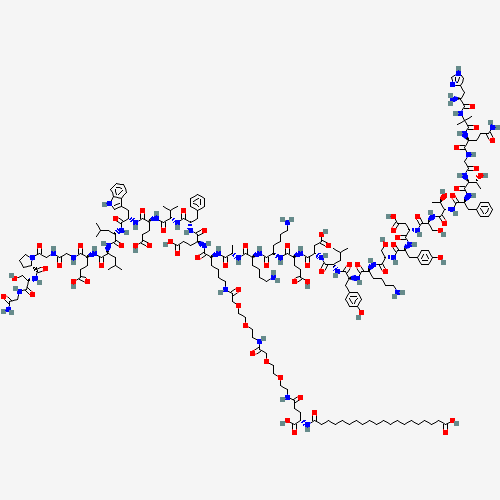
Mazdutide is a glucagon/GLP-1 dual agonist built on oxyntomodulin, a natural gut peptide that hits both receptors. It was licensed from Eli Lilly to Innovent Biologics and developed almost entirely in China, which makes its trial programme unusual: every efficacy result comes from Chinese participants, who start from a lower mean body weight than the Western obesity trials. GLORY-1 gave 14.01% weight loss at 6 mg over 48 weeks against a 0.30% gain on placebo [1], and GLORY-2, at 9 mg over 60 weeks, gave 16.65% against a 1.50% loss [2]. Those are tirzepatide-class numbers. The caveat is the population: whether they transfer to a heavier, more metabolically damaged Western cohort has not been tested, and a head-to-head against semaglutide is only now running [3].
A glucagon/GLP-1 dual agonist with weight results at the top of the field, produced entirely in Chinese trial populations, which is both its distinguishing feature and the main question about it.
- meta-analysis
- RCT
- trial
- observational
- preclinical / case
- review / patent / other
- retracted
- + 16.65% weight loss at 9 mg over 60 weeks, among the highest reported for a dual agonist
- + 14.01% at the lower 6 mg dose over 48 weeks
- + Very low discontinuation for adverse events - 2.9% at 9 mg, and under 2% in GLORY-1
- + Glucagon agonism adds energy expenditure to appetite suppression
- − Every efficacy trial is in a Chinese population with lower baseline weight than Western trials
- − Vomiting in 53% and nausea in 47% at the 9 mg dose
- − No cardiovascular outcome trial has reported
- − Not approved outside China
Overview
The molecule. Mazdutide (IBI362, LY3305677) is based on oxyntomodulin, a naturally occurring product of the proglucagon gene that activates both the GLP-1 and glucagon receptors. It was discovered at Eli Lilly and licensed to Innovent Biologics for development in China [4][5].
The trials, all in China. The phase 1b studies established dose ranges in Chinese adults with type 2 diabetes [4] and with overweight or obesity, the latter reaching 6.4% weight loss over 12 weeks at up to 6 mg [5]. Phase 2 in 248 participants gave -6.7%, -10.4% and -11.3% at 3, 4.5 and 6 mg over 24 weeks, against +1.0% on placebo [6].
GLORY-1, the phase 3 trial, randomised 610 Chinese adults with obesity or overweight plus a weight-related condition. At 32 weeks, weight change was -10.09% at 4 mg and -12.55% at 6 mg against +0.45% on placebo; at 48 weeks, -11.00% and -14.01% against +0.30%, with 35.7% and 49.5% losing at least 15% against 2.0% on placebo [1]. GLORY-2 took the dose to 9 mg in 461 participants over 60 weeks and reported -16.65% against -1.50% [2]. A further phase 2 examined 9 mg specifically in people with BMI of 30 or above [7].
Why the population matters. Mean baseline weight in GLORY-1 was 87.2 kg; in STEP 1 it was about 105 kg [1][8]. Chinese obesity cohorts differ from Western ones in baseline weight, body composition and the distribution of metabolic disease. Percentage weight loss in one does not automatically predict the other, in either direction. Until a trial runs elsewhere - and the DREAMS-3 head-to-head against semaglutide is designed to help with this [3] - the honest reading is that these are excellent results in the population studied.
Tolerability. This is where mazdutide looks unusually good. In GLORY-1, discontinuation for adverse events was 1.5% at 4 mg, 0.5% at 6 mg and 1.0% on placebo [1]. In GLORY-2 at the higher 9 mg dose it was 2.9% against 0% on placebo - despite vomiting in 53.1% and nausea in 46.9% [2]. High symptom rates, very few people stopping.
Mechanism
Oxyntomodulin is the natural template: a proglucagon-derived peptide that activates the GLP-1 receptor and the glucagon receptor, and which reduces food intake and raises energy expenditure in humans. Mazdutide is an engineered analogue of it, acylated for weekly dosing [4].
The two arms divide the labour. GLP-1 reduces intake and holds glycaemia; glucagon raises resting energy expenditure and acts on hepatic lipid handling. The theoretical hazard of glucagon agonism - raised blood glucose - is offset by the incretin arm and by weight loss itself, which is why HbA1c falls in these trials rather than rising [4].
Mazdutide and Survodutide are the same idea executed by different companies, and their weight results are broadly comparable once the population difference is taken into account.
- GLP-1 receptoractivatessupplies appetite suppression and glucose-dependent insulin secretion; mazdutide is built on oxyntomodulin, the natural dual agonist at this receptor and the glucagon receptor [4]strong
- Glucagon receptoractivatesthe second arm, contributing energy expenditure and hepatic effects in the same way as survodutide [5]strong
- Body weightblocksstrong
- HbA1cblocksreduced in the phase 1b trial in Chinese patients with type 2 diabetes, alongside dulaglutide as comparator [4]moderate
Formulation
how the form changes blood levelsA once-weekly subcutaneous injection. The peptide is acylated to a fatty diacid for albumin binding, the standard approach to a week-long half-life [5].
Dosing
as studied or commonly reported; not a recommendationDoses below are what studies used or, where marked, what is commonly reported. None is a recommendation.
Subcutaneous injection
- 4 mg or 6 mg610 Chinese adults with obesity or overweight with a weight-related condition (GLORY-1)once weekly · 48 weekshuman study[1]
- 9 mg
- 3, 4.5 or 6 mg
- 9 mg or 10 mgChinese adults with overweight or obesity, phase 1bonce weekly · multiple ascending dosehuman study[5]
- 3.0, 4.5 or 6.0 mgChinese patients with type 2 diabetes, phase 1b, against placebo and open-label dulaglutideonce weekly · 12 weekshuman study[4]
- Notes
- Baseline weight in GLORY-1 was 87.2 kg, considerably below the 105-110 kg typical of Western obesity trials [1][8]. Percentage weight loss is not automatically transferable between populations of different starting weight and body composition, and no trial outside China has reported. A head-to-head against semaglutide in type 2 diabetes and obesity is underway [3].
Pharmacokinetics
what the body does with it| Half-life | Supports once-weekly subcutaneous dosing; the peptide is acylated for albumin binding [5] |
|---|---|
| Onset | Weight loss accumulates across the trial period, with the 60-week GLORY-2 numbers exceeding the 48-week GLORY-1 numbers at a higher dose [1][2] |
| Metabolism | Peptide catabolism; no dedicated human pharmacokinetic publication was found for this entry beyond the phase 1b dose-ranging work [5] |
Safety
risks and cautions, not medical adviceThe gastrointestinal profile is typical of the class and dose-dependent: in GLORY-2 at 9 mg, vomiting affected 53.1% against 1.3% on placebo, nausea 46.9% against 3.2% [2].
What is striking is how few people stopped. Discontinuation for adverse events was 1.5% and 0.5% at 4 and 6 mg in GLORY-1 against 1.0% on placebo [1], and 2.9% at 9 mg in GLORY-2 against 0% [2]. Those are low numbers for a dual agonist at these doses. Whether that reflects the escalation schedule, the population, or trial conduct is not something the abstracts can settle.
What is not known. No cardiovascular outcome trial has reported. No data exist outside Chinese populations. Long-term exposure beyond 60 weeks has not been published. As with survodutide, glucagon receptor agonism is a mechanism that warrants long-term cardiovascular follow-up.
Class precautions - perioperative gastric emptying, hypoglycaemia with insulin or sulfonylureas - should be assumed [9][10].
Interactions
documented pairs only, not exhaustiveNo dedicated interaction studies have been published. Dulaglutide and semaglutide have appeared as comparators rather than combination partners [3][4].
Class considerations apply: slowed gastric emptying affects oral drug absorption, and combination with insulin or a sulfonylurea raises hypoglycaemia risk.
- SurvodutideavoidThe same dual glucagon/GLP-1 mechanism from a different developer; nothing is added by combining them [5].
- SemaglutideavoidOverlapping GLP-1 receptor agonism. Semaglutide is a comparator in the DREAMS-3 head-to-head trial, not a combination partner [3].
History
Mazdutide originated at Eli Lilly as LY3305677 and was licensed to Innovent Biologics for China. Phase 1b results in type 2 diabetes and in obesity were published in 2022 [4][5], phase 2 in 2023 [6], and the GLORY phase 3 trials in 2025 and 2026 [1][2]. A head-to-head against semaglutide, DREAMS-3, is in progress [3].
FAQ
- How much weight does mazdutide cause?
- 14.01% at 6 mg over 48 weeks and 16.65% at 9 mg over 60 weeks, in Chinese trial populations [1][2].
- Do those numbers apply outside China?
- Unknown. Mean baseline weight in GLORY-1 was 87.2 kg against about 105 kg in the Western semaglutide trials, and no trial has run elsewhere [1][8].
- How does it compare with survodutide?
- Same mechanism, different developer, comparable weight numbers - but the two have never been compared directly and were tested in different populations [1][11].
- Is it well tolerated?
- Symptom rates are high - vomiting in 53% at 9 mg - but discontinuation for adverse events was only 2.9% [2].
References
entry last reviewed 2026-09-19- [1]Once-Weekly Mazdutide in Chinese Adults with Obesity or Overweight.Ji L, Jiang H, Bi Y et al.N Engl J Med 2025RCT · humanPMID 40421736◌ unreviewed
- [2]Treatment With 9-mg Mazdutide for Weight Reduction in Chinese Adults With Obesity: The GLORY-2 Randomized Clinical Trial.Gao L, Jiang H, Cai H et al.JAMA 2026RCT · humanPMID 42251595◌ unreviewed
- [3]Mazdutide versus Semaglutide for the treatment of type 2 diabetes and obesity: Rationale, design and baseline data of DREAMS-3 phase 3 trial.Luo Y, Jiang H, Shi B et al.Contemp Clin Trials 2026clinical trial · humanPMID 41260459◌ unreviewed
- [4]A phase 1b randomised controlled trial of a glucagon-like peptide-1 and glucagon receptor dual agonist IBI362 (LY3305677) in Chinese patients with type 2 diabetes.Jiang H, Pang S, Zhang Y et al.Nat Commun 2022RCT · humanPMID 35750681◌ unreviewed
- [5]Safety and efficacy of a GLP-1 and glucagon receptor dual agonist mazdutide (IBI362) 9 mg and 10 mg in Chinese adults with overweight or obesity: A randomised, placebo-controlled, multiple-ascending-dose phase 1b trial.Ji L, Gao L, Jiang H et al.EClinicalMedicine 2022RCT · humanPMID 36247927◌ unreviewed
- [6]A phase 2 randomised controlled trial of mazdutide in Chinese overweight adults or adults with obesity.Ji L, Jiang H, Cheng Z et al.Nat Commun 2023RCT · humanPMID 38092790◌ unreviewed
- [7]Mazdutide 9 mg in Chinese adults with a body mass index ≥30 kg/m2 but without diabetes: A phase 2 randomized controlled trial.Ji L, Jiang H, Cheng Z et al.Med 2026RCT · humanPMID 41875890◌ unreviewed
- [8]Once-Weekly Semaglutide in Adults with Overweight or Obesity.Wilding JPH, Batterham RL, Calanna S et al.N Engl J Med 2021RCT · humanPMID 33567185◌ unreviewed
- [9]Glucagon-Like Peptide-1 Receptor Agonist Use and Residual Gastric Content Before Anesthesia.Sen S, Potnuru PP, Hernandez N et al.JAMA Surg 2024observational · humanPMID 38446466◌ unreviewed
- [10]Association between glucagon-like peptide-1 receptor agonist use and peri-operative pulmonary aspiration: a systematic review and meta-analysis.Elkin J, Rele S, Sumithran P et al.Anaesthesia 2025meta-analysis · humanPMID 40230298◌ unreviewed
- [11]Glucagon and GLP-1 receptor dual agonist survodutide for obesity: a randomised, double-blind, placebo-controlled, dose-finding phase 2 trial.le Roux CW, Steen O, Lucas KJ et al.Lancet Diabetes Endocrinol 2024RCT · humanPMID 38330987◌ unreviewed