Humanin
also HUMANIN TRIFLUOROACETATE · formyl humanin · Protein Humanin (human) · Humanin, human · 1-24-Protein humanin (human)
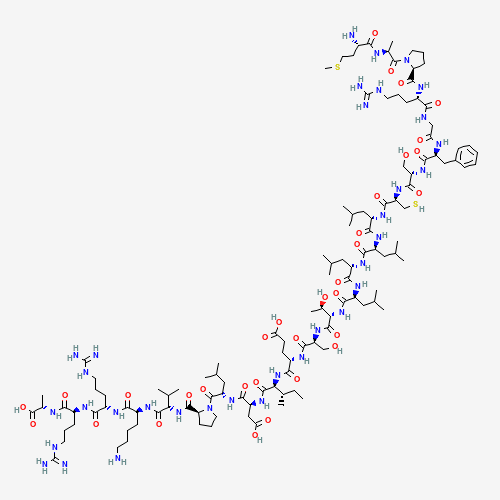
Humanin is a 24-amino-acid peptide encoded not in the nucleus but inside mitochondrial DNA, within the 16S rRNA gene. It was found in 2001 by screening a surviving region of an Alzheimer's brain for factors that protect neurons from amyloid-beta toxicity, which is an unusually direct origin story. It belongs to the same class as MOTS-c - mitochondria-derived peptides, or mitokines, which appear to signal cellular stress from mitochondria to the rest of the body [1]. The preclinical literature is broad: cytoprotection against apoptosis [2], cardiovascular effects [3], roles in cancer and degenerative disease [4] and in the testis [5]. There is no human trial. Circulating humanin declines with age, which is interesting and is not the same as a reason to inject it.
A genuinely novel piece of biology - a peptide written in mitochondrial DNA - with a broad preclinical literature and no human trial of any kind.
- meta-analysis
- RCT
- trial
- observational
- preclinical / case
- review / patent / other
- retracted
- + Protects neurons against amyloid-beta toxicity in the models it was discovered in
- + Broad cytoprotective and anti-apoptotic activity across tissue types
- + Part of a real and growing field of mitochondria-derived signalling peptides
- + Circulating levels decline with age, making it a plausible marker of mitochondrial function
- − No human trial, pharmacokinetic study or safety data
- − Anti-apoptotic activity is a double-edged property where cancer is concerned
- − Almost all evidence is cell culture and rodent
- − No established dose or route in any species that translates
Overview
Where it comes from. Almost every protein in a human cell is encoded in nuclear DNA. Humanin is not: its open reading frame sits inside the mitochondrial 16S ribosomal RNA gene. It was identified in 2001 by screening a region of an Alzheimer's patient's brain that had survived unusually well, looking for factors that protected neurons against amyloid-beta toxicity [2]. That screen produced a 24-residue peptide nobody had predicted existed.
What it does in models. The unifying activity is cytoprotection, largely through suppression of mitochondrial apoptosis [2]. From that base the literature spreads wide: cardiovascular protection in ischaemia and atherosclerosis models [3], roles in cancer and neurodegenerative disease [4], and a described role in the testis [5].
The mitokine idea. Humanin was the first of a family. MOTS-c followed, with its own metabolic phenotype [6], along with the small humanin-like peptides. These are now framed as mitokines: signals that report mitochondrial stress outward to the cell and the whole organism, and that change with age [1]. That is a real and interesting research programme, and it is where humanin's scientific importance lies.
What is missing. Everything clinical. No trial, no pharmacokinetics, no human safety data, no established dose or route. The observation most often used to justify supplementation - that circulating humanin falls with age - is an association in observational data. Declining levels of something could mean it is protective and being lost, or that it is a stress signal produced less because something upstream has changed. The direction of causation has not been established, and no intervention study exists to settle it.
A caution that follows from the mechanism. Humanin's central activity is blocking apoptosis. Apoptosis is how the body removes damaged and potentially malignant cells. The reviews that discuss humanin in degenerative disease also discuss it in cancer [4], and those are not separate topics - they are two consequences of the same property.
Mechanism
Humanin acts both intracellularly and as a secreted factor. Inside the cell it binds pro-apoptotic Bcl-2 family proteins, notably Bax, preventing their translocation to mitochondria and thereby blocking the intrinsic apoptotic pathway [2]. Extracellularly it has been reported to act through a trimeric receptor complex involving CNTFR, WSX-1 and gp130, and through formyl peptide receptor-like 1, activating STAT3 signalling.
As a mitokine, the framing is that mitochondrial stress increases transcription of the humanin reading frame, and the peptide then signals that stress state to the cell and beyond - a retrograde signal from organelle to nucleus and from tissue to organism [1].
Two honest gaps. First, the receptor pharmacology is less settled than the intracellular Bax interaction, and different papers invoke different receptors. Second, much of the in vivo animal work uses HNG (S14G-humanin), an engineered analogue considerably more potent than the natural peptide [2] - so results attributed to "humanin" often belong to a different molecule.
- Apoptosis (Bax and mitochondrial pathway)blocksbinds pro-apoptotic Bcl-2 family proteins and suppresses mitochondrial apoptosis, which is the core of its cytoprotective activity across models [2]moderate
- Amyloid-beta neurotoxicityblocksmoderate
- Cardiovascular tissuemodulatesprotective effects reported across models of ischaemia-reperfusion, atherosclerosis and cardiac injury [3]weak
- Mitochondrial stress signallingmodulatesone of the mitokines - peptides encoded in mitochondrial DNA that communicate mitochondrial stress to the cell and the organism, alongside MOTS-c and the SHLPs [1]weak
Formulation
how the form changes blood levelsSupplied as a lyophilised research peptide. Animal studies have used intraperitoneal, intracerebroventricular and intranasal routes; there is no human formulation and no published route selection for human use.
Much of the potent in vivo data uses the S14G analogue rather than native humanin, which is a distinction worth preserving when reading claims about it [2].
Dosing
as studied or commonly reported; not a recommendationNo doses are listed for this compound.No peer-reviewed human dosing data.
- Notes
- No human dose has been studied by any route, and no animal dose in the reviews available for this entry is reported in a form that converts to a human equivalent. Anything circulating as a humanin protocol is community practice, not a studied dose.
Pharmacokinetics
what the body does with it| Half-life | Not characterised in humans. Native humanin is rapidly cleared; analogues such as HNG (S14G-humanin) were engineered for greater potency in animal work [2] |
|---|---|
| Bioavailability | No human route has been established. Animal studies use intraperitoneal, intracerebroventricular and intranasal administration |
| Metabolism | Peptide catabolism; no published human data |
Safety
risks and cautions, not medical adviceThere is no human safety data of any kind - no trial, no pharmacokinetics, no case series.
The mechanistic concern worth naming explicitly is the anti-apoptotic one. Blocking mitochondrial apoptosis is protective for a neuron under stress and permissive for a cell that ought to die. The same review literature that covers humanin in degenerative disease covers it in cancer [4], and elevated humanin has been described in some tumour contexts. Nobody has studied what sustained exogenous administration does to cancer risk in any species over a relevant timescale.
A second point: because the natural peptide is cleared quickly and most potent animal data come from an engineered analogue [2], there is no basis for predicting what exposure an injection of native humanin produces or what it would do.
- None documented in humans, because no human study has been published
- Not approved for any use anywhere and never given to a person in a published study
- Its core activity is blocking apoptosis, which is also how the body eliminates damaged and potentially malignant cells [4]
- Claims based on falling humanin with age do not establish that raising it is beneficial
- No human trial, pharmacokinetic study or safety data of any kind
- Much of the potent in vivo data uses the engineered S14G analogue rather than native humanin [2]
- The age-related decline in circulating humanin is an association, not a demonstrated cause
- No dose or route has been established in any species in a form that translates
Interactions
documented pairs only, not exhaustiveNo interaction studies exist. The mechanistically related compound on this site is MOTS-c, another mitochondria-derived peptide, but with a metabolic rather than cytoprotective profile [1][6]. They have never been studied together.
- MOTS-ccautionBoth are mitochondria-derived peptides with different profiles - humanin cytoprotective, MOTS-c metabolic [1]. Neither has human trial data and the combination has never been studied.
History
Humanin was identified in 2001 from a screen of surviving occipital cortex from an Alzheimer's disease brain for factors protecting against amyloid-beta toxicity. It was the first peptide shown to be encoded within mitochondrial DNA, and the discovery opened the mitochondria-derived peptide field [2].
MOTS-c was described in 2015 with a distinct metabolic phenotype [6], and the mitokine framework linking these peptides to ageing was consolidated over the following decade [1]. Review coverage has expanded into cardiovascular disease [3], cancer and degeneration [4] and reproductive biology [5]. No clinical trial has been registered or published.
FAQ
- What makes humanin unusual?
- It is encoded inside mitochondrial DNA rather than in the nucleus - within the 16S rRNA gene - and was the first peptide shown to be [2].
- Has it been tested in people?
- No. There is no published human trial, pharmacokinetic study or case series.
- Its levels fall with age - doesn't that mean I should replace it?
- Not on its own. A falling level could mean the peptide is protective and being lost, or that it is a stress signal produced less for upstream reasons. No intervention study exists to distinguish these.
- Is blocking apoptosis safe?
- It is the question to ask. Apoptosis removes damaged and potentially malignant cells, and humanin's reviews cover cancer alongside degenerative disease for exactly that reason [4].
References
entry last reviewed 2026-09-19- [1]Mitochondrial stress and mitokines in aging.Burtscher J, Soltany A, Visavadiya NP et al.Aging Cell 2023reviewPMID 36642986◌ unreviewed
- [2]Humanin: A mitochondrial-derived peptide in the treatment of apoptosis-related diseases.Hazafa A, Batool A, Ahmad S et al.Life Sci 2021reviewPMID 33130077◌ unreviewed
- [3]Role of humanin, a mitochondrial-derived peptide, in cardiovascular disorders.Rochette L, Meloux A, Zeller M et al.Arch Cardiovasc Dis 2020reviewPMID 32680738◌ unreviewed
- [4]Mitochondrial-derived peptide humanin as therapeutic target in cancer and degenerative diseases.Zuccato CF, Asad AS, Nicola Candia AJ et al.Expert Opin Ther Targets 2019reviewPMID 30582721◌ unreviewed
- [5]The emerging role of mitochondrial derived peptide humanin in the testis.Lue Y, Swerdloff R, Jia Y et al.Biochim Biophys Acta Gen Subj 2021reviewPMID 34534645◌ unreviewed
- [6]The mitochondrial-derived peptide MOTS-c promotes metabolic homeostasis and reduces obesity and insulin resistance.Lee C, Zeng J, Drew BG et al.Cell Metab 2015preclinical · animalPMID 25738459◌ unreviewed