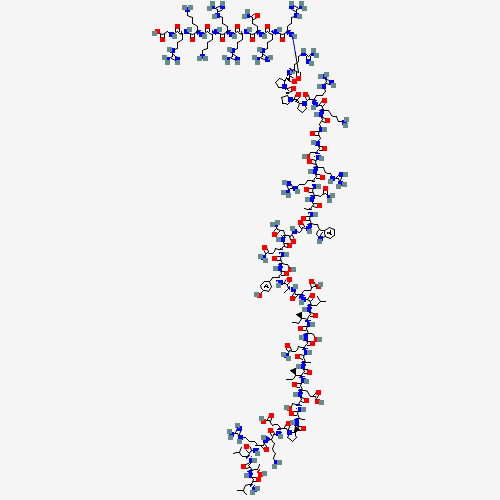
FOXO4-DRI
also FOXO4-DRI TFA salt form
FOXO4-DRI is a senolytic - a compound designed to kill senescent cells, the damaged cells that stop dividing but refuse to die and pump out inflammatory signals. It works by a clever trick: senescent cells stay alive because FOXO4 sequesters p53 in the nucleus, so the peptide is a retro-inverso decoy that breaks that interaction, p53 leaves the nucleus, and the cell kills itself [1]. In the 2017 Cell paper that introduced it, it restored fitness, fur density and kidney function in fast-ageing and naturally aged mice. Nine years later there is still no human trial, no human pharmacokinetics and no human safety data of any kind. There is also a significant piece of counter-evidence: in pulmonary arterial hypertension models, eliminating senescent cells made the disease worse, not better [2].
A genuinely elegant piece of molecular design with striking mouse data, zero human evidence, and at least one disease model where clearing senescent cells is actively harmful.
- meta-analysis
- RCT
- trial
- observational
- preclinical / case
- review / patent / other
- retracted
- + Restored fitness, fur density and renal function in naturally aged and fast-ageing mice
- + Neutralised doxorubicin chemotoxicity in mice
- + Selectively kills senescent cells while sparing normal ones, in the models tested
- + A well-characterised molecular mechanism, mapped down to the p53 transactivation domain
- − No human trial, no human pharmacokinetics, no human safety data
- − Clearing senescent cells worsened pulmonary hypertension in animal models
- − A retro-inverso peptide with no published route, dose or exposure data in people
- − Senescent cells have necessary physiological roles in wound healing and tumour suppression
Overview
What senescent cells are and why anyone would kill them. Cells that accumulate irreparable damage often stop dividing permanently rather than dying - a state called senescence, which evolved partly as a tumour-suppression mechanism. They persist, and they secrete a cocktail of inflammatory cytokines, proteases and growth factors known as the senescence-associated secretory phenotype. Senescent cells accumulate with age and with chemotherapy, and genetically clearing them in mice delays several features of ageing [1].
The design. The 2017 Cell paper from Peter de Keizer's group asked how senescent cells avoid apoptosis and identified FOXO4 as the pivot: in senescent cells FOXO4 binds p53 and keeps it in the nucleus, preventing the mitochondrial apoptosis that p53 would otherwise trigger. They designed a peptide that competes for that interaction. In senescent cells it causes p53 nuclear exclusion and cell-intrinsic apoptosis; normal cells, where the FOXO4-p53 interaction is not load-bearing, are spared. The peptide is retro-inverso - D-amino acids in reverse order - which resists proteolysis while preserving the binding surface, hence FOXO4-DRI [1]. A 2025 structural study mapped the target to the disordered transactivation domain of p53 [3].
The mouse results. Under conditions where it was tolerated, FOXO4-DRI neutralised doxorubicin-induced chemotoxicity, and restored fitness, fur density and renal function in both XpdTTD/TTD fast-ageing mice and naturally aged mice [1]. Later work found it targeted senescent Leydig cells and relieved age-related testosterone insufficiency in aged mice [4], improved spermatogenesis [5], killed keloid senescent fibroblasts [6] and, as a FOXO4 peptide, improved bleomycin-induced pulmonary fibrosis [7].
The counter-evidence, which is not minor. A 2023 Circulation study found senescent cells present in pulmonary arterial hypertension, and then found that eliminating senescent pulmonary endothelial cells by senolytic intervention promoted the development and progression of pulmonary hypertension [2]. Senescence is not uniformly bad; in some tissues and diseases the senescent cells are doing something necessary. Any account of senolytics that does not carry this is incomplete.
Human evidence. There is none. Not a phase 1, not a pharmacokinetic study, not a case series. Reviews continue to discuss the FOXO4-p53 axis as a pharmacological strategy - for brain ageing and cognitive decline, for instance [8] - and FOXO4 itself is being studied as a redox-sensitive regulator [9]. None of that is a trial.
Mechanism
In a senescent cell, p53 is present and would trigger apoptosis if it reached the mitochondria, but FOXO4 binds it and holds it in nuclear foci. FOXO4-DRI is a decoy that occupies the interaction interface. p53 is released, leaves the nucleus, and the cell undergoes intrinsic apoptosis. Because the dependence on FOXO4 is specific to the senescent state, non-senescent cells are largely unaffected [1].
The retro-inverso design is the pharmaceutical half of the idea. Reversing the sequence and using D-amino acids produces a peptide whose side chains project in roughly the same spatial arrangement as the L-peptide but which proteases cannot cleave [8]. That solves stability. It does not solve delivery, distribution or how much reaches a given tissue - none of which has been measured in any species in the literature available here.
The structural work has since shown the interaction runs through the intrinsically disordered transactivation domain of p53 [3], which is both satisfying and a caution: disordered-region interactions are promiscuous, and selectivity that holds in a dish may not hold across a whole animal.
- FOXO4-p53 interactionblocksstrong
- Senescent cell burdenblocksreduced senescent cells and restored tissue homeostasis in XpdTTD/TTD fast-ageing and naturally aged mice, and neutralised doxorubicin-induced chemotoxicity [1]moderate
- Senescent Leydig cells and testosteroneblocksmoderate
- Fibroblast senescenceblocksweak
- Endothelial cell senescenceblocksweak
Formulation
how the form changes blood levelsA retro-inverso peptide: the FOXO4 sequence read backwards, built from D-amino acids. All published work uses injected routes in animals. There is no human formulation, no approved product and no published stability or delivery data [1].
Dosing
as studied or commonly reported; not a recommendationDoses below are what studies used or, where marked, what is commonly reported. None is a recommendation.No peer-reviewed human dosing data. The doses below come from animal studies or company filings; animal doses do not translate directly to people.
Intraperitoneal (animals)
- not stated in a form usable hereXpdTTD/TTD fast-ageing and naturally aged mice; fitness, fur density and renal functionintermittent · weeksanimal study[1]
- not stated in a form usable herenaturally aged mice; testosterone secretion and Leydig cell senescencerepeated · not stated in the abstractanimal study[4]
- Notes
- No human dose has been studied by any route. The mouse doses in the abstracts available for this entry are not reported per kilogram in a form that can be converted to a human equivalent, and full texts were not obtained. Anything quoted as a FOXO4-DRI protocol is community practice, not a studied dose.
Pharmacokinetics
what the body does with it| Half-life | Not measured in any species in the published literature available for this entry |
|---|---|
| Bioavailability | Unknown. Animal work used injected routes; no oral data exist. Retro-inverso design confers resistance to proteolysis, which is its purpose, but no exposure measurements have been published |
| Metabolism | The retro-inverso construction - D-amino acids in reversed sequence - is intended to resist peptidases while preserving the side-chain topology needed for binding [1][8] |
Safety
risks and cautions, not medical adviceThere is no human safety data of any kind. The 2017 paper describes conditions under which the peptide was "well tolerated in vivo" in mice [1], which is a statement about mice.
Three concerns deserve stating plainly.
Senescence is not simply damage. It is a tumour-suppression mechanism, and it has a necessary role in wound healing and tissue remodelling. Removing senescent cells indiscriminately removes those functions too.
There is a disease where clearing them is harmful. In pulmonary arterial hypertension models, senolytic elimination of senescent pulmonary endothelial cells promoted disease development and progression [2]. This is a direct experimental result, not a theoretical worry, and nobody knows how many other contexts behave the same way.
Selectivity in vivo is assumed, not measured in humans. The mechanism's selectivity rests on senescent cells' particular dependence on FOXO4. Whether that holds across human tissues, at whatever exposure an injection actually produces, has never been tested.
A compound that instructs cells to undergo apoptosis, with no human pharmacokinetics and no dose-finding, is not in the same category as a peptide with thin efficacy evidence. The uncertainty is about what it does, not just whether it works.
- None documented in humans, because no human study has been published
- Not approved for any use anywhere and never given to a person in a published study
- Senescence suppresses tumours and supports wound healing; removing senescent cells removes those functions too
- Senolytic intervention promoted disease in a pulmonary hypertension model [2]
- No human trial, no human pharmacokinetics, no human safety data, nine years after the founding paper
- Clearing senescent cells worsened pulmonary arterial hypertension in animal models [2]
- No dose can be given: the mouse doses are not reported in a convertible form
- Selectivity for senescent cells has been demonstrated in models, not in humans [1]
Interactions
documented pairs only, not exhaustiveNo interaction studies exist. The one mechanistically relevant combination in the literature is with doxorubicin, where FOXO4-DRI neutralised chemotoxicity in mice by clearing the senescent cells the chemotherapy had created [1]. That is a plausible clinical application and it has never been tested in a person.
No interactions with other compounds on this site have been documented.
History
The peptide was introduced in a 2017 Cell paper from Erasmus MC in Rotterdam with Judith Campisi at the Buck Institute [1], and attracted wide attention - it was covered in Nature's news pages and drew commentary in the same issue of Cell.
The follow-up literature has been almost entirely preclinical: Leydig cells and testosterone in 2020 [4], pulmonary fibrosis in 2022 [7], spermatogenesis in 2024 [5], keloid fibroblasts and endothelial senescence in 2025 [6][10], and the structural target definition the same year [3]. The Circulation paper showing harm from senolysis in pulmonary hypertension appeared in 2023 [2]. Reviews have begun proposing retro-inverso senolytics for brain ageing [8].
FAQ
- Has FOXO4-DRI been given to humans?
- No. There is no published human trial, pharmacokinetic study or case series [1].
- How does it kill senescent cells and not normal ones?
- Senescent cells depend on FOXO4 to keep p53 in the nucleus, where it cannot trigger apoptosis. The peptide breaks that interaction; normal cells do not have the same dependence [1].
- Is clearing senescent cells always good?
- No. In pulmonary arterial hypertension models, eliminating senescent pulmonary endothelial cells promoted the disease [2]. Senescence also suppresses tumours and supports wound healing.
- What dose do people use?
- There is no studied dose in any species reported in a form that could be converted for humans. Anything circulating as a protocol comes from community practice.
References
entry last reviewed 2026-09-19- [1]Targeted Apoptosis of Senescent Cells Restores Tissue Homeostasis in Response to Chemotoxicity and Aging.Baar MP, Brandt RMC, Putavet DA et al.Cell 2017preclinical · animalPMID 28340339◌ unreviewed
- [2]Eliminating Senescent Cells Can Promote Pulmonary Hypertension Development and Progression.Born E, Lipskaia L, Breau M et al.Circulation 2023preclinical · animalPMID 36515093◌ unreviewed
- [3]The disordered p53 transactivation domain is the target of FOXO4 and the senolytic compound FOXO4-DRI.Bourgeois B, Spreitzer E, Platero-Rochart D et al.Nat Commun 2025preclinical · cellPMID 40593617◌ unreviewed
- [4]FOXO4-DRI alleviates age-related testosterone secretion insufficiency by targeting senescent Leydig cells in aged mice.Zhang C, Xie Y, Chen H et al.Aging (Albany NY) 2020preclinical · animalPMID 31959736◌ unreviewed
- [5]FOXO4-DRI improves spermatogenesis in aged mice through reducing senescence-associated secretory phenotype secretion from Leydig cells.Li Y, Zhang C, Cheng H et al.Exp Gerontol 2024preclinical · animalPMID 39025385◌ unreviewed
- [6]FOXO4-DRI induces keloid senescent fibroblast apoptosis by promoting nuclear exclusion of upregulated p53-serine 15 phosphorylation.Kong YX, Li ZS, Liu YB et al.Commun Biol 2025preclinical · cellPMID 39994346◌ unreviewed
- [7]FOXO4 peptide targets myofibroblast ameliorates bleomycin-induced pulmonary fibrosis in mice through ECM-receptor interaction pathway.Han X, Yuan T, Zhang J et al.J Cell Mol Med 2022preclinical · animalPMID 35510614◌ unreviewed
- [8]Targeting the FOXO4-p53 axis by retro-inverso peptide senolytic agents: a pharmacological strategy to mitigate brain aging and cognitive decline.Alameen AAM, Al-Kuraishy HM, Fawzy MN et al.Naunyn Schmiedebergs Arch Pharmacol 2026reviewPMID 42024235◌ unreviewed
- [9]FOXO4 as a Redox-Sensitive Regulator of Antioxidant Defense and Cellular Senescence: Cysteine-Based Signaling, p53 Interaction, and Therapeutic Targeting.Mateescu DM, Gavrilescu DM, Marinescu AR et al.Antioxidants (Basel) 2026reviewPMID 42510573◌ unreviewed
- [10]FOXO4-DRI regulates endothelial cell senescence via the P53 signaling pathway.Hu Z, Li F, Hu C et al.Front Bioeng Biotechnol 2025preclinical · cellPMID 41625068◌ unreviewed