Cagrilintide
also Cagrilintide [INN] · GTPL13768 · LDERDVMBIYGIOI-IZVMHKDJSA-N · EX-A10092 · AT42613
Cagrilintide is a long-acting analogue of amylin, the pancreatic hormone co-secreted with insulin that signals meal-related satiety. It works on its own - the phase 2 trial gave up to 10.8% weight loss at 4.5 mg over 26 weeks, beating daily liraglutide 3.0 mg at 9.0% [1] - but it is being developed primarily as half of CagriSema, a fixed combination with semaglutide. That combination gave 20.4% weight loss at 68 weeks against 3.0% on placebo in REDEFINE 1 [2], and 13.7% against 3.4% in people with type 2 diabetes [3]. The interest in amylin is that it suppresses appetite by a different route from GLP-1, so the two add up rather than overlap - and in eloralintide's phase 2 trial the amylin mechanism alone reached 20% [4].
The amylin analogue that proved satiety can be attacked from a second direction, best known as the other half of CagriSema and increasingly interesting in its own right.
- meta-analysis
- RCT
- trial
- observational
- preclinical / case
- review / patent / other
- retracted
- + Up to 10.8% weight loss as monotherapy over 26 weeks, beating liraglutide 3.0 mg head to head
- + Combined with semaglutide, 20.4% at 68 weeks - among the highest reported for any combination
- + Acts through amylin receptors, a mechanism independent of GLP-1, so the effects add
- + CagriSema produced clinically relevant blood pressure reductions, with 39.6% of treated participants reducing or stopping antihypertensives
- − Gastrointestinal adverse events in 79.6% of the CagriSema group in REDEFINE 1
- − Mostly developed as a combination, so monotherapy evidence is thinner
- − No cardiovascular outcome trial has reported
- − Not approved at the time of writing
Overview
What amylin does. Amylin is co-secreted with insulin from the pancreatic beta cell after a meal. It slows gastric emptying, suppresses glucagon and - the part that matters here - signals satiety through receptors in the area postrema. It is a genuinely separate satiety pathway from GLP-1, which is why combining the two is more than a dose increase [5][6]. Native amylin aggregates and is short-lived; pramlintide, the first analogue, required three-times-daily dosing. Cagrilintide is acylated for a week-long half-life [7].
On its own. The phase 2 trial randomised 706 adults with overweight or obesity to cagrilintide 0.3-4.5 mg, liraglutide 3.0 mg, or placebo for 26 weeks. Weight reductions ran from 6.0% to 10.8% across cagrilintide doses against 3.0% on placebo - and 4.5 mg beat liraglutide 3.0 mg, 10.8% against 9.0%. Gastrointestinal adverse events affected 41-63% against 32% on placebo, primarily nausea [1]. For a mechanism nobody had taken seriously as a standalone weight drug, that is a strong result.
As CagriSema. The phase 1b trial established that the two peptides could be given together, that cagrilintide's half-life of 159-195 hours matched semaglutide's, and that neither affected the other's pharmacokinetics [7]. REDEFINE 1 then randomised 3417 adults without diabetes to cagrilintide-semaglutide 2.4 mg each, semaglutide alone, cagrilintide alone, or placebo. The combination gave -20.4% at 68 weeks against -3.0% on placebo, and beat placebo on every threshold up to 30% weight loss [2]. REDEFINE 2, in 1206 people with type 2 diabetes, gave -13.7% against -3.4%, with 73.5% reaching HbA1c of 6.5% or less against 15.9% [3]. REIMAGINE 2 compared the combination against each component in type 2 diabetes [8].
Blood pressure. A prespecified analysis of REDEFINE 1 found 63.0% of the CagriSema group reaching blood pressure targets against 32.0% on placebo, and 39.6% of those on antihypertensive medication reducing or stopping it against 18.8% [9].
The context. Eloralintide's phase 2 trial reached 20% weight loss on amylin agonism alone [4], which suggests cagrilintide's monotherapy result was not the ceiling of the mechanism - and that the amylin class is going to be a real competitor, not just a combination partner.
Mechanism
Amylin receptors are formed when the calcitonin receptor associates with receptor activity-modifying proteins, and they are concentrated in the area postrema and nucleus tractus solitarius - brainstem regions outside the blood-brain barrier that sense circulating satiety signals. Amylin agonism there produces meal-related satiation, a different signal from GLP-1's, which is why the two combine additively rather than redundantly [5].
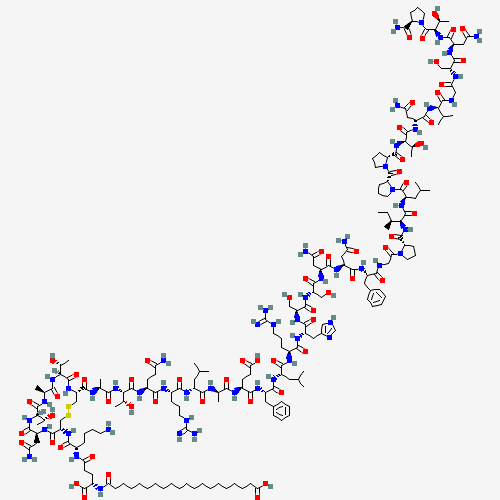
Cagrilintide is an acylated analogue engineered against amylin's natural tendency to aggregate, with a fatty diacid for albumin binding. Its half-life of 159-195 hours was deliberately matched to semaglutide's so that both can be delivered from one weekly injection [7].
There is a practical corollary worth noting. Because amylin acts on a different pathway, its adverse effects are not simply more of GLP-1's - nausea is common but the profile differs, and in eloralintide's trial fatigue emerged as a dose-related effect that is not prominent with incretins [4].
- Amylin and calcitonin receptorsactivatesstrong
- Body weight, as monotherapyblocks6.0% to 10.8% across doses of 0.3-4.5 mg over 26 weeks against 3.0% on placebo, and 10.8% at 4.5 mg against 9.0% for liraglutide 3.0 mg [1]strong
- Body weight, combined with semaglutideblocksstrong
- Blood pressureblocksin REDEFINE 1, 63.0% of the CagriSema group reached blood pressure targets against 32.0% on placebo, and 39.6% of those on antihypertensives reduced or stopped them against 18.8% [9]moderate
- Glycaemic controlblocks73.5% of the CagriSema group reached HbA1c of 6.5% or less against 15.9% on placebo in type 2 diabetes [3]strong
Formulation
how the form changes blood levelsA weekly subcutaneous injection. The commercial development is as CagriSema, a fixed-dose co-formulation of cagrilintide 2.4 mg and semaglutide 2.4 mg in one pen - made possible by matching the two half-lives [7].
Dosing
as studied or commonly reported; not a recommendationDoses below are what studies used or, where marked, what is commonly reported. None is a recommendation.
Subcutaneous injection
- 0.3, 0.6, 1.2, 2.4 or 4.5 mg706 adults with overweight or obesity without diabetes, phase 2, against liraglutide 3.0 mg and placeboonce weekly · 26 weekshuman study[1]
- 2.4 mg, with semaglutide 2.4 mg3417 adults with overweight or obesity without diabetes (REDEFINE 1)once weekly · 68 weekshuman study[2]
- 2.4 mg, with semaglutide 2.4 mg1206 adults with overweight or obesity and type 2 diabetes (REDEFINE 2)once weekly · not stated in the abstracthuman study[3]
- 0.16 to 4.5 mg, with semaglutide 2.4 mg95 adults with BMI 27.0-39.9; pharmacokinetics and tolerability of the combinationonce weekly · phase 1b multiple ascending dosehuman study[7]
- 2.4 mg, with semaglutide 2.4 mgpeople with type 2 diabetes, against semaglutide alone and cagrilintide alone (REIMAGINE 2)once weekly · phase 3human study[8]
- Form
- A weekly subcutaneous injection, and as the fixed-dose combination CagriSema alongside semaglutide 2.4 mg.
- Notes
- REDEFINE 1 included semaglutide-alone and cagrilintide-alone arms alongside the combination, which is the design that lets the contribution of each be separated; the headline published comparison is combination against placebo [2]. Cagrilintide's half-life was matched to semaglutide's deliberately, so that a single weekly injection can carry both [7].
Pharmacokinetics
what the body does with it| Half-life | 159 to 195 hours across doses of 0.16-4.5 mg - roughly a week, which supports weekly dosing and matches semaglutide's so the two can be co-formulated [7] |
|---|---|
| Time to peak | Median 24 to 72 hours after a subcutaneous dose [7] |
| Peak level | 6.14 to 170 nmol/L across the 0.16-4.5 mg dose range [7] |
| Bioavailability | Subcutaneous only; a peptide, not orally absorbed |
| Metabolism | Peptide catabolism plus beta-oxidation of the acyl chain; the acylation gives albumin binding and the week-long half-life [7] |
Safety
risks and cautions, not medical adviceGastrointestinal effects dominate, as across the field. In the phase 2 monotherapy trial they affected 41-63% of cagrilintide groups against 32% on placebo, primarily nausea at 20-47% against 18%; permanent discontinuation was driven by 30 adverse events across the whole trial [1]. In REDEFINE 1, the combination produced gastrointestinal adverse events in 79.6% against 39.9% on placebo [2]; in REDEFINE 2, 72.5% against 34.4% [3].
In the phase 1b combination study, 207 of the adverse events recorded - 37% of the total - were gastrointestinal, and they occurred in nearly every participant on both arms [7].
What is not known. No cardiovascular outcome trial has reported for cagrilintide or for CagriSema. Amylin agonism is a newer mechanism in humans than GLP-1 agonism, with correspondingly less long-term data; the largest body of prior human experience is with pramlintide in type 1 and type 2 diabetes. Long-term effects on lean mass, bone and the brainstem targets are not characterised.
The class perioperative gastric-emptying precaution applies, and applies more strongly to a combination [10][11].
Interactions
documented pairs only, not exhaustiveThe important interaction is the intended one. Cagrilintide and semaglutide do not affect each other's pharmacokinetics [7], and combined they produce substantially more weight loss than either alone [2][8].
Beyond that, no dedicated interaction studies have been published. Delayed gastric emptying affects oral drug absorption, and the combination's blood pressure effect means antihypertensive doses often need revisiting - in REDEFINE 1, 39.6% of treated participants on antihypertensives reduced or stopped them [9].
- Semaglutidecompatible
- EloralintideavoidBoth are amylin receptor agonists; there is no rationale for combining them [5].
- TirzepatidecautionAmylin and incretin agonism act through different pathways and would be expected to add, but the combination has not been studied and the gastrointestinal burden of each is already substantial [5].
History
Pramlintide, the first amylin analogue, reached the market for diabetes in 2005 but needed dosing with every meal and never found a place in obesity. Novo Nordisk's cagrilintide was the long-acting successor. The phase 1b combination study with semaglutide appeared in 2021 [7], followed by the phase 2 monotherapy trial later the same year [1].
The REDEFINE phase 3 programme reported in 2025 [2][3], with the blood pressure analysis and REIMAGINE 2 in 2026 [8][9]. Amylin has since become one of the most active areas in obesity pharmacology [5][6].
FAQ
- What is amylin and why does it matter here?
- A hormone co-secreted with insulin that signals meal-related satiety through brainstem receptors. It is a separate pathway from GLP-1, which is why the two combine additively [5].
- Does cagrilintide work on its own?
- Yes - up to 10.8% over 26 weeks in phase 2, beating daily liraglutide 3.0 mg at 9.0% [1]. It is mostly developed as a combination, but the mechanism stands alone.
- How much weight does CagriSema cause?
- 20.4% at 68 weeks against 3.0% on placebo in people without diabetes, and 13.7% against 3.4% in type 2 diabetes [2][3].
- Is it better tolerated than a GLP-1 alone?
- No. Gastrointestinal adverse events affected 79.6% of the CagriSema group against 39.9% on placebo in REDEFINE 1 [2].
References
entry last reviewed 2026-09-19- [1]Once-weekly cagrilintide for weight management in people with overweight and obesity: a multicentre, randomised, double-blind, placebo-controlled and active-controlled, dose-finding phase 2 trial.Lau DCW, Erichsen L, Francisco AM et al.Lancet 2021RCT · humanPMID 34798060◌ unreviewed
- [2]Coadministered Cagrilintide and Semaglutide in Adults with Overweight or Obesity.Garvey WT, Blüher M, Osorto Contreras CK et al.N Engl J Med 2025RCT · humanPMID 40544433◌ unreviewed
- [3]Cagrilintide-Semaglutide in Adults with Overweight or Obesity and Type 2 Diabetes.Davies MJ, Bajaj HS, Broholm C et al.N Engl J Med 2025RCT · humanPMID 40544432◌ unreviewed
- [4]Eloralintide, a selective amylin receptor agonist for the treatment of obesity: a 48-week phase 2, multicentre, double-blind, randomised, placebo-controlled trial.Billings LK, Hsia S, Bays H et al.Lancet 2025RCT · humanPMID 41207310◌ unreviewed
- [5]Long-acting amylin-related peptides as therapies for obesity and type 2 diabetes.Bailey CJ, Flatt PR, Conlon JMPeptides 2026reviewPMID 41747885◌ unreviewed
- [6]Amylin Analogs: The Next Major Class of Weight Loss Therapy: A Review of Experimental Data and Early-Phase Clinical Trials.Alhazmi A, le Roux CWDiabetes Obes Metab 2026reviewPMID 42452898◌ unreviewed
- [7]Safety, tolerability, pharmacokinetics, and pharmacodynamics of concomitant administration of multiple doses of cagrilintide with semaglutide 2·4 mg for weight management: a randomised, controlled, phase 1b trial.Enebo LB, Berthelsen KK, Kankam M et al.Lancet 2021RCT · humanPMID 33894838◌ unreviewed
- [8]Cagrilintide-semaglutide (CagriSema) versus semaglutide or cagrilintide in people with type 2 diabetes (REIMAGINE 2): a double-blind, randomised, controlled, phase 3 study.Buse JB, Bajaj HS, Dalskov SM et al.Lancet Diabetes Endocrinol 2026RCT · humanPMID 42251859◌ unreviewed
- [9]CagriSema Reduces Blood Pressure in Adults With Overweight or Obesity: REDEFINE 1.Verma S, Böttcher M, Brown P et al.Hypertension 2026RCT · humanPMID 41328546◌ unreviewed
- [10]Glucagon-Like Peptide-1 Receptor Agonist Use and Residual Gastric Content Before Anesthesia.Sen S, Potnuru PP, Hernandez N et al.JAMA Surg 2024observational · humanPMID 38446466◌ unreviewed
- [11]Association between glucagon-like peptide-1 receptor agonist use and peri-operative pulmonary aspiration: a systematic review and meta-analysis.Elkin J, Rele S, Sumithran P et al.Anaesthesia 2025meta-analysis · humanPMID 40230298◌ unreviewed