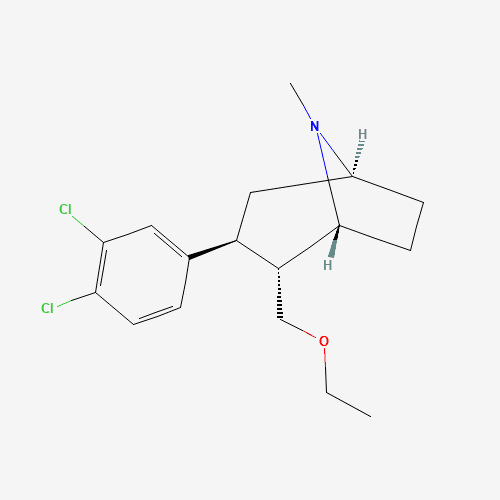
Tesofensine
also NS-2330 · tesofensina · NS2330 · NS 2330 · TESOFENSINUM
Tesofensine is not a GLP-1 anything. It is a triple monoamine reuptake inhibitor - it blocks the transporters for noradrenaline, dopamine and serotonin - originally developed for Parkinson's and Alzheimer's disease, where trials failed but participants lost weight [1]. That observation led to a phase 2 obesity trial in 203 patients: 24 weeks at 0.5 mg gave 9.2% weight loss against 2.0% on placebo, with heart rate up 7.4 beats per minute [2]. It never reached phase 3 for obesity. That trial also carries a Lancet expression of concern, issued in 2013 over under-reporting of adverse effects and never withdrawn [2]. A newer formulation combining tesofensine with metoprolol has been tested in hypothalamic obesity, a condition with almost no other options, giving 6.3% more weight loss than placebo in 21 patients [3].
A stimulant-class appetite suppressant with a striking phase 2 result, a pivotal trial under an unresolved expression of concern, no phase 3 in obesity, and a genuine niche in hypothalamic obesity.
- meta-analysis
- RCT
- trial
- observational
- preclinical / case
- review / patent / other
- retracted
- + 9.2% weight loss at 0.5 mg over 24 weeks in phase 2, roughly double what older obesity drugs achieved
- + A clear dose response across four randomised trials in a different indication
- + Abuse potential assessed formally and found no greater than placebo
- + Tesomet showed benefit in hypothalamic obesity, where few treatments work at all
- − The pivotal Lancet trial carries an unwithdrawn expression of concern about under-reporting of adverse effects
- − Heart rate rose 7.4 beats per minute at 0.5 mg
- − Never completed phase 3 for obesity
- − Dry mouth, insomnia, sleep disturbance and headache are common
- − A monoamine reuptake inhibitor carries the cardiovascular and psychiatric concerns that ended several earlier obesity drugs
Overview
A drug that found its indication by accident. Tesofensine was developed by NeuroSearch as a triple monoamine reuptake inhibitor for Parkinson's and Alzheimer's disease. It did not work for either. What the trials did show was weight loss: pooling four randomised trials, weight change at 14 weeks was +0.5% on placebo against -0.5%, -0.9%, -1.8% and -2.8% at 0.125, 0.25, 0.5 and 1.0 mg, and among the obese participants 32.1% at the top dose lost 5% or more against 2.1% on placebo [1].
The obesity trial. A phase 2 trial in five Danish centres randomised 203 patients with a BMI of 30-40 to tesofensine 0.25, 0.5 or 1.0 mg or placebo for 24 weeks, all on an energy-restricted diet. Placebo produced 2.0% weight loss; 0.25 mg produced 4.5% and 0.5 mg produced 9.2%. Heart rate rose 7.4 beats per minute in the 0.5 mg group; blood pressure did not change significantly at 0.25 or 0.5 mg. The authors concluded tesofensine 0.5 mg might produce twice the weight loss of the drugs then approved, and that phase 3 confirmation was needed [2].
The expression of concern. In April 2013 the Lancet issued an expression of concern about that trial over under-reporting of adverse effects; the authors replied in July 2013. The notice has not been withdrawn [2]. Anyone weighing this drug should weigh that: the headline efficacy number comes from a trial whose adverse-effect reporting the journal publicly questioned.
Phase 3 never happened for obesity in the major markets, and tesofensine is not approved in the United States, the European Union or the United Kingdom.
Hypothalamic obesity. This is the more interesting current use. Damage to the hypothalamus - usually from a craniopharyngioma or its treatment - causes rapid, intractable weight gain that responds poorly to everything. A randomised trial gave 21 adults Tesomet (tesofensine 0.5 mg with metoprolol 50 mg) or placebo for 24 weeks. Tesomet produced 6.3% more weight loss than placebo, and 8 of 13 reached 5% weight loss against 1 of 8. Sleep disturbance affected 50% against 13%, dry mouth 43% against 0% and headache 36% against 0%; heart rate and blood pressure did not differ significantly between groups, which was the point of adding the beta-blocker [3].
Abuse potential. Given that it blocks dopamine reuptake, this was examined directly. In recreational stimulant users, tesofensine's subjective effects were not distinguishable from placebo and were lower than dextroamphetamine 30 mg on every measure; the authors concluded its abuse potential is no greater than placebo [4].
Mechanism
Tesofensine blocks the presynaptic transporters for noradrenaline, dopamine and serotonin, raising synaptic concentrations of all three [2]. Appetite suppression follows from the combined monoaminergic tone - noradrenergic and serotonergic signalling both reduce food intake, and dopaminergic signalling is implicated in food reward.
The rat work adds a mechanistic wrinkle: in diet-induced obese rats, tesofensine reduced food intake and body weight and reduced striatal D2/D3 receptor availability [5] - a change in the reward system rather than only in hunger signalling.
The human appetite study is the most informative. Appetite sensations were suppressed while weight was actively falling; when the drug was reintroduced in a weight-reduced state, it suppressed them again [6]. That matters because the body defends a reduced weight by raising hunger, and a drug that still works against that defence is doing something useful.
The cardiovascular liability comes from the same mechanism. Raising noradrenergic tone raises heart rate; that is why the hypothalamic-obesity product pairs tesofensine with a beta-blocker [3]. It is also why a monoamine-based obesity drug carries history: sibutramine, a noradrenaline and serotonin reuptake inhibitor, was withdrawn over cardiovascular outcomes.
- Noradrenaline, dopamine and serotonin transportersblocksinhibits presynaptic reuptake of all three monoamines, which is the basis of both the appetite suppression and the cardiovascular effects [2]strong
- Appetite and food intakeblocksmoderate
- Body weightblocksmoderate
- Heart rateactivatesmoderate
Formulation
how the form changes blood levelsAn oral tablet, once daily. Tesomet is the fixed combination with metoprolol 50 mg, formulated specifically so that the beta-blocker offsets the sympathomimetic heart-rate effect - and in the hypothalamic obesity trial it did, with no significant heart rate or blood pressure difference against placebo [3].
Dosing
as studied or commonly reported; not a recommendationDoses below are what studies used or, where marked, what is commonly reported. None is a recommendation.
Oral
- 0.25 mg, 0.5 mg or 1.0 mg203 patients with obesity (BMI 30-40) on an energy-restricted diet, phase 2once daily · 24 weekshuman study[2]
- 0.125, 0.25, 0.5 or 1.0 mgpooled from four randomised trials in Parkinson's and Alzheimer's disease, where weight loss was an incidental findingonce daily · 14 weekshuman study[1]
- 0.5 mg tesofensine with 50 mg metoprolol (Tesomet)
- 0.25, 0.5 or 1.0 mg158 participants; appetite sensations during and after weight lossonce daily · two-part studyhuman study[6]
- Form
- An oral tablet. Tesomet is a fixed combination of tesofensine 0.5 mg with metoprolol 50 mg, the beta-blocker added specifically to offset the heart rate rise [3].
- Notes
- The 0.5 mg dose is the one the obesity programme settled on: 1.0 mg gave more weight loss but a worse adverse-effect profile [2]. Tesofensine is not approved for obesity in the United States, European Union or United Kingdom, and no phase 3 obesity trial has been published. Any dose quoted outside these trials is not a studied dose.
Pharmacokinetics
what the body does with it| Half-life | Long, supporting once-daily oral dosing; no figure appears in the abstracts available for this entry |
|---|---|
| Onset | Weight loss accumulated over 24 weeks in the obesity trial and was still progressing at the end [2] |
| Bioavailability | Orally active; all human trials used oral dosing [2] |
| Metabolism | Not characterised in the abstracts available for this entry. Full texts were not obtained |
Safety
risks and cautions, not medical adviceStart with the expression of concern. The pivotal obesity trial's adverse-effect reporting was publicly questioned by the Lancet in 2013, the authors responded, and the notice stands [2]. Every tolerability statement drawn from that trial should be read with that in mind.
What the trials report. In the obesity trial, the most frequent adverse effects were dry mouth, nausea, constipation, hard stools, diarrhoea and insomnia; heart rate rose 7.4 bpm at 0.5 mg, while blood pressure did not rise significantly at 0.25 or 0.5 mg [2]. In the pooled neurology trials, heart rate rose significantly from 0.25 mg upwards [1]. In the hypothalamic obesity trial, sleep disturbance affected 50% against 13% on placebo, dry mouth 43% against 0%, and headache 36% against 0% [3].
Abuse potential was formally assessed and found no greater than placebo in recreational stimulant users [4], which is a more reassuring result than a dopamine reuptake inhibitor might warrant on first principles.
What is missing is the thing that matters most for this drug class: cardiovascular outcome data. No phase 3 obesity trial was completed and no outcome trial exists. Sibutramine looked acceptable on blood pressure and heart rate too, until SCOUT measured events.
- Not approved for obesity in the United States, European Union or United Kingdom
- Do not combine with MAO inhibitors, and treat combination with serotonergic drugs or stimulants as risky
- The adverse-effect record of the pivotal trial was publicly questioned by its journal and the notice still stands [2]
- The pivotal obesity trial carries an unwithdrawn Lancet expression of concern over under-reporting of adverse effects [2]
- No phase 3 obesity trial has been published, 18 years after the phase 2 result [2]
- No cardiovascular outcome data, for a drug class with a history of cardiovascular withdrawals
- The hypothalamic obesity trial randomised 21 patients, of whom 18 completed [3]
Interactions
documented pairs only, not exhaustiveNo formal interaction studies appear in the available literature, but the pharmacology dictates caution. Combining a triple monoamine reuptake inhibitor with an MAO inhibitor risks hypertensive crisis and serotonin syndrome; combining it with SSRIs, SNRIs or other serotonergic drugs raises serotonin syndrome risk; combining it with stimulants compounds the cardiovascular effects.
The one documented combination is deliberate: metoprolol, added to blunt the heart rate rise [3].
- CaffeinecautionBoth raise sympathetic tone; tesofensine raised heart rate 7.4 bpm on its own at 0.5 mg [2].
- Modafinilcaution
- SemaglutidecautionEntirely different mechanisms - monoamine reuptake inhibition against GLP-1 agonism - so additive weight effects are plausible, but the combination has never been studied and tesofensine's cardiovascular profile is uncharacterised [2].
History
NeuroSearch developed tesofensine (NS2330) for Parkinson's and Alzheimer's disease in the early 2000s. Those programmes failed, but a meta-analysis of four randomised trials found consistent dose-dependent weight loss [1], which redirected the compound to obesity.
The phase 2 obesity trial was published in the Lancet in 2008 and attracted immediate attention for producing roughly double the weight loss of approved drugs [2][7]; a Danish secondary publication followed [8]. Abuse potential was assessed in 2010 [4] and appetite mechanisms in 2012 [6]. The Lancet issued its expression of concern in 2013.
Saniona took the compound forward as Tesomet, the metoprolol combination, into rare disease - hypothalamic obesity and Prader-Willi syndrome. The hypothalamic obesity trial reported in 2022 [3].
FAQ
- Is tesofensine a GLP-1 drug?
- No. It is a triple monoamine reuptake inhibitor - noradrenaline, dopamine and serotonin - and shares no mechanism with the incretin drugs [2].
- How much weight did it produce?
- 9.2% at 0.5 mg over 24 weeks against 2.0% on placebo, in a phase 2 trial of 203 patients [2].
- What is the expression of concern about?
- The Lancet questioned under-reporting of adverse effects in that trial in April 2013; the authors replied in July 2013 and the notice has not been withdrawn [2].
- Is it addictive?
- A formal abuse-liability study in recreational stimulant users found its subjective effects indistinguishable from placebo and lower than dextroamphetamine on every measure [4].
- Why is it combined with a beta-blocker?
- To offset the heart rate rise. In the hypothalamic obesity trial, Tesomet produced no significant heart rate or blood pressure difference against placebo [3].
References
entry last reviewed 2026-09-19- [1]Weight loss produced by tesofensine in patients with Parkinson's or Alzheimer's disease.Astrup A, Meier DH, Mikkelsen BO et al.Obesity (Silver Spring) 2008meta-analysis · humanPMID 18356831◌ unreviewed
- [2]Effect of tesofensine on bodyweight loss, body composition, and quality of life in obese patients: a randomised, double-blind, placebo-controlled trial.Astrup A, Madsbad S, Breum L et al.Lancet 2008RCT · humanPMID 18950853◌ unreviewedEXPRESSION OF CONCERN: Lancet. 2013 Apr 6;381(9873):1167. doi: 10.1016/S0140-6736(13)60778-3.23561987
- [3]Randomized controlled trial of Tesomet for weight loss in hypothalamic obesity.Huynh K, Klose M, Krogsgaard K et al.Eur J Endocrinol 2022RCT · humanPMID 35294397◌ unreviewed
- [4]Subjective and objective effects of the novel triple reuptake inhibitor tesofensine in recreational stimulant users.Schoedel KA, Meier D, Chakraborty B et al.Clin Pharmacol Ther 2010RCT · humanPMID 20520602◌ unreviewed
- [5]Triple monoamine inhibitor tesofensine decreases food intake, body weight, and striatal dopamine D2/D3 receptor availability in diet-induced obese rats.van de Giessen E, de Bruin K, la Fleur SE et al.Eur Neuropsychopharmacol 2012preclinical · animalPMID 21889317◌ unreviewed
- [6]The effect of tesofensine on appetite sensations.Gilbert JA, Gasteyger C, Raben A et al.Obesity (Silver Spring) 2012RCT · humanPMID 21720440◌ unreviewed
- [7]Tesofensine--a novel potent weight loss medicine. Evaluation of: Astrup A, Breum L, Jensen TJ, Kroustrup JP, Larsen TM. Effect of tesofensine on bodyweight loss, body composition, and quality of life in obese patients: a randomised, double-blind, placebo-controlled trial. Lancet 2008;372:1906-13.Doggrell SAExpert Opin Investig Drugs 2009reviewPMID 19548858◌ unreviewed
- [8][The effect of tesofensine on body weight and body composition in obese subjects--secondary publication].Nielsen AL, Larsen TM, Madsbad S et al.Ugeskr Laeger 2009RCT · humanPMID 19824222in Danish◌ unreviewed