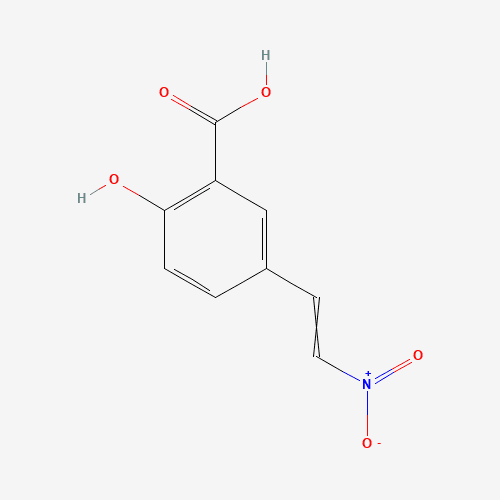
SANA
also MVD1 · 5-(2-nitroethenyl)salicylic acid · 2-hydroxy-5-(2-nitroethenyl)benzoic acid
SANA is a nitroalkene derivative of salicylate, the parent of aspirin, developed for obesity and type 2 diabetes. In obese mice it reduced weight, liver fat and insulin resistance by raising creatine-dependent energy expenditure in fat tissue [1]. MVD1 is the name its first human trial ran under. That trial was a small, 15-day phase 1 study, which reported good tolerability and early effects on body weight and glucose [2].
A genuinely novel fat-burning mechanism with a first human safety study behind it; everything about efficacy in people is still to come.
- meta-analysis
- RCT
- trial
- observational
- preclinical / case
- review / patent / other
- retracted
- + New mechanism, creatine-dependent thermogenesis in fat
- + Worked in mice at doses up to 40 times lower than salicylate
- + Phase 1 trial reported good safety and tolerability
- − Human data is one short phase 1 trial
- − Weight effects in people are exploratory, over two weeks
- − Not approved; sold only as a research chemical
Overview
Salicylate, the ancient drug behind aspirin, showed promise for type 2 diabetes but needed doses too high to use clinically. SANA, 5-(2-nitroethenyl)salicylic acid, was designed as a nitroalkene derivative. In mice with diet-induced obesity it reduced weight, liver steatosis and insulin resistance at doses up to 40 times lower than salicylate [1]. That first report is a preprint, not a peer-reviewed paper.
The peer-reviewed report came in 2025 with a randomised, double-blind, placebo-controlled phase 1A/B trial. Part A gave single doses of 200 to 800 mg to healthy lean volunteers. Part B gave 200 to 400 mg a day for 15 days to healthy volunteers with overweight or obesity [2]. That trial is registered as ACTRN12622001519741 and was run as MVD1, sponsored by EOLO USA [1].
Mechanism
SANA works differently from the usual fat-loss routes. It is not a GLP-1 drug and not a classic uncoupler. It raised mitochondrial respiration and creatine-dependent energy expenditure in adipose tissue. It worked at thermoneutral temperatures, without uncoupling protein 1 (UCP1) and independently of AMPK [2]. Depleting creatine abolished its effect in mice. SANA binds the mitochondrial creatine kinases CKMT1/2, and lowering CKMT1 interfered with its action [1].
Separately, it activates TMEM176B, an immune-regulating ion channel. In mice that prolonged skin and heart graft survival through heme oxygenase-1 and regulatory T cells [3]. That is a different research line from the obesity work, but it shows the molecule acts on more than one target.
- Creatine-dependent thermogenesis in adipose tissueactivatesraises energy expenditure without UCP1 and independently of AMPK [2]moderate
Safety
risks and cautions, not medical adviceThe phase 1 trial's primary endpoint was safety and tolerability, and the authors report that SANA was well tolerated [2]. That is the only human safety data. The longest exposure was 15 days, in small dose groups, so rare or long-term effects are unknown.
Anything sold online as SANA or MVD1 is an unregulated research chemical. Its identity and purity are not checked by anyone.
- Reported as well tolerated in the phase 1 trial [2]; no longer-term data
- Not approved anywhere; product identity and purity are unverified
- Acts on an immune channel as well as metabolism [3]; the consequences in people are unstudied
Interactions
documented pairs only, not exhaustiveNo interaction studies exist. Because SANA is a salicylate derivative, the obvious question is whether it shares aspirin-like effects on bleeding or on other salicylates. The papers cited here do not address that.
FAQ
- Is MVD1 the same as SANA?
- Yes. MVD1 is the name its first human trial (ACTRN12622001519741) ran under, sponsored by EOLO USA [1].
- Has SANA been tested in people?
- In one randomised phase 1 trial of up to 15 days, which reported good tolerability and early effects on body weight and glucose [2].
References
entry last reviewed 2026-09-18- [1]A nitroalkene derivative of salicylate alleviates diet-induced obesity by activating creatine metabolism and non-shivering thermogenesis.Cal K, Leyva A, Rodríguez-Duarte J et al.Res Sq 2023preclinical · animalPMID 37502859◌ unreviewed
- [2]A nitroalkene derivative of salicylate, SANA, induces creatine-dependent thermogenesis and promotes weight loss.Cal K, Leyva A, Rodríguez-Duarte J et al.Nat Metab 2025RCT · humanPMID 40527924◌ unreviewed
- [3]Activation of the Immunoregulatory Cation Channel TMEM176B by a Nitroalkene Derivative of Salicylate Prolongs Graft Survival.Galliussi G, Noboa J, Leyva A et al.Transplantation 2026preclinical · animalPMID 40691833◌ unreviewed