PNC-27
also
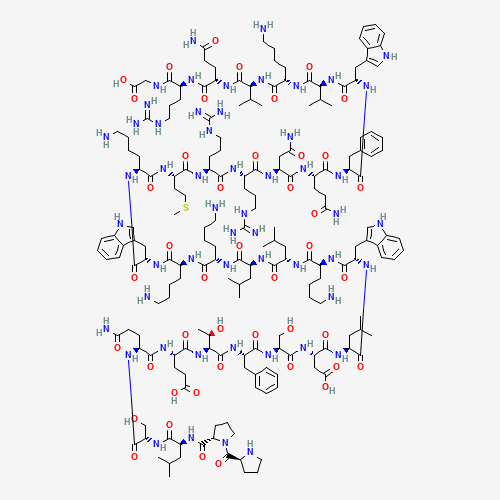
PNC-27 is a chimeric peptide - a fragment of p53 that binds HDM-2, joined to penetratin, a sequence that carries cargo across membranes. Its proposed mechanism is unusual and specific: cancer cells display HDM-2 in their plasma membrane, normal cells do not, and PNC-27 binds that membrane-bound HDM-2 and forms pores, lysing the cell [1][2]. In leukaemia cells it induced necrosis while sparing normal haematopoietic cells [3][4], and later work describes additional disruption of mitochondrial membranes [5]. It is a fifteen-year-old cell-culture programme from a small group of investigators, with no human trial and no published clinical development.
A specific and testable anticancer mechanism with a consistent in vitro record, confined to cell culture for fifteen years, with no human data.
- meta-analysis
- RCT
- trial
- observational
- preclinical / case
- review / patent / other
- retracted
- + A defined, selective mechanism targeting a membrane protein reported to be cancer-specific
- + Killed leukaemia cells while sparing normal haematopoietic cells in the same assays
- + Acts as the intact peptide rather than requiring metabolic activation
- + Kills by necrosis, which does not depend on intact apoptotic machinery
- − No human trial, pharmacokinetic study or safety data
- − Essentially the entire literature comes from one group of investigators
- − Almost all evidence is cell culture
- − The premise that HDM-2 is displayed only on cancer cell membranes is not independently established
Overview
The idea. p53 is the tumour suppressor most often disabled in cancer, and HDM-2 (the human homologue of MDM2) is the protein that binds and degrades it. Blocking that interaction to restore p53 is a well-established drug strategy pursued with small molecules. PNC-27 does something different.
The claim is that HDM-2 is displayed in the plasma membrane of cancer cells and not of normal cells. PNC-27 joins the HDM-2-binding region of p53 to penetratin, a membrane-transducing sequence. It binds membrane-bound HDM-2, adopts a p53-like conformation there, and forms pores that lyse the cell [1][2]. The killing is necrotic rather than apoptotic, so it does not require the apoptotic machinery that many cancers have disabled.
The results. In a poorly differentiated non-solid human leukaemia line, PNC-27 induced necrosis, and the effect depended on HDM-2 expression in the plasma membrane [4]. A 2020 study reported necrosis in leukaemia cells but not in normal haematopoietic cells [3]. The intact peptide, not a breakdown product, is the active species [6]. A 2022 structural study characterised the HDM-2-bound conformation and the pore formation [2], and a 2024 paper added mitochondrial membrane disruption as a second interaction [5].
What is missing, and what is unverified. There is no human trial, no pharmacokinetic study and no animal efficacy data in the abstracts available here. More fundamentally, the premise the whole programme rests on - that HDM-2 sits in cancer cell membranes and not normal ones - comes from the same group that developed the peptide and has not, in this literature, been independently established. If that premise is wrong, or holds only in some cancers, the selectivity argument goes with it.
The pattern to notice. Fifteen years of consistent in vitro results from a small set of investigators, with no progression to animal efficacy studies or clinical development. That is not evidence the work is wrong. It is a reason to ask why the next step has not been taken.
Mechanism
PNC-27's active region is the p53 sequence that contacts HDM-2, fused to penetratin. The proposed sequence of events is: the chimeric peptide reaches a cancer cell, binds HDM-2 exposed in the plasma membrane, adopts the conformation p53 takes when bound to HDM-2, and in doing so forms a transmembrane pore. The cell lyses [1][2].
Two features distinguish this from the conventional HDM-2 strategy. It does not restore p53 function - it uses p53's binding surface as a targeting device. And it kills by necrosis, so it is unaffected by loss of the apoptotic machinery, which is a genuine advantage if the mechanism is real [4].
The 2024 addition of mitochondrial membrane disruption [5] complicates the selectivity argument rather than strengthening it: a peptide that disrupts mitochondrial membranes has a route to toxicity that does not depend on membrane HDM-2 at all, and therefore does not depend on the cell being cancerous.
The whole account rests on the cancer-specific membrane localisation of HDM-2. That is the load-bearing claim, and it is the one least independently verified.
- Membrane-bound HDM-2blocksmoderate
- Plasma membrane integrityblocksmoderate
- Mitochondrial membranesblockslater work describes a second interaction, with mitochondrial membranes, causing mitochondrial disruption alongside the plasma membrane effect [5]weak
- Cancer cell necrosisactivatesinduced tumour cell necrosis in a poorly differentiated non-solid human leukaemia line, dependent on HDM-2 expression in the plasma membrane [4]moderate
Formulation
how the form changes blood levelsA synthetic chimeric peptide, used in cell culture in all the published work. No formulation, route or delivery system for use in an organism has been published.
Dosing
as studied or commonly reported; not a recommendationNo doses are listed for this compound.No peer-reviewed human dosing data.
- Notes
- No dose has been established in humans or in any animal study reported in the abstracts available for this entry. The published work is cell culture, where concentrations in a dish do not translate to a dose in an organism. Anything quoted as a PNC-27 protocol is community practice, not a studied dose.
Pharmacokinetics
what the body does with it| Half-life | Not measured in any species. The intact peptide is the active species, so stability matters, and nothing has been published on it [6] |
|---|---|
| Bioavailability | No route has been established in any species |
| Metabolism | Not characterised |
Safety
risks and cautions, not medical adviceThere is no safety data of any kind - no human study, and no animal toxicology in the abstracts available here.
The selectivity claim is the safety claim, and it is worth separating the two things it rests on. The in vitro observation that normal haematopoietic cells survived while leukaemia cells died [3] is a real result in a specific comparison. The general premise that membrane HDM-2 marks cancer cells across tissues is an extrapolation from it.
The reported mitochondrial membrane disruption [5] is the finding that should temper confidence most: mitochondrial membranes are not cancer-specific.
A pore-forming peptide with no pharmacokinetic data, no animal toxicology and no established dose is not in the same risk category as a compound with weak efficacy evidence. The uncertainty is about what it does to an organism, and nobody has looked.
- None documented, because no study in an organism has been published
- Not approved anywhere and never given to a person in a published study
- This is a cell-culture programme, and cancer is not a condition to treat on cell-culture evidence
- Fifteen years without progression to animal efficacy or clinical development is itself informative
- No human trial, no pharmacokinetics, and no animal efficacy data in the available literature
- The premise that HDM-2 is displayed only on cancer cell membranes has not been independently established
- Essentially the entire literature comes from one group of investigators
- Reported mitochondrial membrane disruption is a route to toxicity that is not cancer-specific [5]
Interactions
documented pairs only, not exhaustiveNo interaction studies exist.
History
The PNC series came out of work on p53-derived peptides at New York Medical College and collaborating institutions. The key mechanistic papers appeared in 2010 - the HDM-2-binding conformation and membrane killing [1], and the demonstration that the intact peptide is the active species [6].
Leukaemia work followed in 2014 [4] and 2020 [3], a structural account of pore formation in 2022 [2], and the mitochondrial interaction in 2024 [5]. No clinical trial has been registered or published in this literature.
FAQ
- How is PNC-27 supposed to work?
- By binding HDM-2 displayed in the plasma membrane of cancer cells and forming pores that lyse them - using p53's binding surface as a targeting device rather than restoring p53 function [1][2].
- Has it been tested in people or animals?
- No human trial exists, and the abstracts available here report cell culture work rather than animal efficacy studies.
- Is it selective for cancer cells?
- In one comparison it killed leukaemia cells while sparing normal haematopoietic cells [3]. The general premise behind that - cancer-specific membrane HDM-2 - comes from the same investigators and is not independently established.
- What about the mitochondrial effect?
- A 2024 paper describes disruption of mitochondrial membranes as a second mechanism [5]. Mitochondrial membranes are not cancer-specific, which complicates the selectivity argument.
References
entry last reviewed 2026-09-19- [1]Anticancer peptide PNC-27 adopts an HDM-2-binding conformation and kills cancer cells by binding to HDM-2 in their membranes.Sarafraz-Yazdi E, Bowne WB, Adler V et al.Proc Natl Acad Sci U S A 2010other · humanPMID 20080680◌ unreviewed
- [2]PNC-27, a Chimeric p53-Penetratin Peptide Binds to HDM-2 in a p53 Peptide-like Structure, Induces Selective Membrane-Pore Formation and Leads to Cancer Cell Lysis.Sarafraz-Yazdi E, Mumin S, Cheung D et al.Biomedicines 2022otherPMID 35625682◌ unreviewed
- [3]Targeting Membrane HDM-2 by PNC-27 Induces Necrosis in Leukemia Cells But Not in Normal Hematopoietic Cells.Thadi A, Lewis L, Goldstein E et al.Anticancer Res 2020other · humanPMID 32878773◌ unreviewed
- [4]The anti-cancer peptide, PNC-27, induces tumor cell necrosis of a poorly differentiated non-solid tissue human leukemia cell line that depends on expression of HDM-2 in the plasma membrane of these cells.Davitt K, Babcock BD, Fenelus M et al.Ann Clin Lab Sci 2014other · humanPMID 25117093◌ unreviewed
- [5]Anti-Cancer Peptide PNC-27 Kills Cancer Cells by Unique Interactions with Plasma Membrane-Bound hdm-2 and with Mitochondrial Membranes Causing Mitochondrial Disruption.Krzesaj P, Adler V, Feinman RD et al.Ann Clin Lab Sci 2024other · humanPMID 38802154◌ unreviewed
- [6]The anti-cancer peptide, PNC-27, induces tumor cell lysis as the intact peptide.Sookraj KA, Bowne WB, Adler V et al.Cancer Chemother Pharmacol 2010other · humanPMID 20182728◌ unreviewed