Tropisetron
also Navoban · ICS-205-930 · Tropisetronum
Tropisetron is a prescription 5-HT3 receptor antagonist used as an antiemetic and a partial agonist at α7 nicotinic acetylcholine receptors [1][2]. Small adjunctive trials in schizophrenia reported better auditory P50 sensory gating and selected attention or memory measures after 1 day to 8 weeks, usually in nonsmokers taking risperidone [3][4][5]. Those studies do not establish it as a general cognitive enhancer.
A proven antiemetic with an interesting α7 nicotinic action, but its cognitive evidence comes from small, narrow schizophrenia studies rather than healthy users.
- meta-analysis
- RCT
- trial
- observational
- preclinical / case
- review / patent / other
- retracted
- + Established 5-HT3 antiemetic pharmacology and clinical use
- + Direct α7 nicotinic partial agonism demonstrated in a human-receptor expression system
- + Repeated small trials found better P50 sensory gating in schizophrenia
- − Cognitive trials enrolled only about 40 patients each and mostly used add-on risperidone
- − The 20 mg arm caused two adverse-effect withdrawals in one ten-day study
- − Oral exposure varies widely with CYP2D6 activity
Overview
Tropisetron was developed for nausea and vomiting, not cognition. As a 5-HT3 antagonist it was effective against acute chemotherapy-induced emesis, and a six-day randomised trial found 5 mg better than 2 mg for acute nausea and vomiting, at the cost of more headache [6]. Reviews place it alongside ondansetron and granisetron; combining it with dexamethasone worked better than tropisetron alone in older chemotherapy trials [1].
The cognitive interest comes from a second action. Tropisetron is a partial agonist at the α7 nicotinic receptor, a receptor implicated in attention and in the P50 auditory-gating deficit seen in schizophrenia [2]. In an eight-week trial of 40 patients taking risperidone, 10 mg daily improved P50 gating in nonsmokers and one sustained-attention task, without changing schizophrenia symptoms [3].
A ten-day dose-ranging trial in 40 nonsmoking patients reported better overall cognition at 5, 10 and 20 mg and correlations between cognitive and P50 changes [4]. A separate one-day study, again with 40 nonsmokers on risperidone, found improvements on selected RBANS and P50 measures, but the dose pattern was not monotonic: total RBANS improved at 5 and 20 mg, immediate memory at 10 mg, and P50 ratio at 5 and 10 mg [5]. That irregular pattern, tiny samples and repeated testing make the results hypothesis-generating.
Mechanism
5-HT3 antagonism explains the antiemetic. 5-HT3 is an ion-channel serotonin receptor in peripheral vagal pathways and central emetic circuitry. Blocking it prevents much of the acute nausea and vomiting triggered by chemotherapy; delayed emesis responds less completely because other transmitters contribute [1].
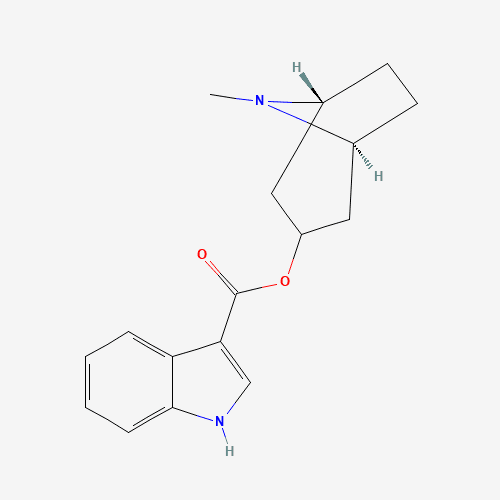
α7 partial agonism explains the nootropic interest. In frog oocytes expressing human receptors, tropisetron activated α7 nicotinic receptors as a selective partial agonist. Dissecting the molecule showed that its charged tropane nitrogen was sufficient for weak activation, while the indole-containing whole molecule supplied potency and subtype selectivity [2]. The same experiment found blockade of α3β4 but not α4β2 nicotinic receptors [2].
In a mouse model built with repeated phencyclidine exposure, two weeks of tropisetron improved recognition-memory deficits, and an α7 antagonist blocked that benefit; ondansetron, which lacks the same α7 action, did not reproduce it [7]. Human studies consistently show better P50 gating, but a systematic review found the wider sensory-processing literature heterogeneous and too small to establish clinical cognitive benefit [8].
- 5-HT3 receptorblocksblocks serotonin signalling at central and peripheral 5-HT3 receptors, the established basis of its acute antiemetic effect [1]strong
- α7 nicotinic acetylcholine receptoractivatesacts as a selective partial agonist in oocytes expressing human α7 receptors; the tropane portion supplies the minimal activating pharmacophore [2]strong
- α3β4 nicotinic acetylcholine receptorblocksinhibited α3β4 receptors in the same expression study, while showing no effect at α4β2 receptors [2]moderate
- P50 auditory sensory gatingmodulatesmoderate
Dosing
as studied or commonly reported; not a recommendationDoses below are what studies used or, where marked, what is commonly reported. None is a recommendation.
Intravenous
- 5 mgprevention of nausea and vomiting during low-dose cisplatin or non-cisplatin chemotherapyonce on day 1 · 1 day, followed by oral treatmenthuman study[6]
Oral
- 5 mgdelayed-phase prevention after the intravenous day-1 antiemetic doseonce daily on days 2–6 · 5 dayshuman study[6]
- 10 mgadjunct to stable risperidone in 40 patients with chronic schizophreniaonce daily · 8 weekshuman study[3]
- 5, 10 or 20 mgcognition and P50 gating in 40 nonsmoking patients with schizophrenia taking risperidoneonce daily · 10 dayshuman study[4]
- Timing and food
- The antiemetic trial used intravenous dosing on chemotherapy day 1 and oral dosing on days 2–6. Cognitive studies used once-daily oral dosing [3][4][6].
- Time to effect
- P50 and cognitive-test changes were reported after a single day, ten days and eight weeks in separate schizophrenia studies [3][4][5]. Whether they translate to durable daily function is not known.
- Notes
- The 5–20 mg cognitive regimens were experimental adjuncts in schizophrenia, not nootropic dosing guidance. Two of ten patients assigned to 20 mg in the ten-day study withdrew because of adverse effects [4].
Pharmacokinetics
what the body does with it| Half-life | Mean 5.7 hours after a single 5 mg oral dose in healthy volunteers [9]. |
|---|---|
| Time to peak | Mean 2.6 hours after a single 5 mg oral dose [9]. |
| Peak level | Mean 3.46 ng/mL after a single 5 mg oral dose [9]. |
| Bioavailability | Mean 60%, with a wide 27–99% range inversely related to CYP2D6 activity [9]. |
| Metabolism | CYP2D6 activity is a major determinant of first-pass loss and oral exposure [9]. |
Safety
risks and cautions, not medical adviceAt antiemetic doses the common signal is headache. In the 152-patient dose trial, 5 mg controlled acute nausea and vomiting better than 2 mg but caused more headache [6]. Broader reviews describe tropisetron as generally well tolerated in adults and children receiving chemotherapy [1].
The schizophrenia studies were small. Ten milligrams daily for eight weeks was reported as well tolerated [3], while two participants assigned to 20 mg daily withdrew because of adverse effects in the ten-day dose-ranging trial [4]. The paper's abstract does not specify those effects, so they should not be guessed.
CYP2D6 makes exposure unusually variable. After a 5 mg oral dose, bioavailability ranged from 27% to 99%; slower CYP2D6 metabolism meant higher bioavailability [9]. A fixed dose can therefore produce materially different exposure between people.
- Cognitive trials enrolled about 40 patients each, often selected for abnormal P50 gating and nonsmoking status [3][4][5]
- Participants were taking risperidone, so the studies do not establish effects as monotherapy [3][4][5]
- Results concern laboratory sensory-gating and cognitive tests, not durable improvement in daily function [8]
- No cited trial tested cognition in healthy adults
- The apparent cognitive response was not consistently dose-ordered [4][5]
FAQ
- Is tropisetron a cholinergic drug or a serotonin drug?
- Both descriptions are relevant. It blocks 5-HT3 serotonin receptors and partially activates α7 nicotinic acetylcholine receptors [1][2].
- Does it improve cognition?
- Small schizophrenia studies found better P50 gating and selected test scores, but they used narrow samples on risperidone and did not measure durable real-world function [3][4][5][8].
- Why does CYP2D6 matter?
- It controls much of tropisetron's first-pass metabolism. In healthy volunteers, oral bioavailability ranged from 27% to 99% and was inversely related to CYP2D6 activity [9].
References
entry last reviewed 2026-09-20- [1]Tropisetron: an update of its use in the prevention of chemotherapy-induced nausea and vomiting.Simpson K, Spencer CM, McClellan KJDrugs 2000reviewPMID 10882164◌ unreviewed
- [2]Molecular dissection of tropisetron, an alpha7 nicotinic acetylcholine receptor-selective partial agonist.Papke RL, Schiff HC, Jack BA et al.Neurosci Lett 2005preclinical · cellPMID 15781147◌ unreviewed
- [3]A randomised, double-blind, placebo-controlled trial of tropisetron in patients with schizophrenia.Shiina A, Shirayama Y, Niitsu T et al.Ann Gen Psychiatry 2010RCT · humanPMID 20573264◌ unreviewed
- [4]Short-term tropisetron treatment and cognitive and P50 auditory gating deficits in schizophrenia.Zhang XY, Liu L, Liu S et al.Am J Psychiatry 2012RCT · humanPMID 22952075◌ unreviewed
- [5]One-day tropisetron treatment improves cognitive deficits and P50 inhibition deficits in schizophrenia.Xia L, Liu L, Hong X et al.Neuropsychopharmacology 2020RCT · humanPMID 32349117◌ unreviewed
- [6]A randomized, double-blind, multicentre study comparing daily 2 and 5 mg of tropisetron for the control of nausea and vomiting induced by low-dose cisplatin- or non-cisplatin-containing chemotherapy.Wymenga AN, van der Graaf WT, Wils JA et al.Ann Oncol 1996RCT · humanPMID 8839906◌ unreviewed
- [7]Phencyclidine-induced cognitive deficits in mice are improved by subsequent subchronic administration of tropisetron: role of alpha7 nicotinic receptors.Hashimoto K, Fujita Y, Ishima T et al.Eur J Pharmacol 2006preclinical · animalPMID 17094961◌ unreviewed
- [8]Selective 5HT3 antagonists and sensory processing: a systematic review.Tsitsipa E, Rogers J, Casalotti S et al.Neuropsychopharmacology 2022meta-analysis · humanPMID 35017671◌ unreviewed
- [9]Pharmacokinetics of therapeutic doses of tropisetron in healthy volunteers.Kees F, Färber L, Bucher M et al.Br J Clin Pharmacol 2001RCT · humanPMID 11736884◌ unreviewed