Teriparatide
also Teriparatida · Teriparatidum · 1-34-Human PTH · Human PTH (1-34) · ZT-034
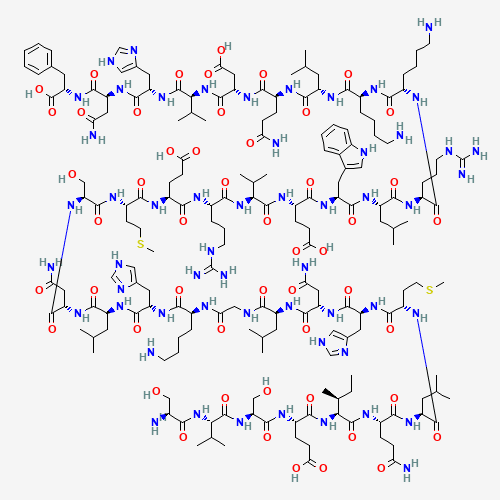
Teriparatide is the first 34 amino acids of human parathyroid hormone, and it is the odd one out in this group: a licensed medicine with a fracture-outcome trial behind it. Parathyroid hormone continuously elevated - as in hyperparathyroidism - destroys bone. Given as a single daily injection it does the opposite and builds it, which is one of the more surprising dose-schedule effects in pharmacology. The pivotal trial randomised 1637 postmenopausal women with prior vertebral fractures: new vertebral fractures occurred in 14% on placebo against 5% and 4% on 20 µg and 40 µg [1]. VERO later compared it head to head with risedronate in severe osteoporosis and found new vertebral fractures in 5.4% against 12.0%, a hazard ratio of 0.44 [2]. It is included here because it is a peptide bioregulator in the literal sense - and because it shows what the rest of this group's evidence would look like if it existed.
A licensed anabolic bone drug with fracture-endpoint trials, head-to-head superiority over a bisphosphonate, and a defined treatment duration - the evidence standard the rest of this group does not meet.
- meta-analysis
- RCT
- trial
- observational
- preclinical / case
- review / patent / other
- retracted
- + Reduced new vertebral fractures from 14% to 5% against placebo in the pivotal trial
- + Beat risedronate head to head on new vertebral and clinical fractures in severe osteoporosis
- + Builds new bone rather than only slowing its loss, unlike bisphosphonates
- + Fracture risk reduction persisted after the drug was stopped
- − Daily subcutaneous injection, with a defined treatment duration rather than indefinite use
- − The 40 µg dose had similar fracture effects to 20 µg with more side effects
- − Transient hypercalcaemia, nausea, headache and leg cramps
- − Bone gains are lost after stopping unless followed by an antiresorptive drug
Overview
The paradox that makes it work. Parathyroid hormone regulates calcium, and chronically raised levels - primary hyperparathyroidism - cause bone loss. Yet a single daily injection increases bone formation. The difference is entirely one of exposure pattern: an intermittent pulse favours osteoblast activity and survival, while continuous elevation tips the balance toward resorption [3][4]. Teriparatide is recombinant human PTH(1-34), the fragment that carries the receptor-binding activity.
The pivotal trial. 1637 postmenopausal women with prior vertebral fractures were randomised to 20 µg, 40 µg or placebo daily. Over a median 21 months, new vertebral fractures occurred in 14% on placebo, 5% on 20 µg and 4% on 40 µg; new non-vertebral fragility fractures occurred in 6% on placebo and about half that on treatment. The 40 µg dose raised bone density more but had similar fracture effects and more side effects [1]. The benefit persisted after withdrawal [5].
Head to head against a bisphosphonate. VERO was the first trial to compare osteoporosis drugs with incident fractures as the primary outcome. 680 patients per arm with severe osteoporosis - at least two moderate or one severe vertebral fracture - received teriparatide or risedronate for 24 months. New vertebral fractures: 5.4% against 12.0%, risk ratio 0.44. Clinical fractures: 4.8% against 9.8%, hazard ratio 0.48. Non-vertebral fragility fractures: 4.0% against 6.1%, which did not reach significance [2].
Where it sits now. Network meta-analyses place teriparatide among the more effective agents, alongside romosozumab, denosumab and abaloparatide [6][7][8][9]. Romosozumab beat it on bone density in patients transitioning from oral bisphosphonates [10]. Combination with denosumab produced larger density gains than either alone [11][12], and abaloparatide is a related PTH-pathway drug with its own fracture trial [13].
Why it is on this page. Teriparatide is a peptide bioregulator in the strict sense - a fragment of a human regulatory hormone, used to direct tissue behaviour. It is also the only compound in this group with a fracture-endpoint randomised trial, a head-to-head superiority result and a licence. It is worth reading alongside the short peptides here as a demonstration of what that evidence looks like.
Mechanism
PTH(1-34) binds the PTH1 receptor on osteoblasts and osteocytes, raising cyclic AMP and activating PKA signalling. The anabolic outcome depends on the time course: a brief daily pulse increases osteoblast number and lifespan and stimulates bone formation before the resorptive response catches up, whereas sustained exposure drives RANKL expression and net resorption [3][4].
This creates an "anabolic window" - a period after starting treatment when formation outpaces resorption - which narrows over months as resorption rises. It is why teriparatide is given for a defined period rather than indefinitely, and why the gains are lost after stopping unless an antiresorptive follows [14].
The short half-life of about an hour is not a limitation to be engineered away; it is the mechanism [3]. This is the opposite of the design philosophy behind most of the peptides on this site, where longer exposure is treated as self-evidently better.
- PTH1 receptor on osteoblastsactivatesstrong
- Vertebral fracture riskblocksstrong
- Clinical and non-vertebral fracture riskblocksclinical fractures 4.8% against 9.8% for risedronate, hazard ratio 0.48; non-vertebral fragility fractures 4.0% against 6.1%, which did not reach significance [2]moderate
- Bone mineral densityactivatesstrong
Formulation
how the form changes blood levelsRecombinant human PTH(1-34), produced in E. coli, supplied as a refrigerated multi-dose pen for daily subcutaneous injection. Related agents include abaloparatide, a PTH-related protein analogue [13], and full-length PTH(1-84), which has been used in some markets [4].
Dosing
as studied or commonly reported; not a recommendationDoses below are what studies used or, where marked, what is commonly reported. None is a recommendation.
Subcutaneous injection
- Form
- A daily subcutaneous injection from a multi-dose pen.
- Timing and food
- Once daily; the pulse is the mechanism, so the schedule is not negotiable [3].
- Time to effect
- Bone density changes are measurable at six months; the fracture endpoints in the trials were assessed at 21-24 months [1][2].
- Notes
- The 40 µg dose increased bone mineral density more than 20 µg but had similar effects on fracture risk and more side effects, which is why 20 µg is the licensed dose [1]. Treatment duration is capped in the label, and bone gains are lost after stopping unless followed by an antiresorptive - which is why sequential treatment has its own meta-analysis [14].
Pharmacokinetics
what the body does with it| Half-life | About one hour after subcutaneous injection - deliberately short, because the anabolic effect depends on a transient daily pulse rather than sustained exposure [3] |
|---|---|
| Onset | Bone formation markers rise within weeks; fracture benefit was measured over a median 21 months [1] |
| Bioavailability | Subcutaneous injection; a peptide, not orally available |
| Metabolism | Non-specific enzymatic cleavage in liver and periphery [4] |
Safety
risks and cautions, not medical adviceWell characterised over two decades of licensed use. Common adverse effects are transient hypercalcaemia, nausea, headache, dizziness and leg cramps. The 40 µg dose in the pivotal trial produced more side effects than 20 µg without better fracture protection, which set the licensed dose [1].
The osteosarcoma question. Teriparatide carried a boxed warning based on osteosarcoma in rats given high doses for most of their lifespan. Long-term surveillance in humans has not borne this out, and the boxed warning has since been removed in major markets, with the treatment-duration limit relaxed. This is worth knowing as a piece of history: a strong rodent signal that did not translate.
The practical limitation is not toxicity but durability. Bone gained during treatment is lost after stopping unless an antiresorptive follows, which is why sequential regimens have their own literature [14]. Fracture protection did persist for a period after withdrawal in the pivotal trial's follow-up [5], but the density does not hold indefinitely.
Contraindications follow from the mechanism: pre-existing hypercalcaemia, severe renal impairment, prior skeletal radiation, and bone metastases or other metabolic bone disease.
- Transient hypercalcaemia, nausea, headache, dizziness and leg cramps
- The 40 µg dose produced more side effects than 20 µg without better fracture protection [1]
- Contraindicated in pre-existing hypercalcaemia, severe renal impairment, prior skeletal radiation and metabolic bone disease
- Plan what follows it: stopping without an antiresorptive loses the bone that was gained [14]
- The historical rat osteosarcoma signal did not translate to humans, and the boxed warning has been removed in major markets
- Daily injection, with a treatment duration limit rather than indefinite use
- Bone gains are lost after stopping unless an antiresorptive follows [14]
- Non-vertebral fracture reduction did not reach significance against risedronate [2]
- Romosozumab outperformed it on bone density in patients transitioning from oral bisphosphonates [10]
Interactions
documented pairs only, not exhaustiveThe clinically important interactions are with other osteoporosis drugs, and they are not intuitive. Combining teriparatide with denosumab produced greater bone density gains than either alone [11][12] - whereas earlier work with bisphosphonates suggested they could blunt the anabolic response, which is part of why romosozumab outperformed teriparatide in patients transitioning off oral bisphosphonates [10].
Order matters in a way that is now standard practice: anabolic first, antiresorptive after, not the reverse [14]. Digoxin requires care because of the transient rise in calcium.
A note on fracture risk unrelated to the drug: in the VERO trial, psychotropic medications and proton pump inhibitors were examined as fracture risk factors within the trial population [15].
History
The observation that intermittent parathyroid hormone builds bone dates to the 1920s and 1930s, and was revisited seriously in the 1980s. Teriparatide's pivotal fracture trial was published in the New England Journal of Medicine in 2001 [1], and it was approved for osteoporosis shortly after.
Persistence of fracture protection after withdrawal was reported in 2004 [5]. The DATA trial of combination with denosumab appeared in 2013 with its extension in 2014 [11][12], romosozumab's head-to-head in 2017 [10], and VERO - the first osteoporosis trial with incident fractures as the primary comparative outcome - in 2018 [2].
FAQ
- Why does a hormone that destroys bone build it when injected?
- Exposure pattern. A brief daily pulse favours osteoblast activity and bone formation; continuous elevation, as in hyperparathyroidism, drives resorption [3][4].
- How much does it reduce fractures?
- New vertebral fractures fell from 14% to 5% against placebo over a median 21 months [1], and from 12.0% to 5.4% against risedronate in severe osteoporosis [2].
- Is it better than a bisphosphonate?
- In severe osteoporosis, yes for vertebral and clinical fractures - hazard ratios 0.44 and 0.48 against risedronate. Non-vertebral fractures did not reach significance [2].
- What happens when you stop?
- Fracture protection persisted for a period after withdrawal [5], but the bone gained is lost unless an antiresorptive drug follows [14].
- Does it cause osteosarcoma?
- A boxed warning was based on rats given high doses for most of their lifespan. Human surveillance has not borne it out and the warning has been removed in major markets.
References
entry last reviewed 2026-09-19- [1]Effect of parathyroid hormone (1-34) on fractures and bone mineral density in postmenopausal women with osteoporosis.Neer RM, Arnaud CD, Zanchetta JR et al.N Engl J Med 2001RCT · humanPMID 11346808◌ unreviewed
- [2]Effects of teriparatide and risedronate on new fractures in post-menopausal women with severe osteoporosis (VERO): a multicentre, double-blind, double-dummy, randomised controlled trial.Kendler DL, Marin F, Zerbini CAF et al.Lancet 2018RCT · humanPMID 29129436◌ unreviewed
- [3]Parathyroid hormone, its fragments and their analogs for the treatment of osteoporosis.Whitfield JF, Morley P, Willick GETreat Endocrinol 2002reviewPMID 15799210◌ unreviewed
- [4]PTH-analogs: comparable or different?Verhaar HJJ, Lems WFArch Gerontol Geriatr 2009other · humanPMID 19124166◌ unreviewed
- [5]Sustained vertebral fracture risk reduction after withdrawal of teriparatide in postmenopausal women with osteoporosis.Lindsay R, Scheele WH, Neer R et al.Arch Intern Med 2004RCT · humanPMID 15477438◌ unreviewed
- [6]Effectiveness and Safety of Treatments to Prevent Fractures in People With Low Bone Mass or Primary Osteoporosis: A Living Systematic Review and Network Meta-analysis for the American College of Physicians.Ayers C, Kansagara D, Lazur B et al.Ann Intern Med 2023meta-analysis · humanPMID 36592455◌ unreviewed
- [7]PTH1 receptor agonists for fracture risk: a systematic review and network meta-analysis.Beaudart C, Veronese N, Douxfils J et al.Osteoporos Int 2025meta-analysis · humanPMID 40047881◌ unreviewed
- [8]Meta-Analysis of Clinical Fracture Risk Reduction of Antiosteoporosis Drugs: Direct and Indirect Comparisons and Meta-Regressions.Albert SG, Wood EEndocr Pract 2021meta-analysis · humanPMID 34252583◌ unreviewed
- [9]Efficacy and safety of teriparatide vs. bisphosphonates and denosumab vs. bisphosphonates in osteoporosis not previously treated with bisphosphonates: a systematic review and meta-analysis of randomized controlled trials.Li M, Ge Z, Zhang B et al.Arch Osteoporos 2024meta-analysis · humanPMID 39312040◌ unreviewed
- [10]Romosozumab (sclerostin monoclonal antibody) versus teriparatide in postmenopausal women with osteoporosis transitioning from oral bisphosphonate therapy: a randomised, open-label, phase 3 trial.Langdahl BL, Libanati C, Crittenden DB et al.Lancet 2017otherPMID 28755782◌ unreviewed
- [11]Teriparatide and denosumab, alone or combined, in women with postmenopausal osteoporosis: the DATA study randomised trial.Tsai JN, Uihlein AV, Lee H et al.Lancet 2013RCT · humanPMID 23683600◌ unreviewed
- [12]Two years of Denosumab and teriparatide administration in postmenopausal women with osteoporosis (The DATA Extension Study): a randomized controlled trial.Leder BZ, Tsai JN, Uihlein AV et al.J Clin Endocrinol Metab 2014RCT · humanPMID 24517156◌ unreviewed
- [13]Effect of Abaloparatide vs Placebo on New Vertebral Fractures in Postmenopausal Women With Osteoporosis: A Randomized Clinical Trial.Miller PD, Hattersley G, Riis BJ et al.JAMA 2016RCT · humanPMID 27533157◌ unreviewed
- [14]The sequential antifracturative treatment: a meta-analysis of randomized clinical trials.Fassio A, Gatti D, Biffi A et al.Ther Adv Musculoskelet Dis 2024otherPMID 38654732◌ unreviewed
- [15]Psychotropic medications and proton pump inhibitors and the risk of fractures in the teriparatide versus risedronate VERO clinical trial.Kendler DL, Marin F, Geusens P et al.Bone 2020RCT · humanPMID 31654779◌ unreviewed