GB-115
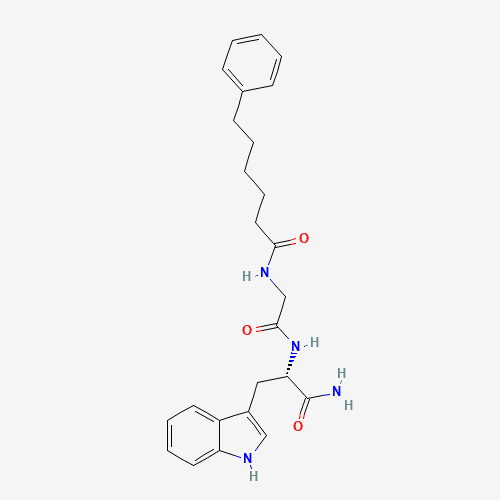
also N-(6-phenylhexanoyl)-glycyl-L-tryptophan amide
GB-115 is a synthetic glycyl-tryptophan dipeptide analogue of cholecystokinin studied as an anxiolytic [1][2]. A Russian open-label pilot in 31 people with generalised anxiety disorder reported reduced anxiety and fatigue over 21 days, with 6 mg daily selected after a small dose-finding stage [3]. Without a placebo group, efficacy remains uncertain.
Interesting CCK-pathway peptide with a readable Russian pilot study, but no controlled efficacy result in the cited literature.
- meta-analysis
- RCT
- trial
- observational
- preclinical / case
- review / patent / other
- retracted
- + Reduced anxiety scores in a 21-day uncontrolled clinical pilot
- + Improved attention and reaction measures in the same pilot
- − The clinical pilot was open-label and had no placebo comparator
- − Four of 31 participants reported adverse events
- − Long-term human safety and receptor selectivity are unclear
GB-115 was designed as a short retro-analogue of cholecystokinin-4. Its chemical name is N-(6-phenylhexanoyl)-glycyl-L-tryptophan amide [2][3]. Animal open-field and elevated-plus-maze tests found anxiety-like behaviour changed after oral administration, with responses varying by strain and baseline emotionality [1].
The main clinical report is in Russian, and its full text is available from the journal. It enrolled 31 people with generalised anxiety disorder: five first received 3 mg a day, then five received 6 mg, followed by 20 more at 6 mg. One person in the 3 mg group stopped on day 5; the protocol otherwise ran for 21 days. There was no randomised or blinded control group. Anxiety, fatigue, sleep-related symptoms and some attention measures improved against baseline; the authors judged 6 mg the more promising dose [3]. The reported 92% response at 6 mg was compared with an assumed historical placebo response, not an observed placebo arm [3].
The developers describe GB-115 as a low-affinity blocker of central cholecystokinin receptors, a pathway implicated in anxiety signalling [3]. Structural work on the peptide and restricted analogues associated anxiolytic activity with a beta-turn-like conformation [2]. Neither establishes which receptor subtype mediates the human result, or proves that the clinical improvement was caused by CCK blockade.
Dosing
as studied or commonly reported; not a recommendationDoses below are what studies used or, where marked, what is commonly reported. None is a recommendation.
Oral
- 3 mg per dayfirst five patients in an open-label dose-finding pilot; one stopped on day 5daily · up to 21 dayshuman study[3]
- 6 mg per day
- 0.1 mg/kg
- Form
- Oral 1 mg tablets were used in the clinical pilot. A rat pharmacokinetic study found that tablet formulation changed relative exposure substantially [3][4].
- Time to effect
- In the open-label pilot, symptom ratings began improving by day 3 and continued through day 21 [3].
- Notes
- All human dose rows come from one uncontrolled Russian-language study; they are descriptions of the protocol, not established effective doses [3].
Pharmacokinetics
what the body does with it| Half-life | The clinical paper reports 0.57–1.06 hours after 1–3 mg oral doses in healthy volunteers, citing an earlier PK report [3]. |
|---|---|
| Time to peak | The clinical paper reports 0.83 hours after 1 mg and 1.42 hours after 15 mg orally in volunteers [3]. |
| Bioavailability | A rat comparison found large formulation-dependent differences in relative exposure; these are not absolute human bioavailability measurements [4]. |
Safety
risks and cautions, not medical adviceIn the 31-person pilot, four participants had five adverse events. Possible drug-related events were increased blood pressure, hypercholesterolaemia and dry mouth; another participant reported a menstrual-cycle change. Most were mild and transient, but the blood-pressure rise reached 150/100 mm Hg [3]. The sample and 21-day follow-up cannot rule out less common or long-term effects. No controlled safety comparison is reported in this trial [3].
- Blood-pressure rise, high cholesterol and dry mouth were considered possibly related in the clinical pilot [3]
- The pilot excluded people with substantial medical illness, pregnancy and psychotropic co-medication, limiting generalisation [3]
- Is GB-115 clinically proven for anxiety?
- The published pilot reported improvement, but it was open-label and lacked a placebo comparator [3].
References
entry last reviewed 2026-09-24- [1]Anxiolytic activity of dipeptide GB-115 after oral administration.Kolik LG, Konstantinopolsky MA, Ryibina IV et al.Bull Exp Biol Med 2013preclinical · animalPMID 24130989◌ unreviewed
- [2][The study of biologically active conformation of cholecystokinin-4 dipeptide analog GB-115].Gudasheva TA, Lezina VP, Kir'ianova EP et al.Bioorg Khim 2013preclinical · animalPMID 24397028in Russian◌ unreviewed
- [3][Results of a clinical study of a new anxiolytic, a blocker of central cholecystokinin receptors].Neznamov GG, Dorofeeva OA, Metlina MV et al.Zh Nevrol Psikhiatr Im S S Korsakova 2019clinical trial · humanPMID 31626171in Russian◌ unreviewed
- [4][Pharmacokinetics of three peroral dosage forms of new dipeptide anxiolytic drug GB-115].Ivannikova EV, Boĭko SS, Zherdev VP et al.Eksp Klin Farmakol 2014preclinical · animalPMID 25322652in Russian◌ unreviewed